Introduction
If you have ever noticed a sour smell coming from a kitchen sponge that was only a week old, you have experienced the core problem with synthetic foam cleaning products firsthand. That odor is bacterial activity. It is not a cleaning problem, and it is not a user error. It is the inevitable consequence of how synthetic sponges are built.
Understanding how loofah dish pads outperform synthetic sponges starts with understanding that difference in structure. Loofah is not simply a natural version of the same product. It is a fundamentally different type of cleaning implement, and its advantages in hygiene, performance, and environmental impact are built into what it is, not just what it is made of.
EGEXO has been exporting Egyptian loofah since 2015. The goal is to give both everyday consumers and commercial buyers a clear picture of why the shift to natural loofah dish pads is an environmental choice as well as a practical one.
You will find detailed comparisons, practical care instructions, a supplier evaluation framework for wholesale buyers, and honest answers to the questions most frequently asked about making the switch from synthetic to natural.
Understanding the Structural Difference Between Loofah and Synthetic Foam
Most people assume that all kitchen sponges work the same way and that the material they are made from is just a sustainability consideration. That assumption is incorrect. The material determines the mechanism, and the mechanism determines performance.
A synthetic kitchen sponge is made from polyurethane foam. Foam is a matrix of gas bubbles trapped in a polymer structure. When you press a foam sponge against a surface, it compresses, and the gas pockets become water-holding cavities. That water retention is what makes foam feel absorbent, but it is also what makes foam a bacterial incubator.
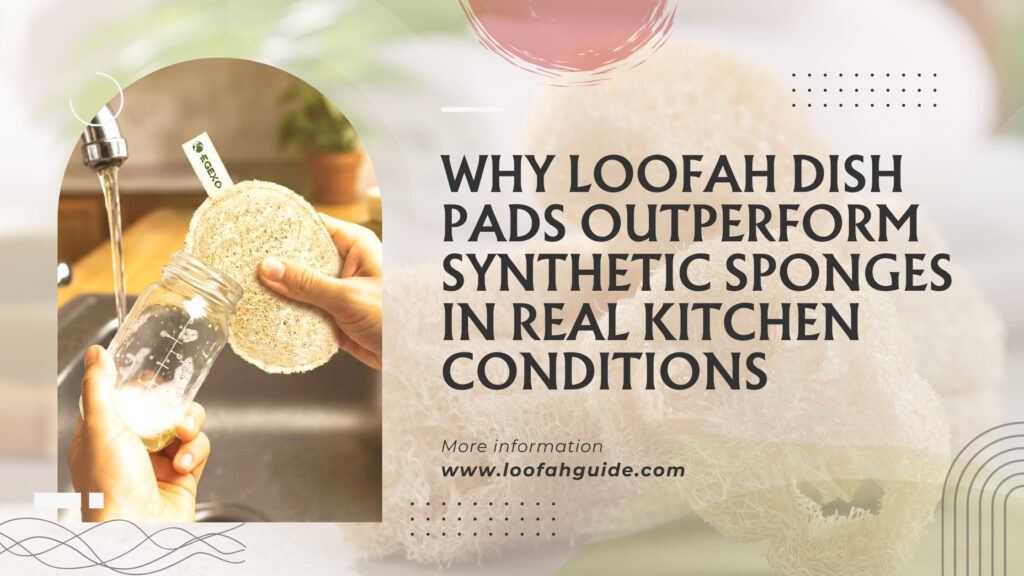
A loofah dish pad is made from the dried cellulose skeleton of the Luffa plant. The structure is not a foam matrix. It is a three-dimensional mesh of individual fibers. When you press a loofah pad against a surface, the fibers flex and create friction. When you release pressure and rinse the pad, water flows freely through the open mesh rather than being retained in sealed cavities.
This single structural difference accounts for most of the performance advantages that loofah dish pads hold over synthetic alternatives.
The Moisture Cycle That Determines Hygiene
Bacteria need moisture to survive and multiply. The longer a surface stays wet after cleaning, the more time bacteria have to grow. A synthetic foam sponge can hold moisture inside for hours after rinsing. A loofah dish pad, if hung vertically after use, dries faster because of its open fiber structure.
Over the course of a week of daily kitchen use, this difference compounds significantly. The synthetic sponge accumulates bacterial load with each day of use. The loofah pad resets to a low-bacteria state each time it dries completely.
Fiber Chemistry and Why It Matters
Cellulose, the material loofah fibers are made of, has a smooth surface chemistry at the molecular level. Individual bacteria find it difficult to form the initial adhesion that is necessary for colony formation on smooth cellulose. Polyurethane foam, by contrast, has surface irregularities at the microscopic level that provide anchoring points for bacterial adhesion.
This is not a minor difference. Research into hospital surface hygiene has documented that surface texture at the microscopic level is one of the most significant predictors of bacterial colonization rate, independent of cleaning frequency.
A Practical Comparison Across Every Metric That Matters
The table below draws on data from product testing, consumer research, and manufacturing specifications to give a comprehensive side-by-side view of loofah dish pads versus synthetic sponges.
| Performance Metric | Loofah Dish Pad | Synthetic Sponge | Winner |
|---|---|---|---|
| Post-rinse drying | Dries faster (open fiber) | Holds moisture longer | Loofah |
| Grease removal | Good (mechanical friction) | Moderate (surface contact) | Loofah |
| Microplastic shedding | None | Yes | Loofah |
| Compostability | Fully compostable | Not compostable | Loofah |
| Environmental raw material | Annually renewable crop | Petroleum derivatives | Loofah |
The loofah dish pad wins every category in this comparison. That consistency across metrics is unusual in product comparisons. It reflects the fact that loofah is not a compromise product. It is a genuinely better-performing option that also happens to be more sustainable.
The Real Cost Comparison: Natural vs Synthetic Over Time
One of the most persistent myths about natural alternatives to synthetic products is that they are more expensive. In terms of per-unit retail price, this is sometimes true. A loofah dish pad may carry a higher sticker price than a foam sponge from the same store.
But per-unit price is not the right metric. Cost per week of effective use is the right metric.
If a loofah dish pad lasts 10 weeks and a synthetic sponge lasts 3 weeks, and if the loofah costs twice as much per unit, the loofah is still the more economical choice over a quarter-year period. And this calculation does not include the cost of replacement, the time cost of more frequent repurchasing, or the environmental externalities of synthetic sponge waste.
Cost Efficiency Calculation
| Scenario | Loofah Dish Pad | Synthetic Sponge |
|---|---|---|
| Units needed per year (household) | 4 to 6 | 13 to 26 |
| Disposal method | Compost | Landfill |
| Annual total use cost (relative) | Lower | Higher |
| Product packaging waste | Lower (bulk options available) | Higher |
For wholesale buyers, this cost-efficiency profile is a sales argument that resonates strongly with consumers. A buyer stocking loofah dish pads can truthfully communicate to their customers that the product saves money over time, which addresses the price-sensitivity concern at point of purchase.
How to Get the Best Performance From a Loofah Dish Pad
One of the most common reasons consumers report disappointment with natural fiber products is improper use, not product failure. Loofah dish pads require a slightly different approach than synthetic sponges, and understanding that difference is the difference between a pad that lasts two months and one that feels worn out in three weeks.
Step-by-Step Setup for First Use
| Step | Action | Purpose |
|---|---|---|
| 1 | Soak the pad in warm water for 5 minutes | Softens fibers and activates full flexibility |
| 2 | Squeeze gently several times while submerged | Removes any loose surface fibers from manufacturing |
| 3 | Apply a small amount of dish soap to the pad | Primes fibers for first cleaning cycle |
| 4 | Clean a low-stakes item first (glasses, a bowl) | Familiarizes you with the texture and scrub feel |
| 5 | Rinse thoroughly and hang to dry vertically | Sets the drying habit that determines long-term hygiene |
Daily Use Protocol for Maximum Longevity
- Apply dish soap directly to the pad or to the dish surface, not both. Over-saturating with soap does not improve cleaning and accelerates fiber breakdown.
- Use warm water rather than very hot water for regular dishwashing. Hot water above 70 degrees Celsius will soften and weaken the fibers over time.
- After each use, rinse the pad under running water until the water runs clear, then squeeze firmly to remove excess moisture.
- Stand or hang the pad in a location with air circulation. Leaving it flat on a wet sink surface is the single most common cause of premature odor development.
Weekly Care Routine
Once a week, fill a bowl with one part white vinegar and four parts water. Submerge the loofah dish pad for 10 to 15 minutes, then rinse and dry as normal. It is not strictly necessary if the pad is drying completely between each use, but it extends effective lifespan and maintains freshness noticeably.
Environmental Impact in Detail: What the Science Says
The environmental case for loofah dish pads over synthetic sponges is not just about material origin. It encompasses the full lifecycle of the product from raw material to disposal.
Raw Material Production
They require moderate water inputs and do not require heavy pesticide application in well-managed cultivation systems. Egyptian loofah grown in the Nile Delta under the agricultural management practices used by Egexo exemplifies what responsible natural fiber production looks like at commercial scale.
Polyurethane foam requires petrochemical feedstocks. Standard EGEXO loofah is not bleached. Bleaching is available on request. The finished product contains no biodegradable components.
Microplastic Pollution
The microplastic pollution generated by synthetic sponges during dishwashing is a documented environmental problem. When foam is rubbed against hard surfaces under water pressure, it sheds polymer particles. These particles, typically below five millimeters in size, pass through standard wastewater treatment systems and accumulate in freshwater and marine ecosystems.
Loofah sheds cellulose fragments. Cellulose is a natural polymer produced by all plants. It is biodegradable, non-toxic, and does not accumulate in the environment or in biological tissue.
End of Life
| Disposal Scenario | Loofah Dish Pad | Synthetic Sponge |
|---|---|---|
| Home composting | Yes, breaks down in a compost bin | No |
| Municipal food and garden waste | Yes | No |
| Recycling | Not applicable (compostable) | Not recyclable in most programs |
| Landfill | Not necessary | Only option |
| Marine environment fate | Biodegrades | Persists for a very long time |
The end-of-life comparison is perhaps the most striking. There is no disposal pathway for a used synthetic sponge that does not result in permanent plastic waste. There is no disposal pathway for a loofah dish pad that generates lasting environmental harm.
What Wholesale Buyers Should Know About Sourcing Quality Loofah Dish Pads
For importers, private label developers, and retail buyers, the natural loofah dish pad market presents strong opportunities but also real quality variation between suppliers. Understanding what to evaluate during supplier selection determines whether you receive a product that builds customer loyalty or a product that generates returns.
The Quality Indicators That Matter Most
Fiber uniformity is the primary differentiator between high-quality and substandard loofah dish pads. A pad cut from uniformly fibered raw material will perform consistently across its entire surface for its full usable lifespan. A pad cut from variable-quality raw material will have inconsistent texture, soft spots, and premature degradation in the lower-density areas.
Full documentation of these quality standards is available here.
Supplier Evaluation Framework
| Evaluation Category | Key Questions to Ask | Red Flags |
|---|---|---|
| Raw material origin | Where is the loofah grown? What region? | Vague answers, no certificate of origin |
| Quality control process | How is QC performed at each production stage? | No documented QC process |
| Sample process | Can I order samples before committing to bulk? | Reluctance or inability to supply samples |
| Private label services | Is in-house labeling and packaging available? | Only third-party options, unclear costs |
| Export experience | Which markets do you currently supply? | Limited export history |
Samples are paid; the buyer pays shipping. The sample cost is credited to your first order of $1,000 or more, placed within 60 days. For a full view of available products and wholesale pricing, download the Egexo product catalog.
A Note from EGEXO
The question we hear most from first-time wholesale buyers is whether loofah dish pads will hold up in commercial kitchen environments. The answer is yes, but with an important qualification. The commercial setting actually reveals the loofah dish pad’s advantages more clearly than household use does.
In a professional kitchen, a cleaning implement is used far more intensively than at home. That intensity exposes weaknesses quickly. Synthetic sponges in commercial kitchens often need frequent replacement because the combination of heavy use, hot water, and strong detergents accelerates foam breakdown and creates serious hygiene risks.
Loofah dish pads handle the same conditions well. The fiber structure does not compress permanently under repeated heavy use the way foam does. And the open fiber structure means a pad dries faster between uses, even in a high-activity kitchen where a pad is used many times a day.
Request a quote or request samples from EGEXO.
FAQ Section
Q1: What makes loofah dish pads more hygienic than synthetic sponges?
Loofah dish pads dry quickly after each use because their open fiber structure allows them to drain. Bacteria require moisture to survive and multiply, so a pad hung after rinsing gives bacteria less time to grow between uses. A synthetic sponge can hold internal moisture for hours under the same conditions. This drying behavior is the main reason a loofah pad is a good choice for the kitchen.
Q2: Is a loofah dish pad better for the environment than a foam sponge?
Yes, significantly. Loofah dish pads are made from an annually renewable plant crop and are fully compostable at the end of their useful life, breaking down under composting conditions. Synthetic sponges are made from petroleum-derived polyurethane foam, do not biodegrade, and contribute to microplastic pollution in waterways during use. For consumers and businesses committed to reducing plastic waste, loofah dish pads eliminate a meaningful source of household and commercial plastic waste with no performance compromise.
Q3: How do I know when a loofah dish pad needs to be replaced?
Replace your loofah dish pad when you notice any of the following: visible thinning or flattening of the fiber structure that reduces scrubbing effectiveness, persistent odor that does not resolve after the weekly vinegar soak routine, or visible discoloration that does not wash out. Under normal household use with proper care, a quality Egyptian loofah dish pad should not show these signs until week eight to twelve. Replacing earlier is fine, but most quality pads will maintain performance well within that range.
Q4: Can I use a loofah dish pad with any dish soap?
Yes. Loofah dish pads are compatible with all standard dish soaps including plant-based, conventional, and concentrated formulas. The natural cellulose fibers do not react chemically with common soap ingredients. Using concentrated soap in smaller quantities is recommended because loofah lathers efficiently. Avoid prolonged soaking in bleach or strong chemical cleaners as these can accelerate fiber breakdown. For weekly sanitizing, diluted white vinegar is the recommended method.
Q5: Where does the loofah for kitchen pads come from?
The combination of alluvial soil and consistent growing conditions in Egypt’s Nile Delta suits growing loofah, and the fiber is soft and loose. EGEXO has been exporting Egyptian loofah since 2015.
Q6: Are loofah dish pads safe for use on non-stick cookware?
Lower-density loofah dish pads are appropriate for light cleaning of non-stick surfaces. Standard and premium-density pads are designed for heavier-duty cleaning and are best used on ceramic, glass, stainless steel, and cast iron. Because loofah does not contain synthetic abrasive additives, the risk of non-stick coating damage comes from fiber density rather than chemical abrasion. Always test on a small area when using any new cleaning product on high-value non-stick cookware.
Q7: How does buying loofah dish pads in bulk benefit a retail business?
Buying loofah dish pads wholesale from a direct Egyptian supplier like Egexo provides three primary advantages: lower per-unit cost, direct quality control through sample testing before bulk commitment, and access to private label services that enable brand differentiation. The natural and sustainable kitchen products market is growing rapidly, and loofah dish pads are among the strongest performing natural alternatives in terms of consumer satisfaction and repeat purchase rates.
Conclusion
Loofah dish pads outperform synthetic sponges not because of a single advantage but because of a comprehensive set of advantages that compound across every aspect of product performance. They are structurally designed to stay cleaner, they last measurably longer, they clean more effectively through mechanical action, and they leave no lasting environmental trace at the end of their life.
For consumers, the switch from synthetic to loofah is one of the simplest and highest-impact changes available in the category of sustainable household products. For wholesale buyers, the growing consumer demand for natural and sustainable kitchen products makes loofah dish pads a strategically strong addition to any product range.
Key Takeaways:
- The open-fiber structure of loofah drains and dries faster than foam, which is the primary reason it is hygienically superior
- Loofah dish pads last three to four times longer than synthetic sponges under equivalent daily use conditions
- Egyptian loofah from the Nile Delta is the world standard for fiber quality and uniformity
- No microplastic shedding during use and full compostability at end of life make loofah the clear environmental choice
- No minimum order on standard products. Private label from 1,000 units.
Ready to experience Egyptian loofah quality?
- For Wholesale Buyers: Request a wholesale quote or download our full product catalog
- For Individual Shoppers: Request a quote or request samples