A single polyurethane kitchen sponge can harbor up to 362 different species of bacteria within its first week of use, according to a study published in Scientific Reports. The porous, slow-drying foam creates a perfect environment for microbial growth that no amount of squeezing or microwaving can fully eliminate. This is one reason why millions of people and thousands of commercial operations around the globe are reconsidering what they use to clean their kitchens and homes.
Natural loofah is the best choice for kitchen and household cleaning for reasons that go far beyond hygiene. Derived from the fibrous skeleton of the Luffa aegyptiaca gourd, this remarkable plant material delivers a combination of scrubbing efficiency, moisture management, surface safety, and environmental responsibility that no factory-produced sponge can replicate. The fibers are naturally antimicrobial-resistant due to their quick-drying structure, they biodegrade completely within weeks, and they perform exceptionally across dozens of household cleaning tasks.
This guide is designed for everyone who interacts with loofah, from the home cook searching for a better dishwashing tool to the retail buyer evaluating sustainable product lines. You will find detailed performance data, surface compatibility charts, maintenance schedules, and sourcing insights drawn from decades of industry expertise. Every recommendation in this article reflects real-world testing and the knowledge of experienced Egyptian loofah cultivators, including the specialists at Egexo who have spent more than 25 years perfecting the craft of growing, grading, and exporting premium loofah.
For those who want to start shopping immediately, Egexo’s kitchen loofah range offers products suited for every cleaning need. Wholesale buyers can request a detailed quotation tailored to their volume and market.
What Makes Natural Loofah Superior for Cleaning Tasks
The Unique Fiber Architecture of Luffa Aegyptiaca
To understand why natural loofah is the best choice for kitchen and household cleaning, it helps to look at the fiber itself under magnification. A mature loofah fruit develops an intricate internal lattice of cellulose fibers arranged in a multidirectional weave. Unlike the uniform bubble structure of synthetic foam, this natural weave creates thousands of tiny scrubbing edges along every surface of the sponge.
This architecture produces three distinct cleaning advantages. First, the multidirectional fibers attack grime from multiple angles simultaneously, lifting grease and stuck food more effectively than a flat-surfaced sponge. Second, the spaces between fiber strands allow water and air to flow freely through the material, which means faster rinsing and faster drying. Third, the cellulose itself is moderately stiff when dry but becomes more pliable when wet, giving users control over scrubbing intensity simply by adjusting moisture levels.
No synthetic material achieves all three of these properties in a single product without chemical treatments or composite engineering. Natural loofah does it by default.
How Loofah Outperforms Common Alternatives in Practice
Home users frequently describe the difference between loofah and synthetic sponges as immediately noticeable. The loofah grips surfaces instead of sliding, and the fibrous texture lifts residue in fewer passes. Professional cleaning operations report similar efficiency gains, particularly in restaurant kitchens where speed and hygiene standards are non-negotiable.
For businesses evaluating cleaning supplies, that efficiency translates directly to labor savings and reduced chemical usage. A tool that cleans faster and requires less soap means lower operating costs per cleaning cycle.
Surface Compatibility Guide for Natural Loofah
One concern that both consumers and commercial buyers raise is whether natural loofah might scratch delicate surfaces. The answer depends on the grade of loofah, the moisture level, and the surface material. The following chart provides a comprehensive compatibility reference.
Loofah Surface Safety Chart
| Surface Type | Safe to Use Loofah | Recommended Technique | Notes |
|---|---|---|---|
| Stainless Steel | Yes | Scrub with wet loofah, follow grain direction | Excellent for removing water spots and grease |
| Cast Iron | Yes | Light scrubbing, minimal soap | Preserves seasoning layer better than steel wool |
| Non-Stick Coatings | Yes | Soak loofah first, use gentle pressure | Wet fibers soften enough to protect coating |
| Ceramic and Porcelain | Yes | Standard wet scrubbing | Ideal for sinks, toilets, tiles |
| Glass Cooktops | Use Caution | Very wet loofah with soft pressure only | Test small area first on flat-surface cooktops |
| Copper and Brass | Yes | Wet loofah with baking soda paste | Removes tarnish without harsh chemicals |
| Natural Stone Countertops | Yes | Damp loofah, no acidic cleaners | Safe on granite, marble, and soapstone |
| Wooden Cutting Boards | Yes | Quick wet scrub, dry board immediately | Loofah reaches into grain patterns |
| Plastic Containers | Yes | Standard wet scrubbing | Removes stains better than cloth |
| Fine China and Crystal | No | Too abrasive for gilded or hand-painted finishes | Use soft cloth instead |
This compatibility range is part of what makes natural loofah such a versatile household tool. A single piece can move from the kitchen sink to the bathroom counter to the garden shed without damaging any surface along the way.
Businesses stocking loofah for retail can use this chart as educational content for in-store displays or product packaging. For materials and resources to build a branded loofah product line, explore Egexo’s private label manufacturing service.
Room-by-Room Cleaning Applications for Natural Loofah
Kitchen Cleaning Tasks
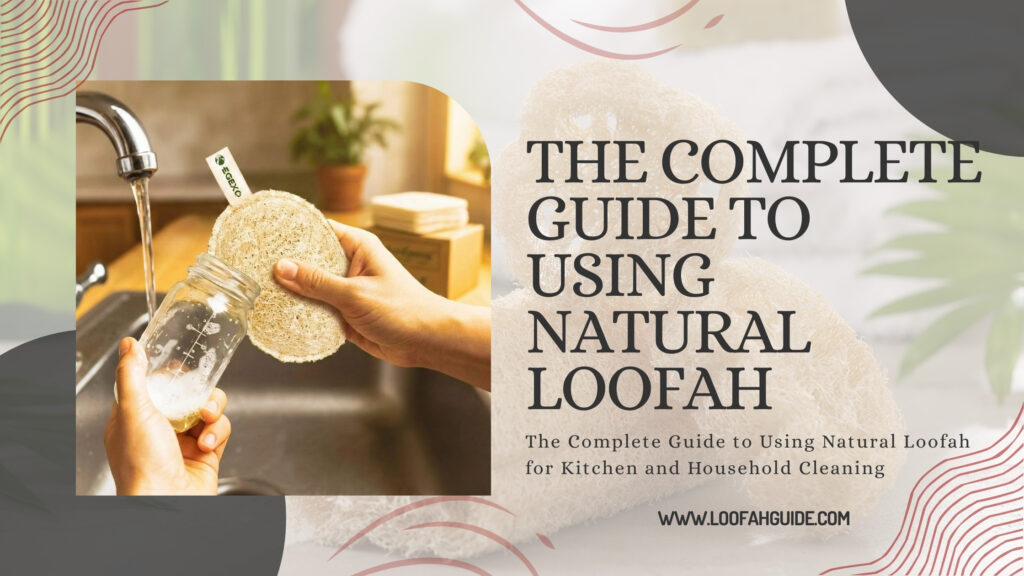
The kitchen is where natural loofah earns its reputation. Daily dishwashing is the most common application, but the list of kitchen tasks where loofah excels is considerably longer. It handles grease on stovetops, baked residue on sheet pans, stains inside coffee mugs, buildup around faucet bases, and food particles on cutting boards. The key advantage over synthetic sponges in the kitchen is that loofah maintains its scrubbing structure even after weeks of heavy use. Foam sponges compress and lose effectiveness, but loofah fibers spring back to their original form after each squeeze.
For commercial kitchens and food service operations, kitchen loofah products are available in bulk quantities with consistent sizing that fits standard kitchen workflows. Purchasing in volume also allows operations to schedule regular replacement cycles, a practice recommended by food safety guidelines.
Bathroom and Wet Area Cleaning
Soap scum, mineral deposits, and mildew stains are persistent bathroom challenges. Natural loofah tackles all three. The abrasive fibers remove mineral buildup from shower heads and faucets more effectively than spray-and-wipe methods. For tile grout, a loofah cut into a narrow strip can be worked into grout lines with precision.
The fact that loofah dries quickly between uses is especially valuable in humid bathroom environments where synthetic sponges tend to develop odors rapidly.
Living Areas and General Surfaces
Loofah works well for spot-cleaning upholstery stains, dusting textured surfaces like wicker furniture, and scrubbing scuff marks off baseboards. A dry loofah also functions as a gentle exfoliating surface cleaner for suede shoes and leather accessories.
Outdoor and Utility Applications
Gardeners and DIY enthusiasts find loofah indispensable for cleaning pots, tools, outdoor furniture, and even car interiors. The fibers handle mud, grass stains, and grime without the brittleness of steel wool or the flimsiness of paper towels. At end of life, outdoor-used loofah goes straight into the compost pile, closing the sustainability loop entirely.
For retailers targeting the gardening or outdoor lifestyle market, raw loofah scrubbers provide an unprocessed product that appeals to natural living consumers. Wholesale buyers can also explore body and spa loofah categories for cross-selling opportunities.
How to Select, Prepare, and Maintain Kitchen Loofah
Choosing the right loofah and caring for it properly makes a meaningful difference in both performance and lifespan. This section provides a complete lifecycle guide from purchase to composting.
Selecting the Right Loofah for Cleaning
When shopping for a kitchen loofah, look for these indicators of quality. The fiber network should appear tight and uniform when you hold it up to light. Gaps or thin patches suggest a loofah that was harvested too early or dried unevenly. The color should be a consistent cream to light tan, indicating proper curing. Press the dry loofah firmly between your thumb and forefinger. Quality fibers resist compression and spring back immediately. A soft or crumbly texture means reduced durability.
Egyptian loofah from the Nile Delta region consistently scores highest on these criteria because the growing conditions produce naturally denser fibers. Egexo’s grading process ensures that every product shipped meets strict density and uniformity benchmarks. Learn more about these standards on the Egexo quality standards page.
First Use Preparation
Before using a new loofah for the first time, soak it in warm water for 5 to 10 minutes. This softens the fibers to their optimal cleaning flexibility and rinses away any residual plant dust from processing. After soaking, squeeze and release the loofah several times to flush the internal fibers. The loofah is now ready for its first cleaning task.
Weekly Maintenance Schedule
Consistent maintenance prevents odor and bacterial buildup while maximizing the useful life of each loofah piece.
| Day | Task | Details |
|---|---|---|
| Daily | Rinse and dry | Rinse thoroughly under running water, squeeze out moisture, store in open air |
| Day 3 or 4 | Quick sanitizing rinse | Submerge in boiling water for 1 to 2 minutes, then air dry completely |
| Day 7 | Deep clean soak | Soak for 15 minutes in a mixture of 2 tablespoons white vinegar and 2 cups warm water |
| Week 3 to 5 | Evaluate condition | Check for fiber thinning, persistent odor, or loss of scrubbing texture |
| End of life | Compost | Tear into pieces and add to compost bin or garden bed |
Following this schedule keeps the loofah performing at peak effectiveness throughout its usable lifespan. Hospitality businesses managing large loofah inventories can build similar schedules into their housekeeping protocols.
Environmental Impact Comparison of Cleaning Sponge Materials
Sustainability is a deciding factor for a growing segment of consumers and retailers. The following table compares the environmental footprint of natural loofah against the most common synthetic cleaning sponge types.
Environmental Footprint Comparison
| Environmental Factor | Natural Loofah | Polyurethane Foam Sponge | Melamine Foam Sponge | Cellulose Blend Sponge |
|---|---|---|---|---|
| Raw Material Source | Renewable plant crop | Petroleum derivatives | Formaldehyde-melamine resin | Wood pulp mixed with synthetic fiber |
| Carbon Footprint of Production | Very low, sun-dried crop | High, industrial chemical process | High, resin manufacturing | Moderate |
| Water Usage in Manufacturing | Minimal, rain-fed crop | Significant industrial water use | Moderate | Moderate to high |
| Microplastic Release During Use | Zero | Yes, every wash cycle | Yes, particles break off | Partial, depending on synthetic content |
| Biodegradability | Complete in 30 days | None, persists 200+ years | None, persists indefinitely | Partial, synthetic fibers remain |
| Compostable | Yes, home compost safe | No | No | No in most formulations |
| Recyclable | Not needed, fully compostable | Rarely accepted by recyclers | No | Rarely accepted |
| Toxic Residue Potential | None | May leach chemical compounds | Contains formaldehyde traces | Low but possible |
This data makes the environmental case clear. Natural loofah is the only mainstream cleaning sponge option that leaves zero lasting environmental trace. For retailers building eco-conscious product collections and for households committed to reducing waste, loofah is the logical centerpiece of any sustainable cleaning strategy.
To see how Egyptian loofah moves from farm field to finished product with minimal environmental impact, read the Egexo farm to export process overview.
Understanding Market Demand and Business Opportunity
The shift toward natural household products is not a passing trend. Global market data reveals sustained year-over-year growth across all categories of eco-friendly home goods. For retailers, distributors, and brand owners, natural loofah represents a product segment with strong fundamentals.
Key Market Indicators
The global green cleaning products market reached an estimated 41.2 billion USD in 2024 and is projected to grow at a compound annual rate of 7.4 percent through 2030. Within this broader category, plant-based cleaning tools including natural sponges and scrubbers are among the fastest-growing subcategories, driven by consumer awareness of microplastic pollution and chemical exposure concerns.
Natural loofah offers particularly attractive economics for businesses. The cost of raw Egyptian loofah at wholesale prices provides significant margin room when positioned as a premium, eco-friendly product at retail. Minimum order quantities from established suppliers like Egexo start as low as 500 pieces for initial orders, reducing the risk for new market entrants.
Businesses exploring this opportunity can download the Egexo product catalog for a comprehensive overview of available products, grades, and packaging options. Those interested in creating a branded product line should explore Egexo’s custom product design services.
For consumer-focused buying guides and additional product education, Wholesale Loofah provides resources tailored to bulk sourcing, while the Egexo shop offers direct purchasing for individual and small-quantity orders.
Expert Insight from Egexo
Selecting the right loofah for kitchen cleaning is not just about size or shape. The harvest timing of the fruit determines the cleaning performance of the finished product. A loofah fruit harvested too early produces soft, loosely woven fibers that wear out quickly and lack scrubbing power. One left on the vine too long becomes excessively rigid and may crack during use. The ideal harvest window is when the fruit has fully matured and the outer skin has begun to dry and separate from the inner fiber, but before the fibers become brittle. In the Nile Delta growing region of Egypt, experienced farmers with generational knowledge can identify this precise window by touch and visual inspection. This attention to harvest timing is why Egyptian loofah from trusted growers like Egexo consistently outperforms loofah sourced from regions with less cultivation heritage. Every cleaning loofah that carries the Egexo name has been harvested within this optimal window and graded by hand for fiber integrity.
Frequently Asked Questions
Q1: What makes natural loofah better for kitchen cleaning than a regular sponge?
Natural loofah is the best choice for kitchen and household cleaning because of its unique cellulose fiber network. The multidirectional weave scrubs more effectively per stroke than flat foam, absorbs large amounts of water for efficient rinsing, and dries rapidly between uses to resist bacterial colonization. It also produces no microplastics and composts completely at end of life, something no synthetic sponge achieves.
Q2: Will natural loofah scratch my pots, pans, or countertops?
Natural loofah is safe for the vast majority of kitchen and household surfaces including stainless steel, cast iron, ceramic, porcelain, natural stone, and non-stick coatings. When moistened, the cellulose fibers soften to a texture that is firm enough to remove grime but gentle enough to protect surface finishes. The only surfaces to avoid are gilded or hand-painted fine china and delicate crystal.
Q3: How often should I replace a kitchen loofah?
Under heavy daily kitchen use including dishwashing and scrubbing cookware, replace your natural loofah every 3 to 5 weeks. For lighter household duties like countertop wiping and bathroom cleaning, a single loofah can last 6 to 8 weeks. Signs it is time to replace include persistent odor despite cleaning, visible thinning of fibers, or noticeably reduced scrubbing texture.
Q4: Can restaurants and commercial kitchens use natural loofah?
Absolutely. Many food service operations use natural loofah for dishwashing, surface cleaning, and equipment maintenance. The quick-drying properties align with commercial hygiene standards. Bulk purchasing from a wholesale supplier like Egexo provides consistent sizing and quality at a cost that supports frequent scheduled replacement, which food safety protocols recommend.
Q5: Where does the highest quality cleaning loofah come from?
The Nile Delta region of Egypt produces what is globally recognized as the finest quality loofah for both cleaning and body care. The rich alluvial soil, long growing season, and deep generational farming expertise create fibers with unmatched density and durability. Egexo has cultivated and exported loofah from this region for over 25 years, applying strict quality controls at every processing stage.
Q6: How do I sanitize natural loofah without damaging the fibers?
The gentlest effective method is a weekly soak in diluted white vinegar, using two tablespoons per two cups of warm water for 15 minutes. For mid-week freshening, a brief one to two minute submersion in boiling water kills surface bacteria without degrading the cellulose fiber structure. Avoid bleach or harsh chemical disinfectants, which can weaken the fibers and reduce lifespan.
Q7: Is there a way to purchase natural loofah in bulk for a retail business?
Yes. Egexo specializes in wholesale loofah supply with minimum order quantities starting at 500 pieces. They offer multiple quality grades, custom sizing, private label packaging, and complete export documentation. Businesses can request free samples to evaluate quality before committing to a full order at egexo.com/request-loofah-samples.
Q8: Can used loofah be composted at home?
Natural loofah is fully compostable in a home compost bin or garden bed. At end of life, simply tear or cut the loofah into smaller pieces to accelerate breakdown. Under normal composting conditions, loofah fibers decompose completely within approximately 30 days, returning organic material to the soil without leaving any synthetic residue behind.
Conclusion
Every room in your home and every surface in a commercial kitchen benefits from the natural cleaning power of loofah. Its cellulose fiber structure delivers scrubbing strength that synthetic sponges cannot match, while its rapid drying capability keeps bacteria at bay far more effectively than any foam product. The environmental case is equally decisive, with complete biodegradability, zero microplastic shedding, and a renewable agricultural source that supports sustainable farming communities in Egypt.
For individual consumers, switching to natural loofah for daily cleaning is one of the simplest and most impactful steps toward a healthier kitchen and a lighter environmental footprint. For retailers and wholesale buyers, the growing global demand for plant-based household products makes loofah a smart addition to any product portfolio, with strong margins and genuine consumer enthusiasm behind it.
Egyptian loofah from the Nile Delta remains the gold standard, and Egexo’s quarter-century of expertise ensures consistent quality from field to finished product.
Key Takeaways:
- Natural loofah is the best choice for kitchen and household cleaning across virtually every performance and sustainability metric
- The unique multidirectional fiber weave scrubs more effectively and dries faster than synthetic alternatives
- Egyptian Nile Delta loofah offers the highest fiber density and durability available globally
- Proper weekly maintenance extends loofah lifespan to 3 to 8 weeks depending on use intensity
- Wholesale opportunities start at MOQs as low as 500 pieces with private label and custom options available
Ready to experience Egyptian loofah quality?
- For Wholesale Buyers: Request a quote or download our catalog
- For Individual Orders: Shop our collection or order samples