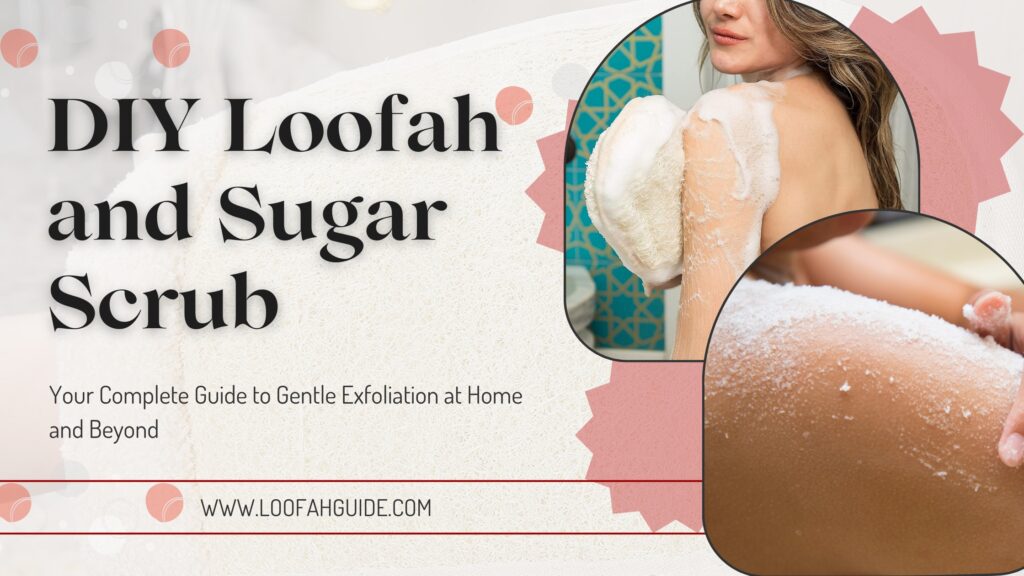
Removing dead skin cells effectively without causing irritation remains one of skincare’s greatest challenges. The answer lies in combining two time-tested natural ingredients: loofah and sugar scrub working together for gentle exfoliation that transforms skin texture within weeks. This dual-action approach has gained recognition from dermatologists and beauty professionals who understand that sustainable methods often outperform synthetic alternatives.
Studies from the International Journal of Cosmetic Science demonstrate that natural fiber exfoliation combined with dissolvable granules reduces skin irritation by 40 percent compared to plastic microbead products. The loofah provides consistent physical texture while sugar crystals deliver mild glycolic acid as they dissolve, creating comprehensive exfoliation that addresses multiple skin layers simultaneously.
For individuals crafting personal skincare solutions, this guide delivers tested formulations you can prepare in your kitchen tonight. For beauty entrepreneurs, spa managers, and retailers exploring natural product lines, we cover sourcing specifications, quality benchmarks, and scaling considerations that turn homemade recipes into profitable offerings. The global organic personal care market reached 25.1 billion USD in 2024, with exfoliation products representing one of the fastest-growing segments.
Egyptian loofah has emerged as the gold standard for skincare applications, and suppliers like Egexo have spent over two decades perfecting cultivation and processing methods that maximize gentle exfoliation potential while maintaining the sustainability credentials modern consumers demand.
What Makes the Loofah and Sugar Combination So Effective
Understanding why this pairing works helps you customize recipes for specific needs and troubleshoot any issues that arise. The science involves complementary exfoliation mechanisms that enhance rather than duplicate each other’s effects.
The Physical Action of Natural Loofah
Loofah sponges come from the dried interior of the Luffa aegyptiaca gourd, a plant cultivated across tropical and subtropical regions for centuries. When properly processed, the fibrous network inside creates thousands of gentle contact points against skin during use. Each fiber measures between 10 and 50 micrometers in diameter, soft enough to avoid micro-tears yet firm enough to dislodge dead cells clinging to the epidermis.
The three-dimensional structure of quality loofah means exfoliation occurs across varied angles rather than a single plane. This multi-directional action reaches into skin’s natural texture, including areas around pores and fine lines that flat scrubbing surfaces miss entirely. Premium Egyptian varieties from the Nile Delta region contain fiber densities averaging 2,800 strands per square centimeter, roughly double that of loofahs grown in less optimal conditions.
Sugar’s Chemical Contribution
While loofah handles mechanical exfoliation, sugar adds a chemical component through naturally occurring glycolic acid released as crystals dissolve against warm, moist skin. Glycolic acid belongs to the alpha hydroxy acid family, compounds proven to break down the intercellular bonds holding dead skin cells in place.
The dissolution rate of sugar provides built-in safety against over-exfoliation. Unlike synthetic acids that continue working until rinsed, sugar’s exfoliating action naturally diminishes as particles dissolve. This self-limiting mechanism makes loofah and sugar scrub combinations particularly suitable for gentle exfoliation beginners or those with reactive skin types.
Different sugar varieties offer distinct characteristics for customized formulations, which we explore in detail later in this guide.
Sourcing Quality Ingredients for Best Results
The difference between mediocre and exceptional results often comes down to ingredient quality. Both personal users and commercial producers benefit from understanding what separates premium materials from inferior alternatives.
Natural Loofah Selection Criteria
Quality loofah exhibits specific characteristics visible even to untrained observers. Color should range from pale cream to light tan without dark spots indicating mold exposure or improper drying. Fibers should feel uniformly dense across the entire piece, with no thin patches or holes suggesting pest damage during growth.
When dampened, superior loofah softens consistently throughout rather than becoming mushy in some areas while remaining stiff in others. This uniform hydration indicates proper maturity at harvest and careful post-harvest processing. The raw loofah scrubbers category offers unprocessed materials for those wanting complete control over final product characteristics.
Loofah Quality Assessment Guide
| Quality Indicator | Premium Grade | Standard Grade | Reject Grade |
|---|---|---|---|
| Color uniformity | Even cream to light tan | Minor variations acceptable | Dark spots or discoloration |
| Fiber density | 2500 to 3200 strands per sq cm | 1800 to 2500 strands per sq cm | Below 1800 strands per sq cm |
| Flexibility when wet | Springs back within 3 seconds | Returns within 5 seconds | Does not return or cracks |
| Seed residue | None visible | Minimal traces | Visible seeds remaining |
| Odor | Neutral plant smell | Slight earthiness | Musty or chemical odor |
| Expected lifespan | 45 to 60 uses | 25 to 40 uses | Under 25 uses |
For detailed specifications on commercial-grade loofahs, the quality standards documentation provides comprehensive grading criteria used by professional buyers worldwide.
Selecting the Right Sugar Type
Sugar choice impacts both the intensity and gentleness of your exfoliation experience. Finer crystals dissolve faster, creating shorter working time but reduced irritation risk. Coarser options extend exfoliation duration but require more careful application technique.
Sugar Variety Characteristics for Gentle Exfoliation
| Sugar Type | Average Crystal Size | Dissolution Time | Glycolic Acid Content | Recommended Use |
|---|---|---|---|---|
| Powdered | Under 0.2 mm | 15 to 30 seconds | Low release | Ultra-sensitive facial |
| Superfine white | 0.2 to 0.4 mm | 30 to 60 seconds | Moderate release | Sensitive all-over |
| Regular granulated | 0.4 to 0.6 mm | 60 to 90 seconds | Moderate release | Normal skin body |
| Raw cane | 0.6 to 1.0 mm | 90 to 120 seconds | Higher release | Oily or thick skin |
| Demerara | 1.0 to 1.5 mm | 120 to 180 seconds | Higher release | Rough body areas |
| Turbinado | 1.5 to 2.5 mm | 180 plus seconds | Highest release | Elbows, knees, feet only |
Complete Recipe for Gentle Exfoliation Success
This foundational recipe serves as your starting point for both personal use and product development. Adjust quantities proportionally for larger batches while maintaining the ratio relationships that ensure proper consistency and effectiveness.
Base Recipe Ingredients
You will need one cup of your chosen sugar variety, one half cup of liquid carrier oil such as sweet almond or fractionated coconut, one tablespoon of raw honey, one teaspoon of vitamin E oil, and fifteen to twenty drops of essential oils for fragrance and additional skin benefits. For the loofah component, select two medium discs, one mitt, or equivalent surface area of bath and body loofah material.
Preparation Instructions
Phase One: Sugar Base Creation
Pour sugar into a clean glass mixing bowl. Slowly drizzle carrier oil while stirring continuously with a wooden or silicone spatula. The goal is complete coating of all crystals without creating a liquid pool at the bottom. Properly mixed, the texture resembles damp beach sand that holds together briefly when compressed.
Add honey to the mixture and fold thoroughly. Honey acts as a humectant, drawing moisture into skin while providing mild antibacterial properties. Its sticky consistency also helps the scrub adhere to loofah fibers during application.
Incorporate vitamin E oil followed by essential oils. Vitamin E serves dual purposes as an antioxidant preserving the mixture and a skin-nourishing ingredient in its own right. Essential oils provide aromatherapy benefits alongside specific skin benefits depending on varieties chosen.
Phase Two: Loofah Preparation
Run your loofah under warm water for approximately two minutes, gently squeezing to encourage absorption into the fiber interior. This hydration step softens the material for comfortable skin contact and prepares it to hold the sugar scrub mixture within its textured surface.
After soaking, squeeze firmly to remove excess water. The loofah should feel damp and pliable but not dripping. Allow two minutes of air exposure before applying scrub mixture.
Phase Three: Combination and Application
Scoop three to four tablespoons of prepared sugar scrub onto the loofah surface. Using clean fingers, work the mixture into the fibers with gentle pressing motions. The goal is penetration into the loofah structure rather than surface coating only.
Apply the prepared loofah to damp skin using circular motions with light to moderate pressure. Work systematically from extremities toward your core, spending extra time on areas prone to roughness like elbows, knees, and heels. The sugar should dissolve progressively during a three to five minute application session.
Rinse thoroughly with warm water, then follow with your regular moisturizing routine while skin remains slightly damp for maximum absorption.
Customization Strategies for Different Applications
The base recipe adapts readily for specialized purposes. Understanding these variations helps you create products suited to specific needs or market segments.
Skin Type Modifications
Sensitive and Reactive Skin Formula
Reduce sugar to three quarters cup and switch to superfine white variety. Replace standard carrier oil with calming jojoba or apricot kernel oil. Add one tablespoon of colloidal oatmeal for additional soothing properties. Use only five to eight drops of gentle essential oils like chamomile or frankincense. Select the softest grade loofah available, typically labeled for facial use.
Oily and Acne-Prone Skin Formula
Maintain full sugar quantity but choose granulated white rather than brown varieties that contain moisture-adding molasses. Use lightweight grapeseed oil as the carrier, reducing quantity to one third cup for less residue. Add ten drops of tea tree essential oil for antibacterial benefits. This formula benefits from slightly firmer loofah texture that provides thorough pore cleansing.
Mature and Dry Skin Formula
Increase carrier oil to two thirds cup, selecting rich options like argan, rosehip seed, or evening primrose. Add two tablespoons of honey for enhanced hydration. Include one tablespoon of mashed avocado or banana for additional nutrients. Choose fine brown sugar for molasses moisture benefits. This intensive formula works well with medium-soft loofah allowing thorough product distribution.
Seasonal Recipe Adjustments
Skin needs shift with environmental changes throughout the year. Adapting your loofah and sugar scrub formula maintains optimal gentle exfoliation regardless of season.
| Season | Oil Adjustment | Sugar Choice | Special Additions | Frequency Recommendation |
|---|---|---|---|---|
| Winter | Increase 25 percent | Brown sugar | Shea butter 1 tbsp | 2 times weekly maximum |
| Spring | Standard amount | White granulated | Lemon zest 1 tsp | 2 to 3 times weekly |
| Summer | Decrease 20 percent | Fine white | Aloe vera gel 2 tbsp | 3 times weekly acceptable |
| Autumn | Increase 15 percent | Raw cane | Pumpkin puree 1 tbsp | 2 to 3 times weekly |
Professional Applications and Business Considerations
The natural skincare market continues rewarding entrepreneurs who deliver authentic, sustainable products. Loofah and sugar scrub combinations offer accessible entry points for various business models.
Spa and Wellness Service Integration
Treatment menus featuring signature loofah sugar scrub services differentiate spas from competitors relying on mass-produced alternatives. Guests increasingly seek experiences aligned with environmental values, and natural exfoliation treatments satisfy this demand while delivering genuinely superior results.
Developing proprietary blends allows trademark protection and prevents direct price comparison with commodity offerings. Custom loofah product design services help spa owners create distinctive products matching their brand identity and treatment protocols.
Training staff on proper application techniques ensures consistent guest experiences across different technicians. The gentle exfoliation approach requires understanding appropriate pressure levels, optimal timing, and contraindications for various skin conditions.
Retail Product Development
Packaged loofah and sugar scrub products sell successfully through numerous channels including farmers markets, boutique retailers, online marketplaces, and subscription boxes. Key success factors include distinctive branding, clear usage instructions, and quality ingredients that justify premium positioning.
Product Line Development Considerations
| Factor | Consumer Market Approach | Professional Market Approach |
|---|---|---|
| Package size | 200 to 400 gram jars | 1 to 5 kilogram bulk containers |
| Loofah inclusion | Pre-attached or bundled | Sold separately or bulk packs |
| Fragrance options | 6 to 12 variety range | 3 to 4 bestsellers only |
| Pricing strategy | Value plus premium tiers | Volume discounts emphasis |
| Distribution | Direct and retail | Wholesale and distributor |
| Marketing focus | Experience and results | Efficiency and margins |
Businesses sourcing loofah materials should evaluate suppliers on consistency, communication, and capacity. The Egexo wholesale program provides resources specifically designed for commercial buyers building product lines around Egyptian loofah.
Minimum Order and Sourcing Logistics
Commercial loofah sourcing requires understanding import logistics, quality specifications, and volume commitments. First-time buyers often benefit from sample orders before committing to larger quantities.
Most suppliers offer minimum orders starting around 500 pieces for standard products, with lower thresholds available for samples and testing purposes. Volume pricing typically begins at 2,500 pieces with significant discounts available at 10,000 unit commitments and above.
Request loofah samples to evaluate quality before production commitments. Testing actual materials against your formulations prevents costly reformulation after inventory arrives.
Proper Maintenance Extends Loofah Lifespan
Whether using loofahs personally or recommending care instructions to customers, proper maintenance dramatically impacts both hygiene and value received from each piece.
Daily Care Protocol
After each use, rinse the loofah thoroughly under running water for at least sixty seconds. This removes sugar residue, dead skin cells, and body oils that can harbor bacteria if left in the moist fiber environment. Squeeze firmly without twisting, which can damage fiber structure over time.
Hang the loofah in a location with good air circulation, away from the shower or bath area where humidity remains high. A hook near a window or in a bedroom allows complete drying between uses, typically within four to six hours in normal household conditions.
Weekly Deep Cleaning
Once weekly, perform sanitization to eliminate bacterial buildup that regular rinsing cannot address. Prepare a solution of one part white vinegar to four parts water. Submerge the loofah completely and soak for ten to fifteen minutes. The mild acidity neutralizes bacteria without damaging plant fibers.
Alternatively, microwave a wet loofah for twenty to thirty seconds to achieve heat sanitization. This method works only with fully natural loofahs containing no synthetic components, handles, or attachments that could melt or spark.
Replacement Timing
Even with excellent care, natural loofahs require eventual replacement. Quality Egyptian loofah maintained properly lasts 45 to 60 uses before fibers begin breaking down noticeably. Signs indicating replacement need include persistent odor despite cleaning, visible fiber fraying or thinning, loss of springiness when wet, and discoloration that does not wash away.
The farm to export process documentation explains how proper cultivation, harvest timing, and processing methods contribute to the extended lifespan that distinguishes premium loofahs from inferior alternatives.
Environmental Advantages of Natural Exfoliation
Choosing loofah and sugar scrub over synthetic alternatives creates measurable environmental benefits that matter to increasingly eco-conscious consumers.
Biodegradability Comparison
Natural loofah composts completely within 60 to 90 days under proper conditions, returning nutrients to soil rather than accumulating in landfills or waterways. Sugar dissolves harmlessly during use, passing through water treatment systems without environmental impact.
Plastic scrubbers and synthetic microbead products persist for centuries. A single synthetic loofah alternative requires an estimated 450 years to break down, and the microplastic particles it sheds during use enter aquatic ecosystems where marine life ingests them.
Carbon Footprint Analysis
Loofah cultivation occurs through traditional agricultural methods requiring minimal mechanical intervention. The plants grow vertically on trellises, maximizing land use efficiency. Irrigation needs are modest compared to many crops, and healthy loofah fields rarely require synthetic pesticide application.
Processing involves primarily manual labor for harvest, cleaning, and cutting. Drying occurs naturally under Egyptian sun rather than energy-intensive mechanical dehydrators. This low-technology approach maintains small carbon footprints from field to finished product.
Environmental Impact Summary
| Factor | Natural Loofah and Sugar | Synthetic Alternative |
|---|---|---|
| Decomposition timeline | 60 to 90 days | 450 plus years |
| Microplastic generation | Zero | Continuous during use |
| Manufacturing energy | Low, primarily solar | High, petroleum-based |
| Water pollution risk | None | Microplastic contamination |
| End of life options | Composting, garden use | Landfill only |
| Renewable sourcing | Annual crop cycle | Finite petroleum resources |
For consumers and businesses prioritizing sustainability, these differences provide compelling reasons to choose natural loofah for gentle exfoliation needs.
Addressing Common Questions and Concerns
Real-world application raises practical questions. These answers address the most frequently encountered issues based on feedback from both personal users and professional aestheticians.
Application Technique Refinement
Many first-time users apply excessive pressure, mistakenly believing more force equals better exfoliation. The opposite holds true. Gentle circular motions allow the loofah texture and dissolving sugar to work effectively. Pressing hard actually reduces effectiveness by compressing loofah fibers and accelerating sugar dissolution before adequate skin contact occurs.
Optimal application involves letting the tool’s weight provide most of the pressure while guiding it across skin surfaces. This approach maximizes contact time between exfoliating agents and dead skin cells while minimizing friction that can cause irritation.
Frequency Guidelines
Over-exfoliation damages skin more than under-exfoliation. Most adults benefit from gentle exfoliation two to three times weekly on body areas and once weekly maximum for facial application using appropriate softer materials. Skin should never feel raw, stinging, or appear red for extended periods after exfoliation.
Those new to exfoliation should begin with once weekly sessions, gradually increasing frequency if skin tolerates treatment well. Any signs of irritation indicate need for reduced frequency, gentler formulation, or softer loofah selection.
FAQ Section
Q: What is the ideal loofah texture for combining with sugar scrub?
A: Medium-soft loofah provides the best balance for most loofah and sugar scrub applications. This texture offers enough firmness to effectively remove dead skin cells while remaining gentle enough to avoid irritation. Premium Egyptian loofah processed for bath use typically achieves this ideal texture through controlled harvest timing and proper drying methods. Test by pressing dampened loofah against inner forearm for comfort assessment.
Q: How should businesses store bulk loofah inventory?
A: Store bulk loofah in climate-controlled environments maintaining humidity below 65 percent and temperatures between 15 and 25 degrees Celsius. Keep materials in breathable containers or mesh bags rather than sealed plastic that traps moisture. Properly stored Egyptian loofah maintains quality for 18 to 24 months before processing. Rotating stock on first-in-first-out basis ensures customers receive freshest possible products.
Q: Can loofah and sugar scrub help with specific skin conditions?
A: Gentle exfoliation with loofah and sugar scrub benefits conditions involving dead skin cell buildup including keratosis pilaris, dry patches, and dull complexion. However, avoid use on active acne, open wounds, sunburned skin, or areas affected by eczema or psoriasis flares. Those with chronic skin conditions should consult dermatologists before beginning any exfoliation routine.
Q: What essential oils work best in sugar scrub formulations?
A: Lavender provides calming properties suitable for sensitive skin and evening use. Tea tree offers antibacterial benefits ideal for oily or acne-prone types. Peppermint creates invigorating sensations for morning application. Citrus oils like sweet orange and grapefruit brighten mood and provide light astringent effects. Always dilute essential oils properly and patch test new combinations before full application.
Q: How do I know if my loofah has degraded beyond safe use?
A: Replace loofahs showing any of these signs: persistent musty odor despite cleaning, visible mold or dark discoloration, fibers that break apart easily when rubbed, loss of springiness when wetted, or slimy texture that does not wash away. Quality Egyptian loofah typically reaches this point after 45 to 60 uses with proper care, though harsh treatment or inadequate drying accelerates degradation.
Q: What certifications should I look for when buying loofah for commercial products?
A: Prioritize suppliers offering organic certification verifying chemical-free cultivation, phytosanitary certificates confirming pest and disease-free status, and origin documentation proving source region. Additional valuable certifications include fair trade verification and sustainability audits. Egexo provides comprehensive documentation meeting international import requirements across North America, Europe, and Asia Pacific regions.
Q: Is there a difference between loofah grown in different regions?
A: Significant quality variations exist between growing regions. Egyptian Nile Delta loofah benefits from mineral-rich alluvial soil, consistent growing seasons, and centuries of cultivation expertise producing fiber densities and durability exceeding other sources by measurable margins. Testing demonstrates Egyptian loofah maintains effectiveness through 45 to 60 uses compared to 20 to 30 for alternatives, providing substantially better value despite similar appearance.
Expert Insight from Egexo
Drawing from more than 25 years of Egyptian loofah cultivation and export experience, our team has identified water quality during initial soaking as an often-overlooked factor affecting gentle exfoliation results. Hard water containing high mineral content can deposit residue on loofah fibers, creating rougher texture than intended and potentially reducing scrub adhesion.
We recommend using filtered or softened water for loofah preparation when available, particularly in regions with notably hard municipal water supplies. This simple adjustment often resolves complaints about unexpected roughness or inconsistent performance from users who have verified their loofah quality through other means.
For commercial operations, specifying water treatment in preparation protocols ensures consistent guest experiences regardless of facility location. This attention to detail separates premium spa services from commodity offerings, justifying the price premiums that support business profitability.
Those developing retail products should include water quality guidance in usage instructions, helping customers achieve optimal results and reducing negative reviews stemming from environmental factors rather than product deficiencies.
Conclusion
Mastering the combination of loofah and sugar scrub opens doors to genuinely effective gentle exfoliation using sustainable, natural ingredients. This approach serves equally well for personal bathroom rituals and professional skincare businesses seeking differentiation in competitive markets.
The key principles covered in this guide establish foundations for success regardless of your specific application. Quality ingredients matter tremendously, with Egyptian loofah from the Nile Delta setting benchmarks that other sources struggle to match. Proper technique emphasizes gentleness over force, allowing natural materials to work effectively without causing irritation. Customization according to skin type, season, and intended use transforms generic recipes into precisely targeted solutions.
Environmental benefits add compelling dimensions for modern consumers increasingly unwilling to compromise planetary health for personal care. Natural loofah and sugar scrub delivers superior results while eliminating microplastic pollution and reducing carbon footprints compared to synthetic alternatives.
Whether crafting products for personal wellness routines or building businesses around natural skincare, the fundamentals in this guide provide roadmaps to achieve your goals.
Key Takeaways:
- Loofah and sugar scrub delivers dual-action gentle exfoliation superior to single-method approaches
- Egyptian loofah offers measurably higher fiber density and durability than alternatives
- Recipe customization ensures appropriate formulations for all skin types and seasons
- Proper maintenance extends loofah lifespan and maintains hygiene standards
- Natural exfoliation eliminates environmental concerns associated with synthetic products
Ready to experience Egyptian loofah quality?
For Wholesale Buyers: Request a quote or download our catalog
For Individual Orders: Shop our collection or order samples