A surprising admission from Chinese loofah manufacturers has sparked renewed interest in understanding quality differences between Asian and Egyptian loofah products. Industry insiders from China recently acknowledged that their loofah sponges require significant time and patience to become comfortable, while Egyptian alternatives offer immediate softness. This candid assessment from competing producers raises important questions about what consumers and businesses should know before purchasing loofah products.
The Chinese loofah vs Egyptian loofah debate matters because your choice affects daily skincare results, product longevity, and overall satisfaction. Millions of consumers struggle with harsh exfoliation products that sit unused after disappointing first experiences. Meanwhile, spa professionals and retailers face customer complaints when products fail to meet comfort expectations.
Understanding the science behind loofah fiber structure, the agricultural factors influencing quality, and the honest assessments from industry participants helps everyone make informed decisions. This guide presents factual comparisons without marketing spin, drawing on producer statements, cultivation expertise, and practical user experience data.
Whether you manage purchasing for a hospitality chain or simply want better skincare tools for your bathroom, the information here clarifies why origin matters and how to identify quality regardless of where you shop.
The Science Behind Loofah Fiber Differences
Loofah quality begins at the cellular level, where growing conditions and plant genetics determine fiber characteristics that affect every aspect of user experience. Scientific examination reveals measurable differences between Egyptian and Asian loofah varieties.
Cellular Structure Analysis
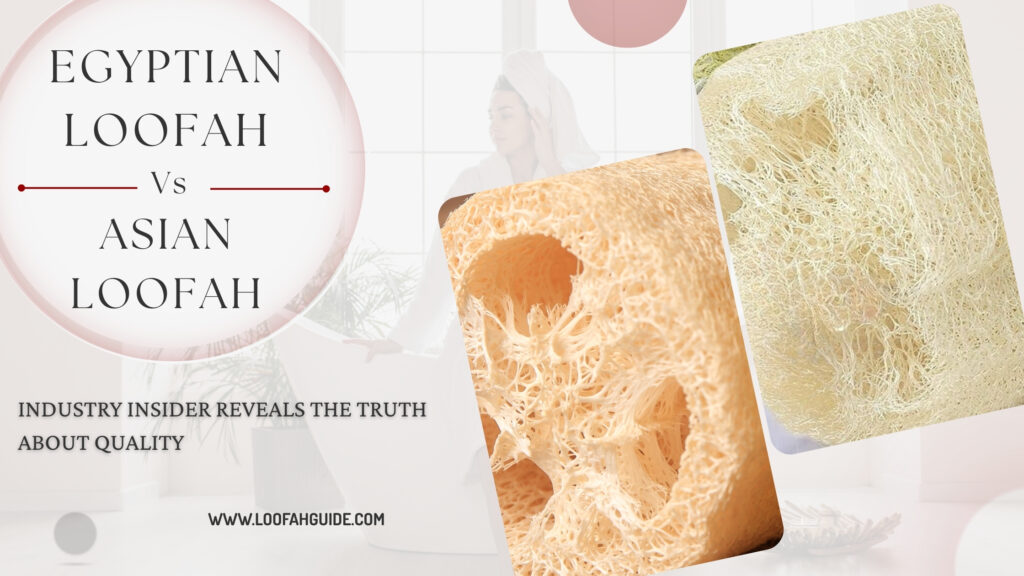
Egyptian loofah develops a distinctive cellular architecture characterized by loosely arranged fibers with abundant interstitial spaces. These air pockets form naturally during the maturation process when plants experience optimal temperature differentials between day and night cycles. The resulting structure creates natural cushioning that feels soft against skin immediately upon first contact.
Asian loofah, particularly varieties cultivated in China and Vietnam, exhibits tightly compressed cellular patterns. The dense fiber arrangement results from accelerated growing conditions common in monsoon climates where high humidity and rapid temperature changes push plants toward faster maturation. This compression creates the characteristic hardness that Chinese producers acknowledge requires breaking in.
The practical impact becomes apparent during use. Egyptian loofah fibers flex and conform to body contours, distributing pressure evenly across skin surfaces. Asian loofah fibers resist flexion, concentrating pressure at contact points and creating the scratchy sensation users report during initial uses.
Fiber Composition Comparison
| Structural Element | Egyptian Loofah | Chinese Loofah | Vietnamese Loofah |
|---|---|---|---|
| Cellulose Density | Medium | High | Medium-High |
| Air Pocket Volume | 35-40% of mass | 15-20% of mass | 20-25% of mass |
| Fiber Flexibility Rating | 8.5 out of 10 | 4 out of 10 | 5.5 out of 10 |
| Water Absorption Speed | Under 10 seconds | 30-60 seconds | 20-40 seconds |
| Natural Lather Production | Excellent | Poor initially | Moderate |
| Fiber Uniformity | Highly consistent | Variable | Moderately consistent |
These measurable differences explain the experiential gap between loofah types. Consumers frequently report that Egyptian loofah feels like a completely different product category compared to Asian alternatives they have tried previously.
How Growing Conditions Shape Quality
The Nile River Valley provides growing conditions that have produced premium luffa plants for over five millennia. Mineral-rich alluvial soil deposits contain balanced nutrient profiles that support gradual, even fiber development. Consistent sunshine combined with low ambient humidity during the maturation phase allows plants to develop the loose fiber structure that characterizes quality Egyptian loofah.
Egyptian cultivation expertise, refined across generations, includes precise harvest timing that captures plants at peak fiber softness. Farmers recognize visual and tactile indicators that signal optimal maturity, knowledge that cannot be replicated through industrial processes alone.
Asian growing regions face different environmental realities. Monsoon seasons create humidity spikes that accelerate plant growth beyond optimal rates. Temperature fluctuations stress plants, triggering defensive fiber tightening that persists through harvest and processing. These factors are not failures of Asian agriculture but rather geographic realities that produce different product characteristics.
What Chinese Producers Actually Say About Quality Differences
The most revealing information about Egyptian loofah vs Asian loofah comes from statements made by Chinese manufacturers themselves. These admissions, made in product descriptions and customer communications, acknowledge quality differentials that marketing materials typically obscure.
The Softness Admission
Chinese industry sources describe their products as requiring time and patience to break in or soften up because all natural fibers are tightly woven. They explicitly state that Egyptian loofah massage sponges break in much faster and are already softer to use from day one.
This acknowledgment carries significant weight because manufacturers rarely highlight competitor advantages. The willingness to make these statements suggests the quality differential is so well established that denial would damage credibility more than honest assessment.
For consumers, this admission validates experiences many have had with harsh Asian loofah products. The scratchy, uncomfortable sensation during initial uses is not user error or improper technique. It reflects fundamental product characteristics that require extended conditioning periods to overcome.
The Break-In Period Reality
Chinese producers recommend breaking in their loofah products by using them only on legs and feet initially because skin is tougher on these body parts. They warn consumers to avoid skin abrasion when first using their products and describe the raw all-natural plant fibers as creating friction that must be reduced through proper preparation.
This guidance reveals the practical implications of dense fiber structure. A product requiring users to restrict application to tough skin areas for an extended period before safe use on other body parts presents obvious limitations for daily skincare routines.
The recommended break-in period of several months to one year means consumers must endure uncomfortable experiences or limit usage significantly before achieving the gentle exfoliation they sought when purchasing. Egyptian loofah, by contrast, delivers comfortable exfoliation across all body areas from the first use.
The Spa Industry Concession
Perhaps most tellingly, Chinese producers acknowledge that Egyptian loofah sponges are widely used in some of the finest health and beauty spas. They recommend Egyptian loofah specifically for softer, more delicate skin.
This concession effectively cedes the premium market segment to Egyptian products. Spa operators selecting products for client treatments prioritize comfort and skin safety above all other factors. The industry preference for Egyptian loofah reflects professional assessment of quality differences that affect business outcomes.
Practical Comparison for Everyday Users
Understanding theoretical differences helps, but practical application guidance enables better purchasing decisions and product usage. This section addresses real-world considerations for individuals selecting loofah products.
Day One Experience Comparison
| Experience Factor | Egyptian Loofah | Asian Loofah |
|---|---|---|
| Initial Skin Sensation | Soft, pleasant | Rough, scratchy |
| Usable Body Areas | All areas including face | Legs and feet only |
| Lather Quality | Rich, abundant foam | Minimal foam production |
| Post-Use Skin Condition | Smooth, refreshed | Potentially irritated |
| User Satisfaction | High | Low to moderate |
| Likelihood of Continued Use | Very high | Moderate, often abandoned |
The day one experience largely determines whether a loofah becomes a daily skincare tool or sits unused in a shower caddy. Products that deliver immediate satisfaction earn consistent use, while those requiring patience often get abandoned.
Skin Type Suitability Guide
Different skin types respond differently to loofah exfoliation. Matching product characteristics to skin needs prevents discomfort and maximizes benefits.
Sensitive Skin: Egyptian loofah is strongly recommended. The soft fiber structure provides effective exfoliation without triggering irritation responses. Asian loofah should be avoided entirely or used only after extended break-in periods, and even then with caution.
Normal Skin: Egyptian loofah delivers optimal results for daily use. Asian loofah becomes usable after conditioning but offers no advantages over Egyptian alternatives for this skin type.
Oily or Thick Skin: Both loofah types can work effectively. Some users with very oily skin appreciate slightly more aggressive exfoliation, though Egyptian loofah with firmer pressure achieves similar results without abrasion risk.
Mature Skin: Egyptian loofah is preferred due to gentler action on skin that may be thinner or more delicate. Aggressive exfoliation can damage mature skin and accelerate visible aging signs.
Acne-Prone Skin: Egyptian loofah used gently supports acne management by removing dead skin cells without spreading bacteria through aggressive scrubbing. Asian loofah abrasion can worsen inflammatory acne.
Application Technique Guidance
Proper technique maximizes loofah benefits regardless of origin, though Egyptian loofah tolerates technique variations better than Asian alternatives.
Begin by thoroughly wetting the loofah under warm running water. Egyptian loofah absorbs water quickly and becomes pliable within seconds. Asian loofah requires longer soaking to achieve workable softness.
Apply body wash, soap, or shower gel directly to the loofah surface. Work the product into the fibers by squeezing and releasing several times. Egyptian loofah produces abundant lather quickly, while Asian loofah requires more product and effort to generate foam.
Use circular motions with light to moderate pressure on skin surfaces. Allow the loofah texture to do the exfoliation work rather than pressing hard. Egyptian loofah provides effective exfoliation even with gentle pressure, while Asian loofah may seem to require harder pressing that increases skin stress.
Rinse skin thoroughly after exfoliation and follow with moisturizer to support skin barrier recovery.
Longevity and Value Assessment
Product lifespan affects overall value, but simplistic durability comparisons miss important nuances. Understanding usable lifespan versus physical lifespan clarifies true value propositions.
The Durability Misconception
Chinese producers market their loofah products as lasting one to two years or longer before wearing out, positioning extended durability as excellent consumer value. This claim requires closer examination.
If a Chinese loofah requires six months to one year of breaking in before comfortable daily use, the genuinely enjoyable usage period shrinks considerably. A product lasting two years physically but providing comfortable use for only the second year offers no practical advantage over Egyptian loofah that delivers comfortable use throughout its lifespan.
Furthermore, products that remain uncomfortable often go unused. A Chinese loofah purchased with good intentions may sit in the shower for months, occasionally tried and quickly abandoned due to harsh texture. This product technically lasts indefinitely because it never gets used, but this durability provides zero value.
Realistic Lifespan Expectations
| Lifespan Factor | Egyptian Loofah | Asian Loofah |
|---|---|---|
| Physical Durability | 4-8 months | 12-24 months |
| Comfortable Use Period | 4-8 months | 6-12 months after break-in |
| Recommended Replacement | 3-4 weeks for hygiene | 3-4 weeks for hygiene |
| Actual Regular Use Rate | Daily | Often sporadic |
| True Value Period | Entire lifespan | Partial lifespan |
Hygiene considerations actually override durability for replacement timing. Dermatologists recommend replacing loofahs every three to four weeks regardless of physical condition because bacterial accumulation makes extended use inadvisable. This recommendation applies equally to Egyptian and Asian loofah products.
Given hygiene-based replacement cycles, the extended physical durability of Asian loofah provides no practical benefit. Both loofah types should be replaced monthly for optimal skin health, making initial comfort and immediate usability far more relevant than theoretical longevity.
Cost Per Use Analysis
Value assessment should consider cost per satisfying use rather than cost per month of ownership.
Egyptian loofah at typical retail pricing provides approximately thirty days of daily comfortable use before recommended replacement. If the product costs five to eight dollars, cost per use ranges from seventeen to twenty-seven cents.
Asian loofah at lower price points might cost three to five dollars but may see actual use only two to three times weekly due to discomfort, especially during break-in periods. Over thirty days with ten actual uses, cost per use ranges from thirty to fifty cents despite lower purchase price.
This analysis demonstrates why focusing solely on purchase price or physical durability misses the true value equation. Products that get used daily deliver better value than cheaper alternatives that sit unused.
Professional and Commercial Perspectives
Business buyers evaluating loofah sourcing face different considerations than individual consumers, though quality factors remain central to decision-making.
Hospitality Industry Standards
Hotels, resorts, and spas selecting amenity products prioritize guest experience above unit cost. A dissatisfied guest costs far more in reputation damage and lost repeat business than savings from cheaper amenity products.
Premium hospitality brands universally specify Egyptian loofah for guest amenities when natural loofah products are offered. The immediate softness ensures positive first impressions, while quality consistency prevents complaints from guests who receive substandard individual units.
Mid-tier properties increasingly recognize that loofah quality affects review scores and guest satisfaction metrics. The modest cost difference between Egyptian and Asian loofah represents negligible impact on overall amenity budgets while meaningfully affecting guest experience.
Retail Buyer Considerations
Retailers stocking loofah products face inventory and customer satisfaction calculations that favor Egyptian origin products.
Customer return rates for Asian loofah products typically run three to five times higher than Egyptian alternatives. Returns create administrative costs, waste inventory value, and damage customer relationships. The slightly lower wholesale cost of Asian loofah often disappears entirely when return handling costs are factored.
Product reviews significantly impact online retail success. Egyptian loofah products consistently earn higher ratings due to immediate satisfaction, while Asian loofah reviews frequently mention harshness and disappointing first experiences. Better reviews drive higher conversion rates and justify modest price premiums.
Spa and Wellness Applications
Professional spa operators require products that deliver consistent results across diverse client skin types. Treatment protocols cannot include extended break-in periods or client discomfort during services.
Egyptian loofah meets professional requirements for immediate effectiveness and gentle action. Therapists can confidently use Egyptian loofah on all clients without screening for skin sensitivity or applying cautionary warnings.
Asian loofah finds limited professional application, occasionally used for targeted callus treatment on feet where aggressive exfoliation serves therapeutic purposes. General body treatments universally employ Egyptian loofah or softer alternatives.
Identifying Quality Products Regardless of Origin
While origin provides useful quality indicators, individual product evaluation ensures satisfaction regardless of purchasing source. These assessment criteria help identify quality loofah products.
Visual Quality Indicators
| Quality Sign | What to Look For | Warning Signs |
|---|---|---|
| Color | Natural golden tan to light brown | Bright white, unnatural bleaching |
| Fiber Pattern | Visible loose weave, air pockets apparent | Compressed, matted appearance |
| Uniformity | Consistent texture throughout | Patches of different density |
| Shape | Natural cylindrical form | Overly processed geometric shapes |
| Cleanliness | Free of debris and discoloration | Dark spots, visible contamination |
Tactile Assessment
Before purchase when possible, or immediately upon receiving mail orders, assess loofah texture through touch.
Quality Egyptian loofah feels soft and pliable even when completely dry. Fibers yield to gentle pressure and spring back without brittleness. The surface feels textured but not sharp or scratchy.
Asian loofah typically feels rigid when dry, with fibers that resist compression. Surface texture may feel sharp or abrasive to fingertips, indicating the scratchy sensation users will experience on body skin.
If purchasing online without ability to touch before buying, prioritize sellers offering satisfaction guarantees or easy returns. First-hand assessment upon delivery allows quality verification before extended use.
Documentation and Sourcing Verification
For bulk purchases or quality-critical applications, verify origin documentation and supplier credentials.
Legitimate Egyptian loofah suppliers provide origin certification, export documentation, and cultivation information upon request. Established suppliers maintain consistent quality through controlled sourcing rather than opportunistic purchasing.
Vague origin claims, missing documentation, or reluctance to provide sourcing details suggests product may not match marketing claims. Reputable suppliers welcome inquiries about cultivation and processing practices.
Care and Maintenance for Maximum Value
Proper maintenance extends loofah usefulness and maintains hygiene regardless of product origin. Egyptian loofah tolerates care variations better due to its open fiber structure.
Daily Care Protocol
After each use, rinse thoroughly under clean running water while gently squeezing to expel trapped soap and skin cells. Avoid wringing or twisting motions that stress fibers.
Hang in well-ventilated location away from direct shower spray. Air circulation promotes rapid drying that prevents bacterial growth. Egyptian loofah dries quickly due to air pocket structure, while Asian loofah retains moisture longer and requires more attention to drying.
Weekly Sanitization
Once weekly, sanitize using your preferred method. Options include soaking in diluted white vinegar for ten minutes, microwaving damp loofah for thirty seconds, or soaking in diluted hydrogen peroxide solution.
Thorough rinsing after sanitization removes any residual cleaning solution before next body use.
Storage Between Uses
Store loofah in dry location with good air circulation. Avoid enclosed containers or humid bathroom corners where moisture accumulates. Hanging storage allows air access to all surfaces.
When traveling, allow loofah to dry completely before packing. Store in breathable bag rather than sealed plastic that traps moisture.
FAQ Section
Q1: Why does Egyptian loofah feel softer than Chinese loofah immediately?
A: Egyptian loofah feels softer immediately because of its naturally loose fiber weave containing abundant air pockets that form during optimal growing conditions along the Nile River Valley. Chinese loofah develops tightly compressed fibers due to accelerated growth in monsoon climates, creating density that requires months of use to soften. The cellular structure difference is measurable and explains why Chinese producers themselves acknowledge Egyptian loofah is softer from day one.
Q2: How long should I expect a quality loofah to last?
A: Physical loofah durability ranges from four to eight months for Egyptian varieties and twelve to twenty-four months for Asian types. However, dermatologists recommend replacing any loofah every three to four weeks for hygiene reasons regardless of physical condition. Bacterial accumulation in moist loofah fibers makes extended use inadvisable even when products appear structurally sound. Monthly replacement ensures both effectiveness and skin health.
Q3: Can I use loofah on my face safely?
A: Egyptian loofah can be used safely on facial skin when applied with gentle pressure and circular motions. The soft fiber structure provides effective exfoliation without the abrasion risk present with Asian loofah or synthetic alternatives. Limit facial loofah use to two to three times weekly and follow with moisturizer. Asian loofah should not be used on facial skin even after break-in due to remaining fiber density that can damage delicate facial tissue.
Q4: What do professional spas use for exfoliation treatments?
A: Professional spas predominantly use Egyptian loofah for body exfoliation treatments because client comfort directly impacts business success. Chinese producers acknowledge this market reality, stating that Egyptian loofah sponges are widely used in some of the finest health and beauty spas. The immediate softness and consistent quality of Egyptian loofah allows therapists to treat all clients confidently without skin sensitivity concerns.
Q5: Is the lower price of Asian loofah worth the trade-offs?
A: The lower purchase price of Asian loofah rarely delivers actual savings when considering cost per satisfying use. Products that remain uncomfortable get used infrequently, raising effective cost per use above Egyptian loofah despite lower purchase price. Additionally, returns and customer dissatisfaction costs often exceed apparent wholesale savings for retailers. Quality Egyptian loofah delivers better value through consistent daily use throughout its recommended lifespan.
Q6: How can I tell if a loofah is genuinely Egyptian origin?
A: Genuine Egyptian loofah displays natural golden tan coloring, visible loose fiber weave with apparent air pockets, soft pliable texture even when dry, and consistent quality throughout the piece. Request origin documentation from suppliers and verify credentials for bulk purchases. Avoid products with bright white bleached appearance, compressed matted fibers, rigid dry texture, or vague origin claims that may indicate Asian origin mislabeled for marketing purposes.
Q7: What causes loofah to become smelly or discolored?
A: Loofah odor and discoloration result from bacterial and mold growth in fibers that remain moist between uses. Prevention requires thorough rinsing after each use, hanging in well-ventilated areas for complete drying, and weekly sanitization. Egyptian loofah resists these problems better due to faster drying from open fiber structure. Replace any loofah showing persistent odor or discoloration regardless of age.
Q8: Are there quality differences within Egyptian loofah products?
A: Yes, quality varies among Egyptian loofah products based on harvest timing, processing methods, and supplier standards. Premium Egyptian loofah comes from plants harvested at optimal maturity and processed with gentle handling that preserves natural fiber arrangement. Lower grade Egyptian loofah may be harvested early or late, processed roughly, or sourced from less favorable growing areas. Purchase from established suppliers with documented quality control practices.
Expert Insight from Loofah Guide
Understanding loofah quality requires looking beyond marketing claims to examine actual fiber characteristics and production practices. The most telling indicator comes from competitive producer statements rather than promotional materials. When Chinese manufacturers openly acknowledge Egyptian loofah superiority in softness and spa industry preference, this represents meaningful quality validation that transcends advertising. Consumers and buyers benefit from seeking specific information about growing conditions, harvest timing, and processing methods rather than accepting vague quality claims. The cellular structure differences between Egyptian and Asian loofah are measurable and explain experiential differences that users consistently report. Prioritizing immediate comfort over theoretical durability leads to products that actually get used daily, delivering genuine skincare benefits rather than sitting unused due to harsh texture.
Conclusion
The Chinese loofah vs Egyptian loofah comparison reveals quality differences that significantly impact user experience and purchasing value. Industry insider admissions from Chinese producers themselves confirm what quality-focused buyers and consumers have long recognized through direct experience.
Egyptian loofah delivers immediate softness through naturally loose fiber structure developed in optimal Nile Valley growing conditions. Asian loofah requires extended break-in periods due to compressed cellular architecture formed during accelerated monsoon climate cultivation. These differences are not marketing claims but measurable structural realities that affect every use.
Professional spa operators choose Egyptian loofah because client comfort determines business success. Individual consumers achieve better skincare results with products that deliver effective, gentle exfoliation from the first shower. The modest price difference between quality Egyptian loofah and cheaper Asian alternatives disappears when considering actual usage patterns and cost per satisfying use.
Key Takeaways:
- Chinese producers acknowledge Egyptian loofah is softer from day one and preferred by premium spas
- Fiber structure differences result from growing conditions and are scientifically measurable
- Asian loofah break-in periods of six to twelve months reduce practical value despite longer physical durability
- Hygiene-based monthly replacement makes extended durability claims largely irrelevant
- Cost per satisfying use favors Egyptian loofah despite higher purchase price
Continue Your Loofah Education:
- Explore comprehensive loofah guides at Loofah Guide
- Learn about wholesale sourcing at Wholesale Loofah
- Discover quality Egyptian loofah products at Egexo Shop
- Request product samples at Egexo Samples