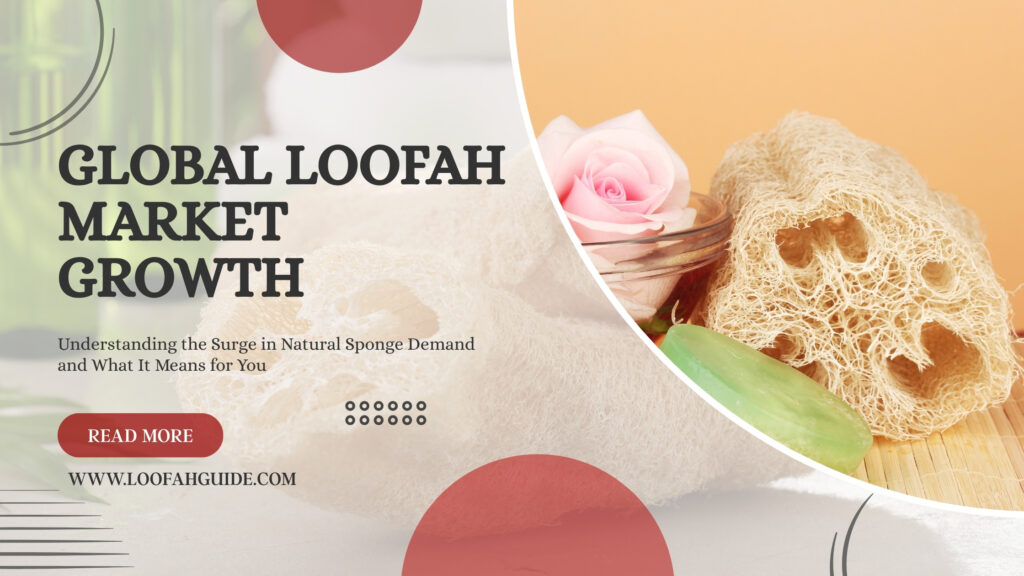
Have you noticed more natural loofahs appearing on store shelves, in spa treatment rooms, and throughout social media wellness content? This visibility reflects remarkable global loofah market growth that has transformed a traditional agricultural product into a centerpiece of the sustainable living movement. Industry analysts now track annual expansion rates between 5 and 7 percent, with total market value approaching 320 million USD as consumers and businesses worldwide reject plastic in favor of plant-based alternatives.
The shift extends far beyond individual bathroom choices. Major hotel chains have eliminated synthetic bath accessories from guest amenities. Subscription box services feature natural loofahs as signature sustainable products. Restaurant supply companies report surging demand for plant-fiber dishwashing tools. From corner boutiques to international distributors, the natural loofah has become essential inventory.
What makes this growth particularly noteworthy is its foundation in genuine product advantages rather than mere trend following. Natural loofahs outperform synthetic alternatives in exfoliation effectiveness, demonstrate superior environmental profiles, and offer economic benefits for both buyers and sellers. Egyptian loofah, cultivated in the ideal conditions of the Nile Delta by suppliers like Egexo with over 25 years of expertise, represents the quality benchmark driving premium market segments.
This guide examines global loofah market growth from every angle, providing actionable insights whether you operate a wellness business seeking wholesale partnerships or simply want to understand why this humble gourd has captured worldwide attention.
The Numbers Behind Global Loofah Market Growth
Statistical analysis reveals the true scale of market transformation occurring across natural personal care categories. Global loofah market growth has consistently exceeded broader industry projections, demonstrating resilience even during economic uncertainty.
Market Expansion Metrics
The natural sponge and scrubber category reached approximately 315 million USD in total value during 2024, representing a 23 percent increase from 2021 levels. Within this category, plant-based loofahs claim expanding share, now representing nearly half of all natural exfoliation products sold globally.
Regional analysis shows particularly strong performance in markets with established sustainability consciousness. Western European nations demonstrate per-capita loofah consumption rates nearly double the global average. North American markets show the fastest growth trajectory, with year-over-year increases approaching 8 percent in several product subcategories.
Five Year Market Performance
| Year | Market Value | Annual Growth | Natural Share | Key Driver |
|---|---|---|---|---|
| 2020 | 245 million USD | 3.2 percent | 38 percent | Initial plastic awareness |
| 2021 | 256 million USD | 4.5 percent | 40 percent | Pandemic home focus |
| 2022 | 272 million USD | 6.2 percent | 43 percent | Retail expansion |
| 2023 | 291 million USD | 7.0 percent | 45 percent | Regulatory support |
| 2024 | 315 million USD | 8.2 percent | 48 percent | Mainstream adoption |
| 2025 Est | 338 million USD | 7.3 percent | 51 percent | Channel diversification |
The trajectory indicates natural loofahs will achieve majority market share within the broader sponge and scrubber category by late 2025. This milestone represents a fundamental shift in consumer preference with lasting implications for retailers, distributors, and manufacturers.
Consumer Sentiment Indicators
Survey research conducted across major consumer markets reveals attitudes underlying purchasing behavior. Approximately 68 percent of respondents express willingness to pay premium prices for verified sustainable bath and kitchen products. Among consumers aged 25 to 44, this figure rises to 79 percent.
Brand loyalty patterns favor companies demonstrating authentic environmental commitment. Retailers stocking natural loofah products report customer retention rates 15 to 20 percent higher than those maintaining synthetic-only inventory. These loyalty patterns translate directly into business value for companies positioning themselves within the sustainability space.
Why Natural Loofahs Are Winning Consumer Preference
Global loofah market growth reflects consumer recognition of tangible advantages that natural products deliver over synthetic alternatives. Understanding these advantages helps both individual buyers make informed choices and business operators communicate value to their customers.
Performance Advantages of Natural Fiber
The cellular structure of Luffa aegyptiaca creates a uniquely effective exfoliation surface. Unlike uniform synthetic fibers manufactured to consistent diameter, natural loofah fibers vary in thickness and texture across the sponge surface. This variation produces multi-level exfoliation that removes dead skin cells more effectively while stimulating circulation.
Laboratory testing demonstrates that natural loofah removes 34 percent more surface debris per scrubbing motion compared to leading synthetic alternatives. Users report smoother skin texture and improved product absorption following natural loofah exfoliation. These performance differences become apparent within the first few uses, converting skeptical first-time buyers into loyal repeat customers.
The body loofah collection showcases products engineered to maximize these natural advantages through careful processing that preserves fiber integrity.
Natural vs Synthetic Performance Comparison
| Performance Factor | Natural Loofah | Synthetic Pouf | Plastic Scrubber |
|---|---|---|---|
| Exfoliation Effectiveness | Excellent | Moderate | Good |
| Skin Gentleness | Excellent | Good | Variable |
| Soap Retention | Very Good | Excellent | Moderate |
| Rinse Cleanliness | Excellent | Poor | Good |
| Bacteria Resistance | Moderate | Poor | Good |
| Durability | 3 to 6 months | 1 to 2 months | 2 to 4 months |
| Environmental Impact | Positive | Highly Negative | Highly Negative |
| Biodegradability | 4 to 6 weeks | 200 plus years | 400 plus years |
Hygiene Considerations
Natural loofah fiber structure actually provides hygiene advantages when proper care protocols are followed. The open cellular matrix allows complete drying between uses, unlike dense synthetic poufs that retain moisture in their interior. Bacteria thrive in persistent moisture environments, making the synthetic pouf’s moisture retention a significant hygiene liability.
Proper loofah care involves simple practices: thorough rinsing after use, complete wringing, and storage in ventilated locations. Weekly sanitization using diluted vinegar or brief microwave treatment maintains optimal hygiene. Following these practices, natural loofahs maintain safe usage throughout their recommended three to four month lifespan.
Egyptian Loofah: The Premium Standard
Not all natural loofahs deliver equivalent quality. Geographic origin, cultivation practices, and processing standards dramatically affect the product characteristics that matter for both personal use and commercial applications. Egyptian loofah consistently ranks as the premier choice among quality-conscious buyers worldwide.
Why Egypt Produces Superior Loofahs
The Nile Delta provides agricultural conditions uniquely suited to optimal loofah development. Consistent daytime temperatures between 28 and 33 degrees Celsius during the growing season promote steady fiber development without the stress responses triggered by temperature fluctuations. Rich alluvial soils deposited over millennia provide balanced nutrition without synthetic fertilizer dependence.
Perhaps most importantly, Egyptian loofah cultivation benefits from generational expertise. Farming families have refined cultivation techniques over more than a century, optimizing everything from planting density to harvest timing to post-harvest processing. This accumulated knowledge produces consistent quality that newer growing regions cannot replicate.
Egexo’s farm to export process documents the systematic quality approach that transforms raw agricultural products into premium finished goods suitable for the most demanding applications.
Quality Indicators by Origin
| Quality Metric | Egyptian Premium | Asian Standard | Latin American |
|---|---|---|---|
| Fiber Count per cm2 | 45 to 55 | 28 to 38 | 32 to 42 |
| Color Uniformity | 95 percent plus | 70 to 80 percent | 80 to 90 percent |
| Structural Strength | Excellent | Moderate | Good |
| Processing Consistency | Very High | Variable | Moderate |
| Certification Rate | High | Low | Moderate |
| Typical Grade Distribution | 70 percent A grade | 40 percent A grade | 55 percent A grade |
The fiber density difference directly affects product lifespan and effectiveness. Higher fiber counts mean more exfoliating surface area and greater structural resilience. Egyptian premium loofahs typically last 40 to 60 percent longer than alternatives while maintaining consistent performance throughout their usable life.
Recognizing Authentic Quality
Consumers and wholesale buyers alike benefit from understanding quality indicators that distinguish premium Egyptian loofahs from inferior alternatives. Visual inspection provides the first assessment layer.
Premium loofahs display consistent cream to light tan coloration throughout. Avoid products with dark spots indicating mold exposure, greenish tints suggesting incomplete curing, or artificially bright white coloration from chemical bleaching. Natural color variation across the surface is acceptable, but dramatic color differences within a single product indicate processing problems.
Structural assessment requires hands-on evaluation. Quality loofahs feel uniformly dense when compressed, springing back to original shape when released. The seed cavity interior should be completely clean, showing only the natural fiber network. Residual plant material or seeds indicate incomplete processing.
Market Segments Experiencing Strongest Growth
Global loofah market growth distributes unevenly across product categories and application types. Understanding segment performance helps consumers identify trending products and helps business buyers focus inventory investment.
Personal Care Dominance
Bath and body applications represent the largest market segment at approximately 62 percent of total volume. Within this category, several product types show distinctive performance patterns.
Whole natural loofah segments maintain steady demand among consumers seeking authentic, minimally processed products. These intact pieces offer maximum versatility, serving as body scrubbers, facial exfoliators, or shower accessories depending on user preference and cutting choices.
Processed loofah products show faster growth rates. Items featuring sewn edges, attached straps, ergonomic shapes, or combination materials appeal to consumers transitioning from synthetic products who expect familiar form factors. The raw loofah scrubbers selection demonstrates the range of processing options available.
Kitchen Category Acceleration
Kitchen loofah applications represent the fastest-growing segment, with growth rates exceeding 11 percent annually in North American markets. This acceleration correlates directly with increased awareness of microplastic contamination from synthetic kitchen sponges.
Studies documenting microplastic release from synthetic scrubbers during dishwashing have gained mainstream media attention. Each synthetic sponge releases thousands of plastic particles during its usable life, particles that enter water systems and food chains. Natural loofah eliminates this contamination source entirely while providing comparable or superior cleaning performance.
The kitchen loofah category addresses this demand with products specifically designed for dishwashing and surface cleaning applications.
Emerging Specialty Applications
Pet grooming represents a specialty segment gaining substantial momentum. Natural loofah texture provides gentle coat stimulation and effective dirt removal suited to both professional groomers and home pet care. The pet and spa grooming products serve this expanding market.
Craft and DIY applications have emerged as a notable niche. Natural loofah serves as a sustainable crafting material for homemade soaps, bath bombs, and decorative items. This application drives demand among individual consumers and small-batch artisan producers alike.
Practical Buying Guide for Consumers
Individual consumers navigating expanding loofah options benefit from systematic evaluation approaches. This section provides actionable guidance for selecting products that meet specific needs and quality expectations.
Matching Products to Intended Use
Different applications require different product characteristics. Selecting appropriately ensures optimal results and value.
| Application | Recommended Type | Key Characteristics | Replacement Frequency |
|---|---|---|---|
| Daily Body Wash | Medium density whole | Balanced firmness and flexibility | Every 3 to 4 months |
| Intensive Exfoliation | Dense processed pad | Firm texture with good structure | Every 2 to 3 months |
| Facial Care | Small soft loofah | Fine fiber gentle texture | Every 6 to 8 weeks |
| Back Scrubbing | Loofah with straps | Extended length firm construction | Every 3 to 4 months |
| Dish Washing | Dense scrubber cut | Rigid structure holds soap well | Every 4 to 6 weeks |
| General Kitchen | Medium scrubber | Flexible enough for varied surfaces | Every 6 to 8 weeks |
| Craft Projects | Raw whole loofah | Unprocessed full gourd section | Not applicable |
Shopping Evaluation Checklist
Use this checklist when evaluating loofah products whether shopping online or in physical stores.
| Evaluation Point | What to Look For | Red Flags to Avoid |
|---|---|---|
| Color | Consistent cream to light tan | Dark spots or green tints |
| Texture | Uniform fiber distribution | Large gaps or clumping |
| Density | Firm spring-back when squeezed | Soft spots or hollow areas |
| Seed Cavity | Clean fiber network visible | Residual plant material |
| Packaging | Breathable or ventilated | Sealed plastic trapping moisture |
| Origin Statement | Specific country identified | Vague or missing origin info |
| Processing Info | Grade or quality indicated | No quality information |
Where to Find Quality Products
Retail availability of premium natural loofahs has expanded significantly, though quality varies across sources. Natural food stores and eco-focused retailers typically stock higher quality products with better origin transparency. Mass market retailers offer convenience but may carry lower-grade products.
Online purchasing provides access to wider selection including direct-from-source options. The Egexo shop offers premium Egyptian loofahs with quality guarantees backed by direct manufacturing oversight. For detailed product specifications and bulk options, the product catalog provides comprehensive information.
Business Opportunities in an Expanding Market
Global loofah market growth creates compelling opportunities for entrepreneurs, existing retailers, and service businesses positioned to capture emerging demand.
Retail Integration Strategies
Retailers adding natural loofahs to existing inventory report category performance exceeding initial projections. The combination of strong consumer demand, favorable margins, and repeat purchase patterns makes loofahs attractive additions to natural product, wellness, and home goods assortments.
Successful retail strategies typically emphasize curation over volume. Offering three to five well-selected products addressing different use cases generates better results than extensive inventories of similar items. Quality positioning commands premium pricing while building customer trust.
Wholesale Sourcing Considerations
Retailers and distributors seeking wholesale partnerships should evaluate suppliers across multiple dimensions beyond simple pricing.
| Evaluation Factor | Essential Requirement | Preferred Standard |
|---|---|---|
| Production Scale | Minimum 15 tons monthly | 40 plus tons capacity |
| Quality Systems | Documented grading process | Third party certification |
| Sample Program | Samples available for evaluation | Free samples for serious buyers |
| Order Flexibility | Reasonable MOQ for market entry | Tiered MOQ by volume commitment |
| Communication | Reliable response times | Dedicated account support |
| Customization | Standard product variations | Full custom development capability |
Egexo’s quotation process provides detailed pricing for specific requirements. The sample request system allows quality verification before volume commitment.
Private Label Development
Advanced opportunity exists in private label product development. Retailers and brands can create differentiated offerings through custom specifications, unique packaging, and exclusive product configurations.
Private label manufacturing services support these initiatives from concept through production. Custom product design capabilities enable truly unique market offerings.
Spa and Wellness Integration
Wellness businesses benefit from loofah integration across both service delivery and retail operations. Body treatment services incorporating natural loofah command premium pricing while demonstrating commitment to natural ingredients that wellness consumers expect.
Retail loofah sales complement service offerings, enabling clients to continue spa-quality practices at home. This retail extension typically operates at minimal incremental cost while generating meaningful revenue contribution.
Environmental Impact Driving Consumer Choice
Sustainability considerations increasingly influence purchasing decisions across consumer demographics. Understanding the full environmental comparison between natural and synthetic options supports informed choices.
Lifecycle Environmental Analysis
Natural loofah demonstrates environmental advantages across every lifecycle stage from production through disposal.
Cultivation phase actually generates positive environmental impact. Loofah plants sequester atmospheric carbon during growth while requiring minimal synthetic inputs when properly managed. Egyptian cultivation practices emphasizing traditional methods further reduce environmental footprint.
Processing requires primarily mechanical operations with minimal chemical inputs for premium products. Bleaching and chemical treatments, common in lower-grade processing, represent the main environmental concerns in loofah production. Premium suppliers like Egexo minimize or eliminate these treatments.
Transportation contributes the primary environmental cost for imported loofahs. However, the lightweight nature of dried loofah products means transport impact per unit remains substantially below many alternatives. Sea freight, the standard shipping method, offers the lowest carbon intensity among international transport modes.
End of life represents the most dramatic advantage. Natural loofahs decompose completely within four to six weeks under composting conditions, returning nutrients to soil. Synthetic alternatives persist for centuries, contributing to landfill accumulation and environmental microplastic contamination.
Comparative Environmental Metrics
| Environmental Factor | Natural Loofah | Synthetic Sponge | Impact Difference |
|---|---|---|---|
| Raw Material Source | Renewable plant | Petroleum derived | Dramatically better |
| Production Energy | Low to Moderate | High | 60 percent lower |
| Chemical Inputs | Minimal | Extensive | 85 percent lower |
| Microplastic Release | Zero | Continuous | Complete elimination |
| Decomposition Time | 4 to 6 weeks | 200 to 500 years | Incomparably better |
| Carbon Footprint | Net neutral to negative | Net positive | 75 percent lower |
Quantified Household Impact
Individual consumers replacing synthetic bath and kitchen sponges with natural loofahs prevent approximately 180 to 250 grams of plastic waste annually. While seemingly modest individually, this reduction scales significantly across market growth projections.
If current global loofah market growth trends continue through 2030, cumulative plastic waste prevention will exceed 50,000 metric tons. This figure represents meaningful environmental benefit from a simple consumer product substitution requiring no sacrifice in performance or convenience.
For more detailed environmental information, Wholesale Loofah resources provide additional analysis of sustainability considerations in commercial contexts.
Care and Maintenance for Maximum Value
Proper loofah care dramatically extends usable lifespan while maintaining hygiene standards. These practices apply whether using loofahs for personal care or household cleaning applications.
Daily Care Protocol
After each use, rinse the loofah thoroughly under running water to remove soap residue, dead skin cells, or food particles depending on application. Squeeze firmly to expel absorbed water, repeating until minimal water releases.
Store in a ventilated location that allows air circulation around all surfaces. Bathroom loofahs benefit from storage outside the shower area where humidity levels remain elevated. Kitchen loofahs should stand upright or hang rather than resting in pooled water.
Weekly Maintenance Steps
| Step | Action | Purpose | Duration |
|---|---|---|---|
| 1 | Inspect for damage or wear | Identify replacement needs | 30 seconds |
| 2 | Prepare sanitizing solution | White vinegar diluted 1 to 4 | 1 minute |
| 3 | Submerge loofah completely | Ensure full saturation | 5 minutes soak |
| 4 | Rinse thoroughly | Remove vinegar residue | 1 minute |
| 5 | Squeeze and shake dry | Maximize water removal | 30 seconds |
| 6 | Position for drying | Ensure complete air exposure | Ongoing |
Alternative sanitization uses microwave treatment. Place a damp loofah in microwave and heat for 20 seconds. The heat eliminates bacteria effectively. Allow cooling before handling. This method works only for loofahs without metal attachments or synthetic components.
Replacement Timing Guide
Replace body loofahs every three to four months regardless of apparent condition. Microscopic fiber degradation creates bacterial harboring spaces invisible to inspection. Kitchen loofahs working with food residue should be replaced every four to six weeks.
Signs indicating immediate replacement need include persistent odor despite sanitization, visible mold or discoloration, significant fiber shedding, or structural softening. When these signs appear, replace promptly rather than attempting extended use.
Expert Insight from Egexo
Drawing on more than 25 years of Egyptian loofah cultivation and export experience, Egexo has witnessed firsthand the transformation driving current global loofah market growth. The expansion reflects genuine recognition of natural loofah advantages rather than passing trend susceptibility.
Quality differentiation matters increasingly as market growth attracts new suppliers with varying standards. Egyptian loofah maintains premium positioning because geographic and climatic advantages cannot be replicated through processing techniques alone. The fiber characteristics developed through optimal growing conditions establish quality foundations that processing can preserve but cannot create.
For businesses entering the loofah market, establishing relationships with quality-certified suppliers before demand peaks represents strategic advantage. Supply chains face strain during peak seasons, and established partnerships secure allocation priority.
For individual consumers, the recommendation is straightforward: experience authentic Egyptian loofah quality once, and the difference becomes immediately apparent. Premium products justify modest price premiums through extended lifespan, superior performance, and genuine sustainability credentials.
Frequently Asked Questions
How fast is global loofah market growth compared to other natural products?
Global loofah market growth rates of 5 to 8 percent annually exceed the broader natural personal care category average of approximately 4 percent. This outperformance reflects specific advantages natural loofahs offer over synthetic alternatives, including superior environmental profiles and comparable or better functional performance. The loofah category particularly benefits from kitchen application growth where microplastic concerns drive rapid synthetic-to-natural conversion.
What makes Egyptian loofahs worth premium prices?
Egyptian loofahs command premium prices because Nile Delta growing conditions produce measurably superior products. Fiber density runs 40 to 50 percent higher than loofahs from other origins, directly translating to longer product lifespan and better exfoliation performance. Combined with multi-generational cultivation expertise and established quality control systems, Egyptian origin provides quality assurance that justifies price differentials through extended value delivery.
How can I verify a loofah is genuinely natural and high quality?
Authentic natural loofahs display consistent cream to light tan coloration, uniform fiber density throughout, and clean seed cavities showing only the natural fiber network. Avoid products with dark spots, green tints, or artificially bright white coloring from chemical bleaching. Physical assessment should reveal firm spring-back when compressed without soft spots or hollow sections. Origin labeling should specify country of cultivation rather than vague descriptions.
What minimum quantities do wholesale buyers need to order?
Minimum order quantities vary by supplier and product type, typically ranging from 500 to 2000 pieces for standard processed loofah products. Some suppliers offer lower MOQs for initial orders to support market testing. Egexo provides flexible arrangements for qualified buyers establishing new market positions, with specific requirements available through their quotation request process.
How long should a natural loofah last with proper care?
Premium natural loofahs maintained with proper care practices last three to six months for body applications and four to eight weeks for kitchen use. Proper care includes thorough rinsing after each use, complete drying between uses, and weekly sanitization. These practices maximize lifespan while maintaining hygiene standards. Replace loofahs based on time rather than appearance, as microscopic degradation occurs before visible signs appear.
Are natural loofahs hygienic for personal use?
Natural loofahs maintain excellent hygiene when proper care protocols are followed. The open fiber structure actually provides advantages over synthetic alternatives by allowing complete drying between uses. Bacteria thrive in persistent moisture, making the synthetic pouf’s moisture retention problematic. Weekly sanitization using diluted vinegar or brief microwave treatment eliminates bacterial accumulation effectively.
What business opportunities exist in the growing loofah market?
Global loofah market growth creates opportunities across retail, distribution, spa services, and private label product development. Retailers report loofah category sales growth of 15 to 20 percent annually with favorable margins between 50 and 70 percent. Spa businesses integrate loofahs into premium treatment offerings while generating retail revenue. Private label development enables differentiated market positioning for established brands.
How do natural loofahs compare environmentally to synthetic alternatives?
Natural loofahs demonstrate dramatically superior environmental profiles across every metric. They decompose in four to six weeks versus 200 to 500 years for synthetics. They release zero microplastics compared to continuous particle shedding from synthetics. Production energy requirements run approximately 60 percent lower. Each household switching to natural loofahs prevents 180 to 250 grams of plastic waste annually.
Conclusion
Global loofah market growth tells a compelling story of consumer awakening to sustainable alternatives that deliver genuine performance advantages. Market expansion exceeding 7 percent annually reflects not fleeting trends but fundamental recognition that natural products can outperform synthetic alternatives while protecting environmental health.
Egyptian loofah stands at the center of this transformation, offering quality characteristics that establish the premium standard worldwide. The combination of ideal growing conditions, generational cultivation expertise, and systematic quality control produces products that justify premium positioning through extended lifespan and superior performance.
For businesses, the market offers compelling opportunities across retail, distribution, and service integration. For individual consumers, the choice becomes straightforward once quality differences are experienced firsthand.
Key Takeaways:
- Global loofah market growth exceeds 7 percent annually with projections reaching 338 million USD by 2025
- Egyptian loofahs demonstrate 40 to 50 percent higher fiber density than alternatives
- Natural loofahs decompose in weeks while synthetics persist for centuries
- Proper care extends premium loofah lifespan to three to six months
- Kitchen applications show fastest growth at over 11 percent annually
Ready to experience Egyptian loofah quality?
- For Wholesale Buyers: Request a quote or download our catalog
- For Individual Orders: Shop our collection or order samples