Black spots on loofah are usually mould, or soap and dirt that have built up in the fibre. Rinse the loofah under warm water and look again. If the spots stay, throw the loofah away and start with a new one.
Quick facts
- Loofah fibre holds water, and mould tends to grow in damp places with little air.
- Spots that rinse off were probably soap or dirt. Spots that stay are a reason to replace the loofah.
- When you are unsure about a loofah, replace it.
- Loofah is 100% biodegradable, so a discarded loofah can go into compost where that is accepted.
- Standard EGEXO loofah is not bleached, and its natural colour varies from piece to piece.
What are the black spots on my loofah?
A loofah is a plant fibre that soaks up water. If it stays damp for long, mould can start to grow on it, and mould often shows up as black, dark green or grey dots. Soap that dries in the fibre and dirt carried in from a shower or a sink can leave dark patches too. From the outside the two can look alike.
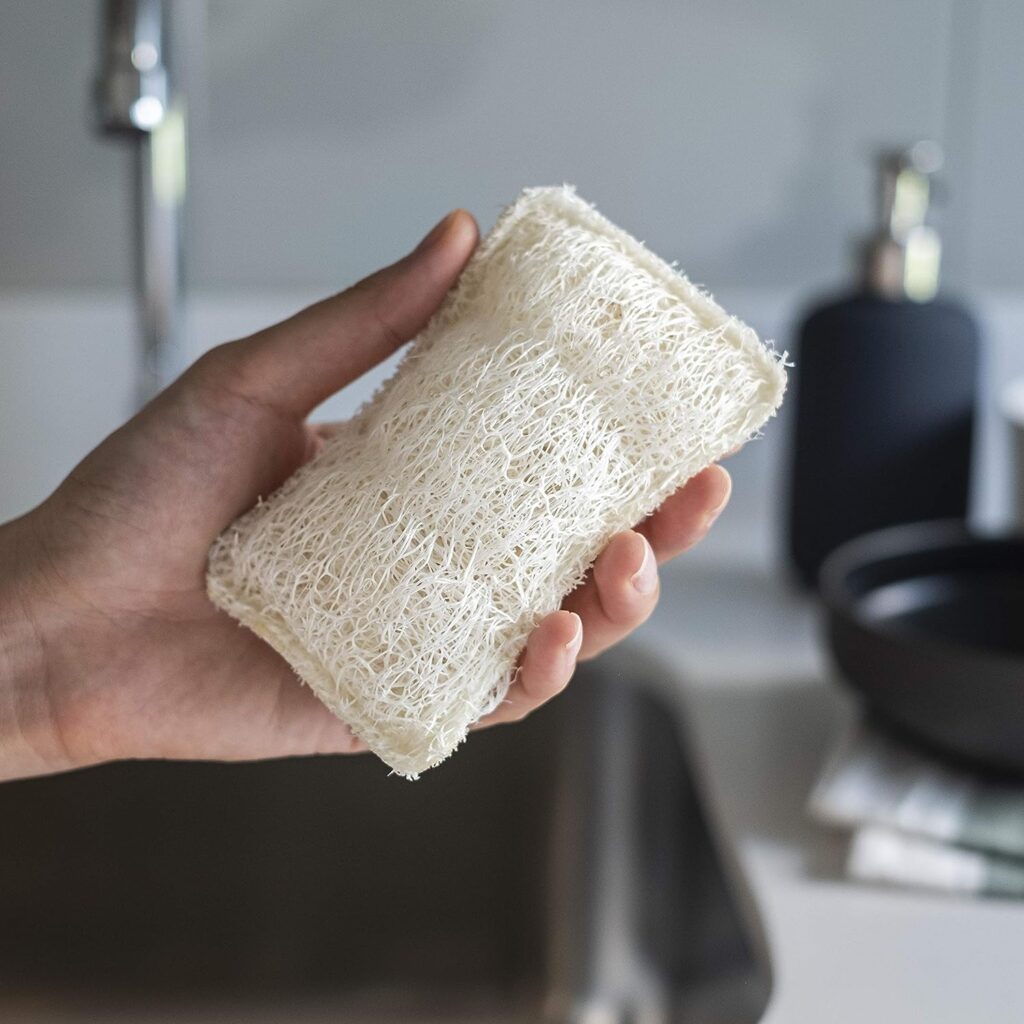
Natural colour is a third thing to keep in mind. Loofah is not one even shade. Standard EGEXO loofah is not bleached, so it can look cream in one place and tan in another. A patch of slightly darker fibre without any dots or fuzz is usually just the plant.
How can you tell mould from soap residue?
Hold the loofah under warm running water and squeeze it several times. Then look at it in good light.
- If the spots wash out and the fibre looks even again, it was most likely soap or dirt.
- If the spots stay, spread, or feel fuzzy or slimy, treat it as mould.
- If the loofah also smells musty after rinsing, treat it as mould too.
- If you cannot tell, treat it as mould.
You do not need to work out exactly what the spots are. The rule of thumb is the same either way: dark spots that remain after rinsing mean the loofah should go.
Buying for a shop or brand? See the EGEXO range of natural loofah and ask for samples or a quote.
Should you throw away a loofah with black spots?
Yes, if the spots do not rinse away. Soaking or scrubbing a loofah that has spots all the way through rarely helps, because the fibre is a thick network and you cannot see inside it. Replace it.
If the spots did rinse out, you can keep the loofah. Watch it closely over the next few uses, and dry it better from now on. Our post on the different ways people clean loofahs describes methods you can try, but a loofah that keeps getting spots is telling you that it is not drying.
Loofah is 100% biodegradable. You can put a discarded loofah in compost where that is accepted. Take off any wooden stick or other part first.
How do you stop black spots from coming back?
Spots come from damp, so the answer is drying. After each use, rinse out the soap, squeeze out the water and hang the loofah where air moves. A bright, airy place dries it faster than a closed corner. For a sunny day, our post on drying a loofah outdoors has simple steps.
- Hang the loofah by its loop or rope rather than leaving it on a soap dish.
- Never put it away damp in a drawer, bag or closed box.
- Use two loofahs in turn if one never gets time to dry.
- Replace the loofah at the first signs of trouble. Our post on how long a shower sponge lasts and the one on making a loofah last through good maintenance cover this in more detail.
What about the cotton loop or edge?
Many finished loofah products have a cotton loop, edge or strap. On EGEXO products these are 100% cotton. Cotton holds water too, so it can show spots before the loofah does. Look at the loop and the edge when you check the loofah.
If a cotton part shows dark spots that do not wash out, treat the whole product the same way and replace it. A worn or spotted loop is also harder to hang, which makes drying harder, which makes the problem worse.
What should you check on the next loofah?
A new loofah should look dry, smell of plain plant fibre and have no dark dots. Natural colour varies, and that is fine. What you look for is dots or fuzz that sit on top of the colour.
- Look at the fibre in good light before you use it.
- Check that the loop or strap is firm and has the same colour all along.
- Wet and rinse it before the first use, so loose fibre washes out.
- Keep it dry between uses, with air all around it.
Black spots are annoying, but they are easy to avoid. A loofah that dries well between uses stays clear for much longer.
If you keep several loofahs, check them all when you find spots on one. They often share the same damp spot, and the others may need a better place to dry.
Frequently asked questions
Are black spots on a loofah always mould?
No. Soap residue and dirt can leave dark spots too. If the spots rinse off, it was probably not mould. If they stay, replace the loofah.
Can I cut the spotted part off and keep using the loofah?
We would not. The fibre is a connected network, so the rest of it may be affected even where you cannot see it. Replace the loofah.
Is a darker colour the same as black spots?
No. Natural loofah varies in colour and may darken with use. Spots, fuzz, a slimy feel or a musty smell are the signs to act on.
Can I put a spotted loofah in the compost?
Loofah is 100% biodegradable, so it can go into compost where that is accepted. Remove any wooden stick or other part first.
Selling loofah in a shop or under your own brand? Request samples from EGEXO and check the fibre and the cotton parts yourself.