
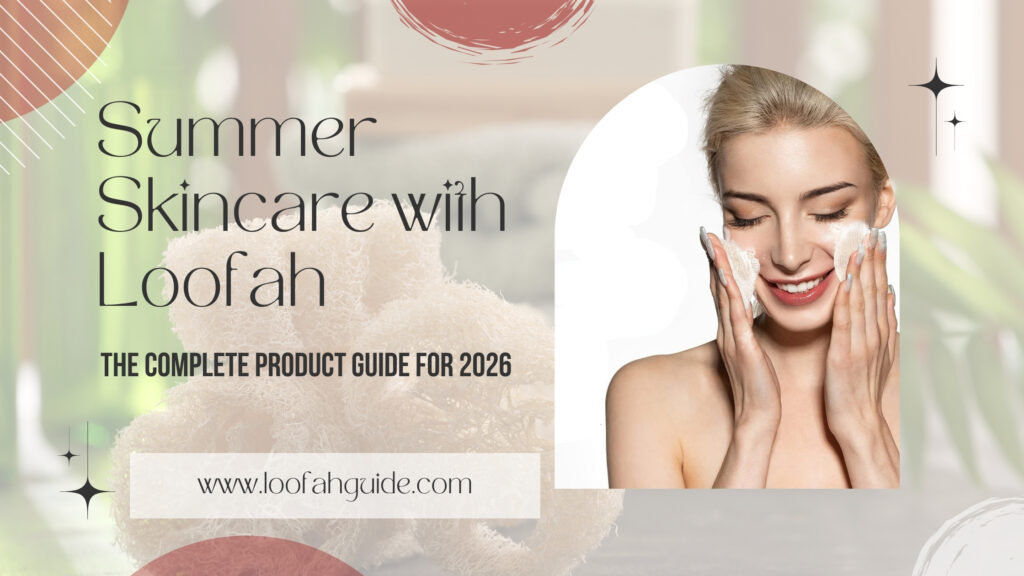
Short answer: For summer skincare, use a damp natural loofah with your usual cleanser and light pressure, then rinse your skin well. Hang the loofah to dry after each use, because a loofah that stays wet can grow bacteria.
The most practical and cost-effective solution to this problem is one of the oldest personal care tools in existence.
Summer skincare with loofah works because it addresses the root cause of summer skin problems directly and mechanically, without requiring expensive product stacks or professional treatments. A quality natural loofah, used with the right technique two to three times per week, removes the cellular debris that blocks pores, dulls complexion, and prevents moisturizers from penetrating to where they are needed.
This guide covers the full picture: how to choose the right loofah product for your specific needs, how to use it correctly for maximum summer skincare results, how to maintain it safely, and what separates premium natural loofah from the generic alternatives that fill most retail shelves. If you are buying for yourself or sourcing for a retail or spa business, the information here applies directly.
Understanding Summer Skin: Why Loofah Is the Logical Solution
Summer creates a specific set of skin challenges that do not exist in cooler months, or exist in milder form. Understanding these challenges makes the role of loofah exfoliation clearer than any product marketing ever could.
When temperatures rise, sebaceous glands produce more oil. Sweat glands are activated more frequently. The combination of oil, sweat, environmental particulates, and topical products like sunscreen, insect repellent, and self-tanner creates a surface film that accumulates faster in summer than at any other time of year. Without consistent exfoliation, the shed cells pile up rather than clearing naturally.
The Science Behind Mechanical Exfoliation in Summer
Mechanical exfoliation, which is what a loofah provides, removes dead cells through physical contact rather than through chemical dissolution. For summer skin, this approach offers a key advantage: it works immediately and does not rely on a complex chemical reaction timed to your skin’s pH and moisture balance.
If you have a skin condition, ask your doctor.
These are not abstract benefits.
The Complete Range of Loofah Products for Summer Skincare
The loofah product category is wider than most consumers realize. Understanding the full range makes it easier to select the right product for specific needs rather than defaulting to whatever is on the shelf.
Full Body Natural Loofahs
The standard format that most people recognize is the full-body loofah: a roughly cylindrical section of dried Luffa aegyptiaca gourd, typically 15 to 25 centimeters in length, with an open fibrous interior that creates a scrubbing surface when wet.
For summer skincare specifically, full body loofahs work best when they are mid-density, neither too firm for initial daily contact nor too soft to provide effective exfoliation. The fiber should spring back immediately when compressed, which indicates appropriate maturity at harvest and correct drying after processing. A loofah that flattens under mild pressure and stays compressed was likely harvested too early or dried insufficiently.
Full body loofahs for summer use are grown by natural loofah producers in Egypt, where the Nile Delta’s dry growing season suits the plant and the fiber is soft and gentle from the first use.
Loofah Slices and Discs for Targeted Summer Care
Summer creates localized skin challenges that a full-body loofah does not always address efficiently. Keratosis pilaris on the upper arms worsens in summer. Calluses on heels thicken from increased barefoot or sandal time. Elbow and knee skin becomes rough from sun exposure and friction.
Loofah disc slices, which are cross-sections of the loofah gourd typically 2 to 4 centimeters thick, provide concentrated scrubbing surface for these targeted areas. They are also easier to hold and control than a full-length loofah, which makes them more effective for knees, heels, and elbows.
The bath and body loofah range at Egexo includes disc slices alongside full-length options, with both bleached and natural-finish variants available.
Loofah Mitts for Gentle Daily Use
For people with sensitive skin, or for anyone who wants to maintain an active daily exfoliation habit without the intensity of a full scrub, loofah mitts offer a gentler format. The loofah material is incorporated into a glove-style accessory that allows full palm contact with the skin surface and very precise control over pressure.
Mitts work particularly well on the arms, chest, and shoulders, areas that are heavily exposed in summer and prone to congestion from sunscreen application. They are also safer for use on slightly irritated or sun-exposed skin than a stiff loofah, because the palm provides a cushioning layer behind the fiber.
Raw Loofah for DIY Summer Skincare
A growing segment of the natural beauty market involves consumers who purchase raw loofah material and create their own products. This ranges from cutting raw loofah to custom dimensions, to soaking loofah sections in infusions of green tea, aloe, or essential oils, to embedding loofah slices in glycerin soap bars for a combined cleanse-and-exfoliate tool.
Standard EGEXO loofah is not bleached. Bleaching is available on request. Egexo’s raw loofah scrubbers category covers this need for both individual buyers and small-batch manufacturers.
Head-to-Head: Loofah Product Comparison for Summer Use
| Product Format | Summer Suitability | Best Skin Type | Scrub Intensity | Ease of Use | Maintenance | Replace Every |
|---|---|---|---|---|---|---|
| Full Body Loofah | Excellent | Normal, oily | Medium | Moderate | Hang to dry | Every few weeks |
| Loofah Disc Slice | Excellent for targeted use | All types | Medium to high | Easy | Rinse and dry | Every few weeks |
| Loofah Mitt | Very good | Sensitive, dry | Low to medium | Very easy | Rinse and air dry | Every few weeks |
| Back Strap Loofah | Very good | Normal, oily | Medium | Requires two hands | Hang to dry | Every few weeks |
| Raw Loofah (DIY) | Good with preparation | Depends on use | Variable | Requires preparation | Cut and dry | Depends on format |
| Soap-Embedded Loofah | Good | All types | Low to medium | Very easy | Not required | When soap is gone |
How to Build a Summer Skincare Routine with Loofah
Building an effective summer skincare routine with loofah takes about ten minutes per session and requires only three things: a quality natural loofah, a gentle liquid body wash, and the right technique.
Preparing Your Loofah for Use
Never use a dry loofah directly on skin. The dry fiber is significantly coarser than wet fiber and can cause microtears on the skin surface, particularly in summer when skin may be slightly sensitized from sun exposure. Always soak your loofah in warm water for a minimum of 60 seconds. For a new loofah or one that has dried fully between sessions, 90 seconds is better.
While the loofah soaks, rinse your skin with warm water. The goal is to hydrate the outermost cell layers before any abrasion occurs. Hot water is counterproductive: it dries the skin and over-stimulates sebum production after showering.
The Correct Summer Exfoliation Technique
Apply your liquid cleanser directly to the soaked loofah rather than to the skin. Using a cleanser that contains a gentle surfactant rather than harsh detergents is important for summer, when the skin’s acid mantle is already under stress from environmental exposure.
Work in sections, starting from the lower body and moving upward. Use circular motions on large areas like the thighs and torso, and shorter back-and-forth strokes on the knees, elbows, and feet. Keep pressure consistent and moderate. The loofah does the work. Pressing harder does not improve results and increases the risk of skin irritation.
Give special attention to areas prone to summer congestion: the back and shoulders, where sweat accumulates under clothing; the upper arms, where heat rash is common; and the lower legs, where sunscreen builds up and dry skin is visible.
After the Scrub: Completing the Routine
Rinse thoroughly, making sure no product residue remains. Pat, do not rub, the skin dry with a clean towel. Apply your moisturizer within three minutes of toweling off. This window matters more in summer than in any other season: freshly exfoliated skin absorbs moisture rapidly, and waiting longer than a few minutes significantly reduces absorption efficacy.
For summer body care, look for lightweight lotions or gel moisturizers rather than heavy creams. Ceramide-containing formulas support barrier repair after exfoliation.
Buying Guide: What to Look for When Purchasing Natural Loofah
Whether you are buying one loofah for personal use or sourcing hundreds of units for retail or spa supply, the same quality criteria apply. The difference is in the verification process.
Quality Indicators at a Glance
| Quality Factor | What Good Looks Like | What to Avoid |
|---|---|---|
| Fiber density | Firm, springs back immediately under pressure | Collapses under mild pressure, stays flat |
| Color (unbleached) | Uniform golden-brown | Patchy brown and white, or dark spots |
| Color (bleached) | Consistent pale cream | Gray patches, yellowing, uneven whiteness |
| Surface texture | Even fiber distribution with no bare patches | Thin sections or dense clumping |
| Odor | Neutral or very mild natural plant scent | Musty, chemical, or ammonia notes |
| Moisture feel | Dry to the touch, slight flexibility | Soft, damp, or spongy when stored |
| Seed remnants | Minimal, easily removed | Excessive seed material embedded in fiber |
For Wholesale Buyers: Supplier Evaluation Criteria
Wholesale buyers should apply a more structured evaluation than individual consumers. The following criteria separate reliable suppliers from risky ones, regardless of price point.
A credible loofah supplier will provide written quality specifications with measurable parameters rather than descriptive language only. They will offer samples before requiring bulk commitment. They will be transparent about cultivation origin and processing methods.
For buyers building a long-term supplier relationship, this level of transparency is a strong indicator of operational reliability. You can also review why Egexo is the right loofah supplier for your business.
Buyers new to the loofah category should order samples before committing to bulk and should treat any supplier that discourages sampling as a significant risk.
Loofah Maintenance in Summer: Extending Product Life and Hygiene Safety
Summer bathroom conditions are specifically challenging for loofah maintenance.
Summer Loofah Care Schedule
| Maintenance Task | Frequency | Method | Why It Matters |
|---|---|---|---|
| Rinse after each use | Every use | Rinse thoroughly with clean water, wring completely | Removes trapped product residue and dead cells |
| Hang to dry | Every use | Hang in well-ventilated area, not inside shower | Reduces moisture that supports bacterial growth |
| Deep clean | Weekly | Soak in diluted white vinegar solution (1 to 10 ratio) for 5 minutes | Helps keep the fiber clean without damaging it |
| Inspect for wear | Every 2 weeks | Check for thinning fiber, persistent odor, or discoloration | Identifies when replacement is needed |
| Replace | Every few weeks in summer | Full replacement with new product | Summer heat accelerates fiber degradation |
The single most common loofah hygiene mistake is storing the loofah inside the shower or on the bathroom floor. Hanging the loofah near an open window or under a bathroom fan is significantly better.
The Business Opportunity: Summer Loofah Sales for Retailers and Spas
For retail buyers and spa operators, summer is not just the peak season for natural loofah demand. It is a good time to introduce new loofah SKUs, build out a natural body care section, or launch a private-label product line anchored to the summer wellness narrative.
Consumer spending on natural body care peaks between May and September in most Western markets, with particular concentration in June and July as consumers prepare for beach and outdoor seasons.
For spa operators, summer loofah protocols, including full-body exfoliation treatments using Egyptian loofah, can be positioned as seasonal offerings. EGEXO has been exporting Egyptian loofah since 2015.
Brands looking to build a custom loofah-based product line for summer launch can explore Egexo’s custom loofah product design service and private label manufacturing options. For bulk pricing and availability, request a wholesale quote directly.
A Note from EGEXO
No minimum order on standard products. Private label from 1,000 units. For buyers, it is about consistency: does order 50 look like order 1?
EGEXO has been exporting Egyptian loofah since 2015, from our own farms and partner farms in the Nile Delta. Our loofah is dried by sun and by machine, and every order is checked by hand for colour, holes, size and dryness.
The result is a product that passes the same physical specification on your first sample order and your fiftieth bulk shipment. For buyers whose brand reputation depends on a consistent product experience, this is not a minor detail. It is the foundation of a reliable supplier relationship.
For consumers, this means that every natural loofah you purchase that carries Egyptian origin and verified quality has been through a process that began months earlier in the Nile Delta’s growing fields. The difference you feel in a quality loofah compared to a generic one is not marketing. It is the result of agricultural precision applied across an entire supply chain.
You can learn more about the supply chain at the Egexo farm-to-export process page, and you can download the full product catalog for complete specification sheets.
FAQ Section
Q1: What is the best loofah for summer skincare beginners?
For someone new to summer skincare with loofah, a medium-density full-body natural loofah is the best starting point. It provides an effective exfoliation experience without the intensity of a disc slice or the learning curve of a back strap. Soak it for 90 seconds before first use, apply light to moderate pressure, and limit your first sessions to two to three times per week. Your skin will adjust to mechanical exfoliation over time, after which you can increase frequency if desired. Natural Egyptian loofah is soft and gentle from the first use.
Q2: How do I know when to replace my loofah in summer?
Replace your loofah when any of these three conditions are present: the fiber no longer springs back after compression, the loofah has a persistent odor that does not clear after rinsing, or the surface fiber is visibly thinning or breaking apart. Higher frequency use and humid storage environments accelerate degradation. A good practice is to replace your loofah at the start of each new month during summer.
Q3: Can I use loofah on my face in summer?
Using a standard body loofah on the face is not recommended. Facial skin is significantly thinner than body skin, particularly around the eyes, and the mechanical pressure required for effective body exfoliation is too aggressive for most facial skin types. For summer facial exfoliation, look for a very soft facial loofah specifically designed for face use, or use a chemical exfoliant appropriate for your skin type. The loofah routine described in this guide is designed for the body and should stay there.
Q4: Does natural loofah carry bacteria even when it looks clean?
All porous exfoliation tools, including natural loofahs, can harbor bacteria if not maintained correctly. A loofah that is rinsed right after use, wrung out completely, and hung in a ventilated area away from the shower is much less likely to stay damp. A loofah left wet in an enclosed shower in summer humidity can quickly develop mold and bacteria. The weekly vinegar soak described in the maintenance section of this guide is a simple way to keep the fiber clean. Replace the loofah every few weeks regardless of visual appearance.
Q6: Where can wholesale buyers source Egyptian loofah reliably?
Egyptian loofah from the Nile Delta region is available through specialized exporters with direct cultivation relationships. EGEXO has been exporting Egyptian loofah since 2015. They ship to more than 40 countries. The process of establishing a wholesale account starts with a paid sample and a quote. Buyers can begin the process by requesting samples or submitting a wholesale quotation request.
Q7: What makes loofah a better summer exfoliation choice than plastic scrubbers?
Plastic and polyester mesh scrubbers carry two specific disadvantages in summer conditions. First, they retain moisture far longer than natural loofah, creating conditions for bacterial growth in warm bathrooms. Second, they shed microplastic particles with each use, contributing to environmental contamination that is increasingly documented in water systems worldwide. Natural loofah dries faster, biodegrades fully at end of life, and produces no microplastic waste. In summer, when bathroom temperatures increase and skin is more exposed, both of these differences become more consequential. For brands serving eco-conscious consumers, the switch from synthetic to natural loofah is also a meaningful sustainability claim.
Conclusion
The case for summer skincare with loofah comes down to a simple proposition: the skin challenges that summer creates are mechanical in nature, and the most effective solution is mechanical. Dead cell accumulation, pore congestion, product absorption barriers, and heat rash risk are all surface-level problems that a quality natural loofah addresses directly, quickly, and affordably.
The quality of the loofah matters more than most people realize. Egyptian loofah from a source like Egexo is soft and gentle from the first use, and every order is checked by hand for colour, holes, size and dryness.
Whether you are a consumer building a summer routine, a spa professional designing seasonal treatments, or a buyer planning summer inventory, the principles are the same: choose quality, verify the source, use the right technique, and replace on schedule.
Key Takeaways:
- Summer skincare with loofah is most effective at two to three sessions per week using correct technique and quality natural fiber
- Proper maintenance, specifically rinsing, hanging to dry, and replacing every 3 to 4 weeks, is essential for hygiene safety
- For wholesale buyers, supplier transparency on quality checks, dryness, and export documentation is a key indicator of reliability
Ready to experience Egyptian loofah quality?
- For Wholesale Buyers: Request a quote or download our catalog
- For Individual Shoppers: Request a quote or request samples
Selling summer body care? Get the EGEXO catalog and see our bath and body loofahs.
Keep reading: how to pick a loofah for your skin type and how to clean and sanitize a loofah.