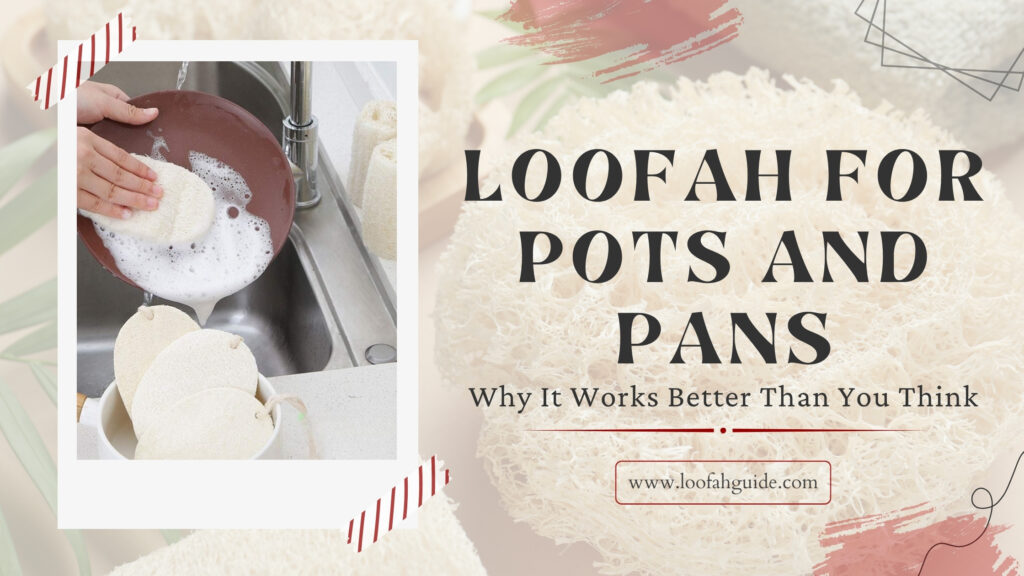
Most kitchen sponges are thrown away within two weeks. In that time, studies have shown that a used kitchen sponge can harbor more bacteria per square centimeter than a toilet seat, largely because foam cells trap food particles and moisture in a closed environment where bacteria thrive. It is not a pleasant thought for something that touches your cookware daily.
The natural kitchen loofah addresses this problem at a structural level. Its open, three-dimensional fiber network allows water and debris to pass through rather than accumulate, and the rapid moisture loss after use creates conditions that are far less hospitable to bacterial growth than any dense foam sponge.
Using a loofah for pots and pans is both a practical and environmental upgrade from the standard kitchen sponge. This guide covers the full story: why the fiber structure works, which cookware types it suits best, how to use it correctly, how to maintain it properly, and where to source a kitchen loofah that is actually worth using.
The quality gap between a genuine Egyptian kitchen loofah and a low-grade alternative is significant enough to make or break the experience. Throughout this guide, references to sourcing and quality will point to Egexo, the leading Egyptian luffa supplier with over 25 years of cultivation and export experience, as the benchmark for what a kitchen loofah should deliver.
Consumers and buyers looking for practical wholesale information can also visit wholesaleloofah.com for additional sourcing resources.
The Real Reason Kitchen Loofah Outperforms Sponges
Understanding why a kitchen loofah cleans better requires a brief look at what each tool is actually doing at a microscopic level.
A conventional sponge cleans primarily through absorption. Soapy water saturates the foam cells and is transferred to the cookware surface through contact pressure. Food particles then enter those same foam cells during rinsing and frequently remain trapped there, creating the bacterial conditions described above.
A natural loofah cleans through mechanical friction and hydraulic flushing. The fiber network creates physical abrasion against the cookware surface, dislodging food particles, while the open mesh allows water and loosened debris to flow continuously through and out of the scrubber rather than becoming trapped. The result is a cleaner tool after every use, not a progressively more contaminated one.
Bacterial Growth Comparison Between Kitchen Cleaning Tools
| Tool | Bacterial Risk Level | Primary Reason | Drying Time | Safe Reuse Period |
|---|---|---|---|---|
| Conventional Foam Sponge | Very High | Closed cells trap food and moisture | 4-6 hours | 7-10 days before replacement |
| Natural Kitchen Loofah | Low-Moderate | Open mesh dries rapidly, self-flushing | 1-2 hours | 4-6 weeks with proper care |
| Silicone Scrubber | Low | Non-porous, easy to rinse | Under 30 minutes | Months |
| Steel Wool Pad | Moderate | Rust and food trapped in metal fibers | 2-4 hours | 2-4 uses |
| Nylon Scrub Pad | Moderate-High | Dense fiber retains particles | 2-4 hours | 2-3 weeks |
| Dish Brush | Low-Moderate | Bristles dry faster than foam | 1-3 hours | 1-2 months |
The loofah occupies a uniquely valuable position in this comparison. Unlike silicone scrubbers, it provides genuine mechanical abrasiveness for baked-on food. Unlike steel wool, it is safe for a wide range of cookware surfaces. And unlike conventional sponges, its open structure makes it manageable from a hygiene standpoint.
For consumers wanting to explore specific kitchen loofah products, Egexo’s kitchen loofah range includes multiple grades and sizes for different household needs.
Which Cookware Is Loofah for Pots and Pans Best Suited For
One of the biggest practical questions for new kitchen loofah users is compatibility. The concern is usually whether the loofah is too rough or not rough enough for a specific type of cookware. The answer is more nuanced than a simple yes or no, and understanding it will save you from either disappointing results or unnecessary caution.
Cookware Compatibility Guide
| Cookware Type | Loofah Compatibility | Technique | Notes |
|---|---|---|---|
| Stainless Steel Pots and Pans | Excellent | Standard circular scrubbing | Safe even for baked-on residue |
| Cast Iron Skillets | Excellent | Minimal soap, circular motion | Preserves seasoning better than steel wool |
| Ceramic Coated Cookware | Good | Moderate pressure | Removes staining without scratching glaze |
| Enamel Dutch Ovens | Good | Moderate pressure | Effective on interior staining |
| Glass Bakeware | Good | Light to moderate pressure | No scratch risk |
| Non-Stick (new coating) | Moderate | Soaked loofah, very light pressure | Safe with caution |
| Non-Stick (worn coating) | Use with caution | Fully soaked, minimal pressure | Inspect coating condition first |
| Copper Cookware | Good | Light pressure with appropriate cleaner | Avoid abrasive compounds |
| Carbon Steel Pans | Excellent | Same approach as cast iron | Rinse quickly, dry immediately to prevent rust |
The kitchen loofah is particularly impressive on stainless steel and cast iron, which are the two most demanding cookware materials from a cleaning standpoint. For cast iron specifically, it is one of the few tools that can clean effectively without aggressively stripping the seasoning layer, especially when used with minimal soap or with coarse salt as the abrasive medium instead.
How to Use a Loofah for Pots and Pans: The Right Technique
Getting results from a kitchen loofah comes down to a handful of technique adjustments that most users skip because they assume the loofah works like a sponge. It does not, and that difference is why some people love it immediately and others give up after the first wash.
The Correct Kitchen Loofah Technique
Preparation is everything. Before the loofah touches a single pan, soak it in warm water for 30 to 60 seconds and squeeze it repeatedly. A dry loofah is significantly more abrasive than a saturated one, and using it dry risks scratching surfaces you intended to protect. After soaking, the fibers become flexible and create a much larger effective contact area against the cookware surface.
Match your soap application to the soil level. For lightly soiled pans, apply dish soap directly to the loofah before scrubbing. For heavily soiled or baked-on food, apply a small amount of soap to the pan surface and add a few drops of warm water, then let it sit for 3 to 5 minutes before introducing the loofah. This pre-soak loosens the residue and dramatically reduces the scrubbing force required.
Use circular motions, not straight back-and-forth. The loofah’s fiber network creates more even abrasion in circular or oval patterns. Back-and-forth motion creates directional pressure that can produce uneven cleaning and occasionally micro-scratching on smoother surfaces.
Adjust pressure by feel, not force. The loofah provides good tactile feedback. If you feel resistance decreasing, the food is loosening and you can maintain or reduce pressure. If it persists, soak the pan a few minutes longer rather than increasing scrubbing force.
Post-Wash Loofah Care Steps
| Step | Action | Time | Critical Reason |
|---|---|---|---|
| 1 | Rinse under warm running water | 20-30 seconds | Removes all food debris from fiber network |
| 2 | Squeeze and release repeatedly | 30 seconds | Expels water and debris from inner fibers |
| 3 | Shake off excess water | 5 seconds | Accelerates drying |
| 4 | Place in ventilated hanging position | Immediately | Prevents bacterial growth from moisture retention |
| 5 | Confirm complete dryness before next use | Before next use | A partially dry loofah can transfer bacteria |
Kitchen Loofah Care: Making It Last and Keeping It Hygienic
The difference between a kitchen loofah experience that impresses and one that disappoints is almost always maintenance. The loofah itself is not difficult to care for, but it requires different habits than a sponge.
Weekly Deep Cleaning Methods
Boiling method: Place the loofah in a small pot of water and bring to a full boil. Boil for 5 minutes, then remove and allow to cool completely before squeezing dry. This method kills virtually all bacteria and mold spores present in the fiber. It is the most thorough sanitization method available without chemicals.
Microwave method: Rinse the loofah thoroughly, then place it damp on a microwave-safe plate. Microwave on high for 90 seconds. The internal steam temperature kills bacteria equivalent to the boiling method. Allow to cool before handling as the fiber retains heat. Do not microwave a dry loofah.
Vinegar soak method: Prepare a solution of one part white vinegar to four parts water. Submerge the loofah for 10 minutes, then rinse thoroughly and hang to dry. This method is effective for controlling mold and surface bacteria between the deeper weekly treatments.
Kitchen Loofah Replacement Schedule
| Condition | Action | Reason |
|---|---|---|
| Color change to gray or dark brown | Replace immediately | Indicates mold or deep bacterial contamination |
| Persistent sour odor after cleaning | Replace immediately | Bacteria embedded beyond cleaning reach |
| Fiber breakdown or excessive shedding | Replace | Degraded fiber loses cleaning effectiveness |
| 4-6 weeks from first use | Replace regardless of appearance | Fiber degradation is not always visible |
Understanding when to replace is as important as knowing how to clean. A loofah that looks acceptable but has exceeded its useful lifespan is a hygiene risk that most consumers underestimate.
For consumers who prefer to always have a fresh loofah available, keeping two kitchen loofahs in rotation (alternating to ensure complete drying for each) extends their individual lifespan and maintains consistent hygiene. Visit Egexo’s shop to explore kitchen loofah options.
Why Egyptian Kitchen Loofah Is the Best Choice
Not all kitchen loofahs perform the same way, and the origin and processing of the luffa fiber are the primary determinants of product quality. This is where the Egyptian advantage becomes clearly measurable.
Egyptian vs Non-Egyptian Kitchen Loofah
| Quality Factor | Egyptian Nile Delta Loofah | Southeast Asian Loofah | Latin American Loofah |
|---|---|---|---|
| Fiber Density (per cm2) | 120-150 | 70-100 | 80-110 |
| Structural Uniformity | High | Low-Moderate | Moderate |
| Fiber Resilience | High | Lower | Moderate |
| Growing Season | 9-10 months | 6-7 months | 7-8 months |
| Lifespan in Use | 4-6 weeks | 2-3 weeks | 3-4 weeks |
| Consistent Grade Availability | Yes | Limited | Limited |
| Premium Grade Availability | Readily available | Rare | Rare |
The longer Egyptian growing season produces thicker, more resilient fiber walls in each individual strand of the luffa network. This is why an Egyptian kitchen loofah lasts noticeably longer and maintains its shape under daily kitchen use where lower-grade alternatives begin to break down and shed fiber within the first two weeks.
Egexo grows Luffa aegyptiaca directly on Nile Delta farms, controlling quality from the field through processing and export. Their farm-to-export process documents exactly how this quality is maintained across every production batch. Businesses can learn more about sourcing standards through Why Choose Egexo.
The Sustainability Story: Why Kitchen Loofah Matters Beyond Cleaning
Switching to a natural kitchen loofah is not just a practical upgrade. For households and businesses that care about environmental impact, it addresses one of the most overlooked sources of household plastic waste.
A standard kitchen sponge contains polyurethane foam, nylon abrasive fibers, and synthetic dyes. It sheds microplastics during every use, contributes those microplastics to wastewater systems, and then sits in a landfill for 200-plus years after disposal. A household replacing two sponges per month generates 24 synthetic scrubbers annually.
A natural Egyptian kitchen loofah is made entirely from plant fiber. It sheds no microplastics, biodegrades fully in 30 to 60 days, and can be composted at end of life. For eco-conscious consumers, the sustainability case is as straightforward as the performance case.
For retailers and distributors building eco-product lines, this sustainability narrative is increasingly what drives purchasing decisions in health, wellness, and natural products channels. Egexo’s private label loofah manufacturing service allows brands to develop fully branded kitchen loofah products that lead with this environmental story.
Buying Guide: What to Look for in a Kitchen Loofah
Whether purchasing for personal use or evaluating for retail stocking, these criteria separate a kitchen loofah worth buying from one that will disappoint.
Consumer Purchase Checklist
| Criterion | What to Look For | What to Avoid |
|---|---|---|
| Color | Pale ivory to light yellow | Gray, dark brown, any visible mold spots |
| Smell when dry | Neutral or faint natural scent | Chemical smell, musty odor |
| Texture when dry | Firm but slightly flexible | Brittle, powdery, or collapsing |
| Texture when wet | Pliable, even flex across surface | Hot spots, uneven rigidity |
| Fiber shedding | Minimal on first use | Heavy shedding immediately |
| Dimensions | Consistent, matches description | Irregular, significantly smaller than stated |
| Packaging | Dry, secure, describes origin | No origin information, wet on arrival |
For wholesale buyers evaluating Egyptian kitchen loofah at a commercial scale, additional criteria apply, including fiber density testing, moisture content at delivery, and certification documentation. Egexo’s quality standards page details the technical specifications that verified export-grade Egyptian kitchen loofah meets.
Buyers can also download the Egexo product catalog for a complete overview of available kitchen loofah grades, sizes, and MOQs, or request a wholesale quotation directly.
Expert Insight from Egexo
One question we receive frequently from retailers considering kitchen loofah for the first time is whether consumers will actually adopt the different usage habits the product requires. The answer, based on our distribution experience across more than 40 countries, is consistently yes, provided the product quality justifies the learning curve.
When a consumer receives a Premium Grade Egyptian kitchen loofah that performs exactly as described, they quickly adapt to soaking it before use and hanging it to dry afterward. These habits become automatic within the first week. What breaks the adoption process is receiving a low-grade product that sheds fiber immediately, develops odor within days, or fails to clean as effectively as the standard sponge it was supposed to replace.
The quality of the initial experience determines whether the consumer switches permanently or reverts to plastic sponges. This is why sourcing matters as much as product category selection. Review Egexo’s raw loofah scrubbers and kitchen-specific options, and consider beginning with sample orders to verify quality before committing to retail volumes.
FAQ Section
Q1: Can I use a loofah to clean all types of pots and pans? A: A natural kitchen loofah is compatible with most cookware including stainless steel, cast iron, ceramic, enamel, glass bakeware, and carbon steel. For non-stick pans, use a fully soaked loofah with minimal pressure and check the coating condition first. The loofah is not appropriate for polished copper surfaces that require specialty cleaners. In all cases, soaking the loofah for 60 seconds before use significantly reduces the risk of surface friction damage.
Q2: How is using a loofah for pots and pans different from using it for bathing? A: The basic fiber structure is the same, but kitchen loofah products are typically produced from denser sections of the luffa gourd for added rigidity, cut into shapes suited for cookware contact, and selected to withstand the more aggressive food residue encountered in cooking. Bath loofahs are generally softer and may not provide sufficient abrasiveness for baked-on food. Never use a bath loofah in the kitchen or vice versa, as cross-contamination of skin bacteria with food preparation surfaces is a hygiene concern.
Q3: Does a kitchen loofah smell when wet during use? A: A clean, well-maintained kitchen loofah should have no significant odor during use. A faint natural scent when newly wet is normal and harmless. Any sour, fishy, or musty odor during use indicates bacterial contamination from insufficient rinsing or drying after previous uses. At that point, the loofah should be deep-cleaned immediately (5-minute boil or 90-second microwave while damp) or replaced if the odor persists after deep cleaning.
Q4: What size kitchen loofah works best for cleaning large pots? A: For large stockpots or woks, a kitchen loofah of at least 12 by 12 centimeters provides sufficient surface coverage per stroke to make cleaning practical. Smaller squares of 8 to 10 centimeters work better for saucepans, skillets, and baking dishes. Some users prefer a cylindrical loofah shape for reaching inside tall pots. Custom sizes and shapes are available through Egexo’s custom loofah product design service for retailers and food service buyers who need specific configurations.
Q5: How do I remove burnt food from a pan using a kitchen loofah without scratching it? A: Fill the pan with warm water and a small amount of dish soap. Allow it to soak for 10 to 15 minutes to loosen the burnt residue. Soak the loofah for 60 seconds. Apply focused circular pressure to the burnt area, working from the edges inward. For very stubborn carbonized residue on stainless steel, a small amount of baking soda applied to the soaked loofah adds gentle abrasive power without scratch risk. Repeat the soak cycle if needed rather than increasing pressure. Patience eliminates the need for force.
Q6: Is kitchen loofah appropriate for eco-certifications or green product labeling? A: Yes. Natural kitchen loofah sourced from a verified Egyptian luffa farm meets the material requirements for most natural and organic product certifications. It is free from synthetic additives, petroleum-derived components, and bleaching agents in a properly processed product. For retailers pursuing eco-certifications for their product line, Egexo can provide origin documentation, material specifications, and processing information to support certification applications. The farm-to-export process documentation provides the supply chain traceability that most certification bodies require.
Q7: How many kitchen loofahs does a typical household need per month? A: A single-person household using one kitchen loofah daily will typically replace it every 4 to 6 weeks, so approximately one loofah per month. A household with heavy cooking activity, particularly involving frequent use of cast iron or high-heat cooking that creates baked-on residue, may go through one loofah every 3 to 4 weeks. Families with 3 or more people cooking regularly may prefer to maintain 2 loofahs in rotation to ensure complete drying between uses. This gives retailers a useful baseline for retail pack sizing recommendations.
Conclusion
The loofah for pots and pans argument is not complicated once the evidence is laid out. Natural kitchen loofah cleans more hygienically than foam sponges, handles a broader range of cookware than steel wool, and generates zero plastic waste over its entire lifecycle. The only requirement is sourcing it from a supplier whose quality standards actually match those claims.
Egyptian kitchen loofah from Egexo represents the global benchmark for that quality. With fiber densities of 120 to 150 per square centimeter, moisture-controlled processing, and a direct-farm supply chain, it delivers results that consumers remember and return for.
For household use, the switch from plastic sponges to natural kitchen loofah is one of the most impactful and least complicated sustainability changes available in the kitchen.
Key Takeaways:
- Natural kitchen loofah outperforms conventional sponges in hygiene due to its open, self-flushing fiber structure
- Egyptian luffa from the Nile Delta produces denser, more durable fiber than alternatives from Southeast Asia or Latin America
- Correct technique requires soaking the loofah before use and hanging it to dry completely after every wash
- Weekly deep cleaning via boiling or microwaving significantly extends lifespan and maintains hygiene
- Kitchen loofah generates no microplastic waste and biodegrades fully within 30 to 60 days
Ready to experience Egyptian loofah quality?
- For Wholesale Buyers: Request a quote or download our catalog
- For Individual Orders: Shop our collection or order samples