There is a reason so many people try a natural loofah once and set it aside. Without the right preparation, a natural loofah straight from the packaging has the texture of a dried kitchen scrubber, which is not exactly what anyone imagines when they picture a luxurious spa exfoliation routine.
The good news is that the fix takes less than 10 minutes, and once you know how to prep a loofah before first use for maximum softness, your experience with natural loofahs changes completely. What feels like a stiff, rough cylinder becomes a soft, flexible, and impressively effective skincare tool that rivals anything available in a high-end spa.
This guide explains exactly why that transformation happens, what it tells you about the quality of the loofah you purchased, and how to maintain that softness through weeks of regular use. We also cover what spa operators, wellness retailers, and wholesale buyers need to understand about preparation as a quality signal, because the same soak test that shows a consumer whether their loofah is ready to use also tells a professional buyer whether the loofah they just received from a supplier meets the standard they paid for.
For those building a retail line or spa product inventory, the Egexo bath loofah collection is worth exploring before we dive in. Egexo is Egypt’s leading loofah wholesale supplier with over 25 years of farm-to-export experience, and their products are the benchmark for what a properly prepared loofah should feel like.
The Science Behind Loofah Softness
Before the preparation steps, it helps to understand what you are actually working with when you hold a natural loofah.
What a Loofah Actually Is
A natural loofah is not a sea creature or a synthetic foam. It is the fibrous skeletal structure of the Luffa plant, a tropical and subtropical vine in the cucumber family. When the fruit of the Luffa aegyptiaca plant is fully mature, it is harvested and dried. What remains after drying is a dense, interlocking mesh of cellulose fibers, which is the same material that gives plant cell walls their structure.
That fibrous matrix is exactly what makes a loofah effective as an exfoliating tool. The irregular fiber network catches dead skin cells and lifts them away while stimulating blood circulation in the process. Studies on mechanical exfoliation have shown that natural fiber tools produce more consistent skin surface renewal compared to smooth synthetic alternatives, which is why natural loofahs remain a preferred tool in professional skincare.
Why the Fibers Start Firm
The drying process that makes a loofah shelf-stable also compresses and stiffens those fibers. Think of it the way dried pasta becomes soft when cooked. The structure is the same material, but the state of hydration changes the physical experience entirely. Rehydrating a loofah correctly allows the cellulose fibers to absorb water, expand, and return to a state closer to their living plant form.
The key insight is that a loofah’s capacity to soften after preparation is a direct indicator of fiber density and quality. Loofahs with dense, uniform fiber networks absorb water more evenly and reach a softer, more consistent texture. Loofahs with sparse or uneven fibers soften unevenly and tend to develop rough patches even after soaking.
This is why the origin and cultivation method of a loofah matters so much. Egyptian loofahs, grown in the mineral-rich soil of the Nile Delta, consistently produce the denser fiber structure that softens most effectively. You can learn more about the specific agricultural conditions that produce this quality on the Egexo farm-to-export process page.
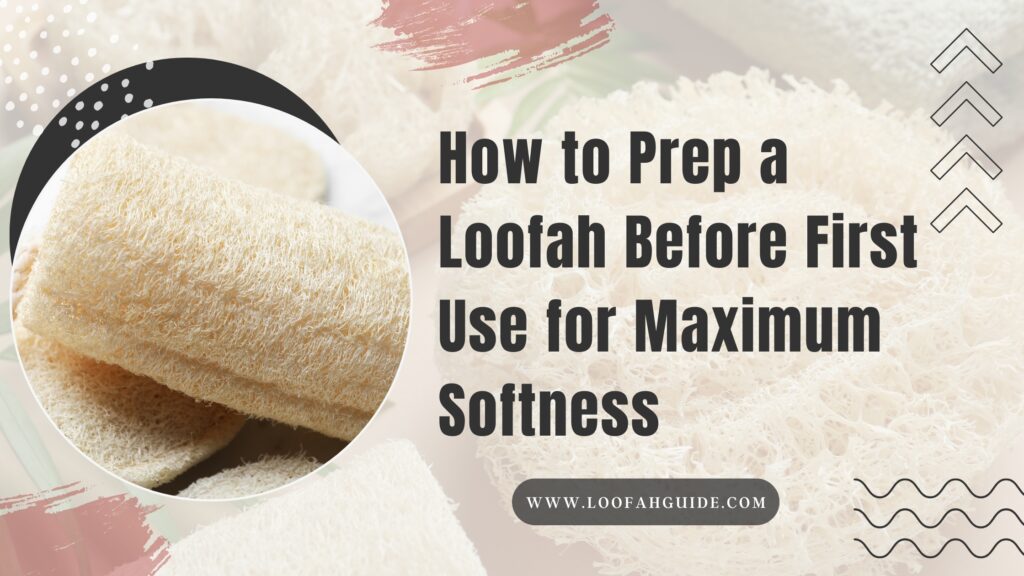
How to Prep a Loofah Before First Use for Maximum Softness
This is the complete method, tested and refined through decades of loofah production and customer feedback.
The Five-Step Preparation Method
Step 1 — Hold under warm running water for 60 to 90 seconds
Warm water, ideally between 38 and 42 degrees Celsius, starts the rehydration process without stressing the fibers. Rotate the loofah so all surfaces get equal exposure. For whole cylindrical loofahs, pay special attention to the ends, which tend to be denser.
Step 2 — Submerge in a bowl of warm water for 5 to 10 minutes
Full submersion is the key step. This is not a quick rinse. Place the loofah in enough warm water to keep it fully submerged and leave it undisturbed for at least 5 minutes. Ten minutes produces the softest results. You will see the loofah visibly expand and relax as the fibers absorb water.
Step 3 — Knead the loofah gently for 1 to 2 minutes
After soaking, remove the loofah and work your fingers through it, squeezing gently and releasing repeatedly. This manual step breaks up any remaining areas of fiber stiffness that the water did not reach uniformly. It is particularly important for thick or whole loofahs.
Step 4 — Test softness on your inner wrist
Gently draw the loofah across the skin on the inside of your wrist. A prepared loofah should feel smooth with a gentle, even drag. If it feels scratchy or rough, return it to the soak for another 5 minutes.
Step 5 — Use with your preferred cleanser
Apply body wash or soap to the prepared loofah and use it with light circular motions. The hydrated fibers will produce a rich lather and exfoliate evenly.
Visual Summary: Preparation Method
| Step | What to Do | Time Needed | What to Look For |
|---|---|---|---|
| Warm rinse | Run under warm tap water, rotating | 60 to 90 seconds | Outer fibers begin to soften |
| Full soak | Submerge in bowl of warm water | 5 to 10 minutes | Visible expansion and relaxation |
| Knead | Squeeze and work fingers through fibers | 1 to 2 minutes | Even softness throughout |
| Texture test | Gentle stroke on inner wrist | 30 seconds | Smooth drag, no scratching |
| Use | Apply cleanser, use with circular motion | As desired | Even lather, no rough patches |
How to Choose a Loofah That Prepares Well
Preparation technique matters, but it cannot create softness that was never there. Loofah quality before preparation determines the ceiling of softness after preparation.
What to Look For When Buying
Whether you are shopping as an individual consumer or evaluating suppliers as a wholesale buyer, the following characteristics indicate a loofah with strong preparation potential.
| Quality Indicator | What It Means | How to Verify |
|---|---|---|
| Dense, uniform fiber color | Consistent cultivation and processing | Visual inspection before purchase |
| No crumbling edges | Fibers are intact and properly dried | Gentle touch test |
| Mild, grassy natural scent | Proper processing, no chemical treatment | Smell test |
| Visible fiber uniformity | Consistent softness after preparation | Cross-section view |
| Certificate of origin | Agricultural traceability | Ask supplier or check packaging |
| Grade A classification | Premium fiber density confirmed | Request specifications from supplier |
The Egyptian Standard
Among global loofah-producing countries, Egypt has consistently maintained the highest standards in fiber quality, which is reflected in the international preference for Egyptian loofahs among luxury spa brands, wellness retailers, and export buyers across Europe and North America.
Egexo represents the Egyptian loofah standard at its best, combining 25+ years of agricultural expertise with direct farm management and rigorous quality control. Reviewing the Egexo quality standards page gives a clear picture of the specifications that differentiate Egyptian Grade A loofahs from lower-grade alternatives.
For wholesale buyers ready to test that quality firsthand, ordering loofah samples is the fastest way to conduct an in-person preparation and softness evaluation before committing to bulk quantities.
Natural Loofah Versus Alternatives: An Honest Comparison
Many people shopping for a body scrubber face a genuine choice between natural loofahs and synthetic options. This comparison covers the preparation angle specifically.
Preparation and Softness Comparison
| Feature | Natural Loofah | Synthetic Bath Puff | Silicone Scrubber | Sea Sponge |
|---|---|---|---|---|
| Requires preparation | Yes, 5 to 10 minutes | No | No | Mild rinse only |
| Softness after prep | Significantly increased | Fixed, medium | Fixed, soft | Naturally soft |
| Exfoliation strength | Adjustable, medium to firm | Low to medium | Low | Very low |
| Skin suitability | Normal to oily skin | Sensitive and normal | All types | Sensitive |
| Biodegradable | Yes | No | No | Yes |
| Lifespan | 3 to 6 weeks | 4 to 8 weeks | 1 to 2 years | 3 to 6 months |
| Bacterial risk | Moderate without proper drying | High | Low | Moderate |
| Consumer eco-rating | Excellent | Poor | Moderate | Good |
The preparation requirement of a natural loofah is often misread as an inconvenience. In reality, it is the characteristic that makes natural loofahs uniquely effective. The same fiber density that requires preparation is the fiber density responsible for effective exfoliation, rich lather production, and the physical stimulation of circulation during use.
Caring for Your Loofah After Preparation
The first preparation is the most impactful step, but consistent care extends the loofah’s softness and safe use period significantly.
Daily Care Routine
After each use, rinse the loofah thoroughly under running water until no soap residue remains. Squeeze out excess water without twisting, then hang the loofah in open air outside the shower enclosure. A small hook or mesh bag works well. Never leave a wet loofah resting on a wet surface.
Weekly Maintenance
Once per week, prepare a solution of one part distilled white vinegar to four parts warm water. Soak the loofah in this solution for 5 minutes, then rinse completely and allow to dry in fresh air. This treatment neutralizes bacteria, removes mineral deposits from water, and refreshes the fiber flexibility.
Monthly Deep Evaluation
Once per month, hold the loofah up to a light source and inspect the fiber network. If you notice significant fiber breakdown, persistent odor even after vinegar treatment, or areas where the structure has collapsed, the loofah has reached the end of its useful life. Replace it.
Lifespan Guide by Use Pattern
| Use Frequency | Expected Life with Proper Care | Key Maintenance Priority |
|---|---|---|
| Daily | 3 to 4 weeks | Air drying is critical every day |
| 4 to 5 times per week | 4 to 5 weeks | Weekly vinegar soak essential |
| 2 to 3 times per week | 5 to 7 weeks | Monthly inspection for fiber breakdown |
| Occasional | Up to 8 weeks | Watch for odor as primary signal |
For Retailers and Spa Professionals: Preparation as a Business Advantage
If you sell natural loofahs or use them in a professional spa setting, how you communicate preparation to your customers or clients directly impacts their experience and your reputation.
Customer Education Drives Retention
Data from wellness retail consistently shows that products requiring any form of customer action before use have significantly higher return rates when that action is not communicated clearly. For natural loofahs, a simple preparation card included in packaging reduces confusion and dramatically improves first-use satisfaction.
Egexo’s private label loofah manufacturing service offers wholesale buyers the ability to customize packaging with preparation instructions, branded design, and care guides. This positions your loofah product as a premium offering rather than a commodity.
Supplier Selection Checklist
Before choosing a loofah supplier, evaluate the following:
| Evaluation Criterion | What to Look For | Why It Matters |
|---|---|---|
| Farm origin transparency | Direct farm sourcing or certified supply chain | Ensures fiber quality control |
| Sample availability | Supplier provides samples before bulk order | Allows preparation soak test |
| Quality grade documentation | Written specs for each grade offered | Prevents grade inconsistency in bulk |
| Export certifications | Phytosanitary, quality, and origin certs | Required for import compliance |
| MOQ flexibility | Lower MOQs available for new buyers | Reduces financial risk for first orders |
| Custom packaging | Available and responsive to brand needs | Enables premium retail positioning |
| Response time | Quote and inquiry response within 48 hours | Indicates reliable partnership potential |
For more guidance on evaluating suppliers and making informed wholesale decisions, the Egexo Why Choose Us page and the wholesale loofah resource hub at wholesaleloofah.com are both valuable references.
Expert Insight from Egexo
With more than 25 years of loofah cultivation and export experience, Egexo has observed a consistent pattern across international markets. The buyers who achieve the highest repeat order rates are not always those who sell the most expensive loofahs. They are the ones who educate their customers most effectively about preparation and care.
A natural loofah is not a finished product in the way a bar of soap is. It is a botanical material that performs at its best when the user understands how to engage with it. The 10-minute preparation soak is not a limitation of the product. It is the activation step that unlocks the full performance of a fibrous structure cultivated over weeks in Egyptian agricultural conditions that have been optimized for loofah quality for generations.
Egexo provides all wholesale clients with preparation guides, care instructions, and optional branded packaging to support this education. Browse the complete range at the Egexo shop, or explore custom product design options if you have a specific retail concept in mind.
FAQ Section
Q1: What is the fastest way to prep a loofah before first use for maximum softness?
A: The fastest effective method is a 5-minute warm water soak combined with active kneading during the last 2 minutes. This compresses the preparation timeline while still achieving meaningful fiber softening. However, the most thorough result comes from a full 10-minute soak without rushing. The kneading step during soaking accelerates water penetration into the center fibers, which is where most of the residual stiffness remains.
Q2: Is it safe to microwave a loofah to soften it quickly?
A: Microwaving a wet loofah is sometimes suggested as a sterilization method, but it is not effective for preparation and carries risks. Uneven heating can damage fiber integrity and create hot spots that cause burns. The correct approach for softening is a warm water soak, which is both safe and effective. Microwaving may be used briefly as a supplementary hygiene measure but should never replace the water soak preparation method.
Q3: How do I know if a loofah has been bleached or chemically treated?
A: Chemically treated loofahs often have an unusually bright white or uniform appearance, a faint chemical odor, or an unnaturally soft texture even when dry. Natural, untreated loofahs have a muted tan or beige color with a mild grassy scent and firm dry texture. When sourcing loofahs wholesale, request documentation of processing methods from your supplier. Egexo provides full transparency on its processing standards through the quality standards page.
Q4: Can children use a prepared natural loofah?
A: Prepared natural loofahs can be used for children, but with considerations. Children have more sensitive skin, and even a well-prepared loofah may be too stimulating for very young children or those with eczema or dermatitis. A fully soaked loofah piece used with very gentle pressure is the safest approach. Always test on a small skin area first and monitor for any redness or irritation.
Q5: How many loofahs should a spa buy per month for treatment rooms?
A: This depends on your treatment volume and single-use policy. A spa offering loofah-based body treatments at 10 sessions per day using single-use loofahs would require approximately 300 loofahs per month per treatment room. Egexo offers flexible wholesale volumes through the quotation page and can advise on appropriate monthly volumes based on your treatment type and client count.
Q6: Does soaking in cold water work as well as warm water?
A: Cold water will eventually rehydrate loofah fibers, but it takes significantly longer and produces less complete softening. Cold water does not penetrate the compressed fiber matrix as efficiently as warm water. For time-efficient preparation with maximum softness results, always use warm water in the 38 to 42 degree Celsius range.
Conclusion
Knowing how to prep a loofah before first use for maximum softness is the one piece of information that determines whether natural loofahs become a lasting part of your skincare routine or a single disappointing experiment. The process is not complicated. A 10-minute warm water soak, a few minutes of gentle kneading, and a quick wrist test are all that stand between a stiff dry loofah and one of the most effective natural exfoliation tools available.
For individual users, this knowledge turns a simple purchase into a spa-quality skincare ritual. For wholesale buyers and spa operators, it becomes a consumer education strategy that improves customer satisfaction, reduces returns, and builds the kind of product loyalty that drives repeat business.
Egyptian loofahs, cultivated with the care and agricultural expertise that Egexo brings to every harvest, represent the highest preparation potential in natural loofah supply. The quality grown into the fiber is what preparation unlocks.
Key Takeaways:
- A 10-minute warm water soak is the single most important preparation step
- Firm dry texture signals authentic fiber density, not poor quality
- Egyptian Grade A loofahs achieve the greatest softness after preparation
- Maintenance after first use is as important as preparation before it
- Wholesale buyers can use the soak test as a reliable quality benchmark
Ready to experience Egyptian loofah quality?
- For Wholesale Buyers: Request a bulk quote or download the product catalog
- For Individual Shoppers: Shop the Egexo collection or order samples