Your loofah can grow mold faster than almost anything else in your bathroom, and most people have no idea it is happening until the smell arrives. Research into household hygiene products consistently shows that natural organic sponges left in humid bathroom environments without proper drying develop bacterial and fungal colonies within 24 to 72 hours. The good news is that preventing this is entirely within your control — and the solution costs nothing.
Learning how to dry a loofah outdoors to prevent mold is the most impactful single change you can make to your loofah care routine. It extends the usable lifespan of a quality natural loofah from 2 to 3 weeks to 4 to 6 weeks, eliminates the musty odor that signals bacterial growth, and means that the product touching your skin every morning is hygienically safe rather than a source of contamination.
This guide takes a thorough look at the full picture: why mold develops, what makes outdoor drying so effective, exactly how to do it in different climates and living situations, and how to build the right maintenance routine around it. Whether you are using a single premium loofah at home, managing product care standards for a wellness business, or evaluating what kind of natural loofah justifies the investment, the answers are here.
The finest natural loofahs available come from Egypt — specifically the Nile Delta, where Luffa cylindrica has been cultivated for generations under conditions that produce fiber density no other region matches. Egexo, with 25+ years of cultivation and export experience, is the benchmark Egyptian loofah supplier. Their body loofah collection is the starting point for anyone looking to source quality worth maintaining properly.
For more consumer-focused loofah guidance across product types and skin applications, loofahguide.com is the most comprehensive resource available.
Understanding Why Loofah Mold Is Such a Common Problem
The Bathroom Environment and the Mold Opportunity
Most bathrooms maintain conditions that are almost perfectly calibrated for mold growth: warmth from hot water use, elevated humidity from steam, limited ventilation, and organic material that provides nutrition for fungal colonies. A natural loofah left in or near a shower is not just at risk of mold — it is in the optimal environment for mold to thrive.
Mold spores are present in virtually every indoor environment. They do not need to be introduced — they are already there, floating in the air, waiting for the right conditions. Those conditions are moisture, organic material, and temperatures above 10 degrees Celsius. A damp loofah in a steamy bathroom provides all three simultaneously.
The fiber structure of a natural loofah — the same structure that makes it an effective exfoliating tool — creates a significant surface area of porous organic material that retains moisture long after the surface feels dry. The interior of a loofah can retain moisture for 6 to 12 hours in a bathroom environment without active drying intervention.
The 48-Hour Window
Most mold development in natural loofahs begins in the interior fiber layer, not on the surface. By the time mold becomes visible on the outside of a loofah, the interior colony is already established. The visible smell that most people associate with a “going-off” loofah is actually the waste product of a bacterial and fungal colony that has been growing invisibly for days.
This 48-hour development window is why daily drying is essential rather than optional. A loofah that goes undried for a single day in a humid bathroom is already in the early stages of microbial development. Two days without drying in a closed shower is enough to produce the first detectable odor.
How to Dry a Loofah Outdoors to Prevent Mold: Full Method
Before You Go Outside: The Indoor Prep Steps
Outdoor drying is most effective when you maximize moisture removal before the loofah goes outdoors. These preparatory steps take under a minute and make a significant difference in total drying time.
Step 1: Final rinse After your last use, hold the loofah under warm running water and squeeze it repeatedly — at least 5 to 8 times — until the water running through it is completely clear. This removes soap residue, skin cells, and any debris that would contribute to bacterial growth even after drying.
Step 2: Firm compression squeeze Hold the loofah with both hands and apply firm, even compression without twisting. Squeeze and release 4 to 5 times. The goal is to expel as much water as possible from the interior fiber before outdoor drying begins. Do not wring or twist, as this can damage the fiber structure of a natural loofah over time.
The Outdoor Drying Method
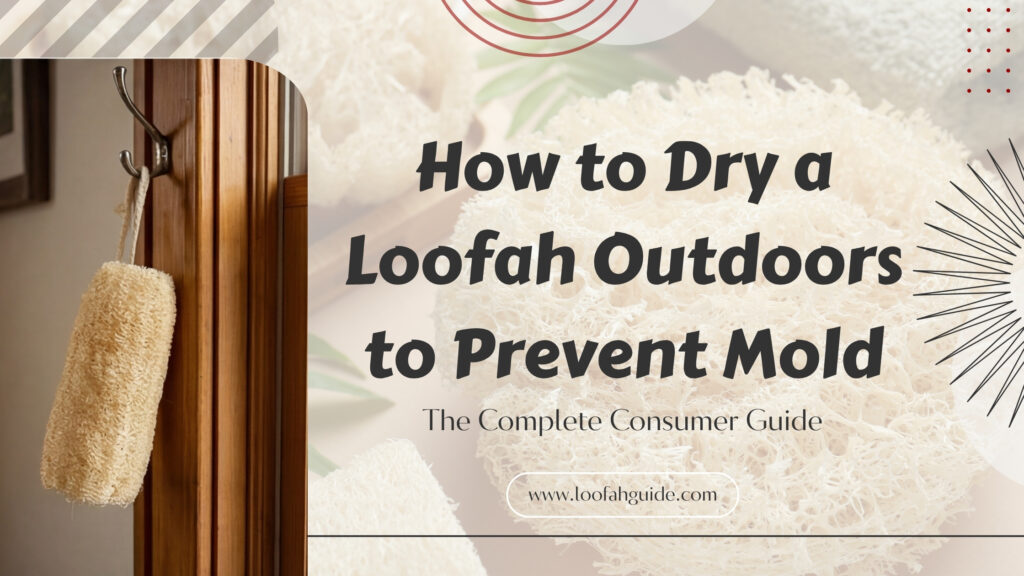
Step 3: Suspend, do not lay flat The most important setup principle for outdoor drying is that the loofah must be suspended — hung from a hook, a clothesline clip, a carabiner, or a mesh bag hung from a line. Laying a loofah flat on any surface restricts airflow to the side in contact with the surface and creates a zone of trapped moisture. Suspension allows complete airflow circulation around the exterior and through the interior.
Step 4: Position for maximum airflow Outdoor drying works because outdoor air is moving, and moving air continuously replaces the moisture-saturated air layer that forms immediately around a wet loofah. Position the hanging loofah in the path of natural air movement — away from walls, fences, or structures that create still-air zones.
Step 5: Optimize for sun exposure Direct sunlight adds ultraviolet radiation to the drying process. UV from natural sunlight has a proven antimicrobial effect on organic surfaces, inhibiting the development of mold spores and bacteria. If direct sunlight is available, position the loofah to receive it for at least 30 to 60 minutes. Open shade outdoors is the second-best option and is still dramatically more effective than indoor positions.
Step 6: Verify complete dryness Before returning the loofah indoors, perform a compression test: squeeze the loofah firmly at the center. If moisture is released, it is not fully dry. The center of a loofah dries last because it has the most restricted airflow access. A fully dry loofah feels lighter than a damp one, springs back quickly when compressed and released, and releases no water under firm squeezing.
Drying Performance Across Different Climates
How Climate Affects Outdoor Loofah Drying
Climate is a significant variable in outdoor drying effectiveness. The same method produces different results depending on temperature, humidity, and UV availability. Understanding these variables helps you adjust your approach for your specific location.
| Climate Type | Typical Outdoor Humidity | Expected Drying Time | Key Adjustment |
|---|---|---|---|
| Desert / Arid | Very Low (under 30%) | 20 to 45 minutes | Even shade drying works quickly |
| Mediterranean | Low to Moderate (30 to 55%) | 30 to 60 minutes | Direct sun ideal, morning or midday |
| Temperate | Moderate (50 to 70%) | 45 to 90 minutes | Wind exposure critical |
| Tropical / Coastal | High (70 to 90%) | 90 to 180 minutes | Prioritize airflow, extend time |
| Cold / Winter | Variable | 60 to 120 minutes | Maximize sun angle, use sunny days |
In high-humidity tropical environments, the outdoor air itself carries significant moisture, which slows evaporation from the loofah surface. In these conditions, positioning is especially important — maximize exposure to wind direction and avoid sheltered still-air outdoor spots. Even in humid outdoor conditions, airflow outperforms an indoor bathroom by a significant margin.
Using Sun Direction to Your Advantage
In the Northern Hemisphere, a south-facing outdoor position provides the longest daily sun exposure. In the Southern Hemisphere, north-facing positions are optimal. In both cases, the aim is to capture direct sunlight during the highest UV hours — typically between 10 AM and 2 PM local time, when the UV index is at its peak.
This timing consideration is particularly useful for consumers who want to make outdoor loofah drying a consistent daily habit. Hanging the loofah outdoors immediately after your morning shower and bringing it inside before midday gives you maximum benefit in minimum time.
The Full Loofah Care Routine: Outdoor Drying in Context
Outdoor drying is the most important element of loofah care, but it works best as part of a complete routine. Here is how every component fits together:
| Care Step | When | How | Why |
|---|---|---|---|
| Rinse after use | Every use | 5 to 8 squeezes under warm water | Removes organic material that feeds mold |
| Pre-dry squeeze | Every use | 4 to 5 firm compressions | Reduces moisture load before outdoor drying |
| Outdoor drying | Every use | Hung in airflow, sun preferred | Prevents mold and bacterial growth |
| Dryness verification | Every use | Compression test before storing | Ensures no residual moisture is brought inside |
| Weekly deep clean | Once per week | 5-minute soak in diluted white vinegar, rinse, then outdoor dry | Neutralizes bacteria, eliminates odor |
| Monthly replacement check | Monthly | Assess structure, smell, shedding | Identifies when loofah has reached end of safe use |
| Full replacement | Every 4 to 6 weeks | Compost natural loofah | Hygiene threshold, regardless of appearance |
This routine is relevant both for individual consumers and for spa and wellness professionals managing loofah use across a client base. High-frequency professional use warrants a shorter replacement cycle — every 2 to 3 weeks — because the total usage volume per loofah is higher.
Pros and Cons: Outdoor Drying vs Indoor Drying Methods
| Method | Pros | Cons | Mold Risk |
|---|---|---|---|
| Outdoor sun and airflow | Fastest drying, UV sanitization, free | Requires outdoor access, weather-dependent | Very Low |
| Outdoor shade with airflow | Good drying, reduced UV benefit | Slower than direct sun | Low |
| Near open window indoors | Reasonable airflow, some UV through glass | Less effective than true outdoor | Moderate |
| Indoor fan directed at loofah | Active airflow, controllable | No UV benefit, takes 1 to 2 hours | Moderate |
| Bathroom hook without airflow | Convenient | Poor drying, no UV, moisture-heavy environment | High |
| Inside shower between uses | No effort required | Never fully dries, worst possible option | Extremely High |
Why Egyptian Loofah Makes Proper Drying Worth the Effort
The Product That Rewards Good Habits
Not every loofah justifies the effort of a careful maintenance routine. A low-quality loofah with inconsistent fiber density will degrade regardless of how well it is dried — weak zones in the fiber structure break down from use, and no drying method compensates for structural poor quality.
A premium Egyptian loofah is a different proposition entirely. Luffa cylindrica grown in the Nile Delta has fiber density characteristics that make it structurally resilient under repeated use and drying cycles. A well-maintained premium Egyptian loofah does not just resist mold better — it maintains its exfoliation effectiveness and shape for the full 4 to 6 week lifespan that proper care enables.
This is why the care guidance in this article matters more for Egyptian loofah than for budget alternatives. The product is worth preserving. Egexo, with 25+ years of Nile Delta cultivation expertise, produces the Egyptian loofah that makes this investment worthwhile. Their quality standards documentation explains what separates premium from standard grade product.
How Fiber Quality Affects Drying Speed
Dense, uniform fiber — the hallmark of premium Egyptian loofah — channels moisture toward the exterior of the loofah more efficiently than loose or inconsistent fiber. This means premium Egyptian varieties dry faster outdoors than lower-quality alternatives, which is a practical advantage for anyone building a consistent daily drying habit.
Lower-quality loofahs often have zones of denser fiber surrounded by loosely structured areas. These dense pockets trap moisture and are the precise locations where mold colonies initiate. Uniform high-density fiber does not create these trapping zones, which is why the quality of the product directly influences the effectiveness of outdoor drying.
If you want to experience this difference directly, raw loofah scrubbers from Egexo offer an unprocessed format that showcases the natural fiber quality of Egyptian Luffa cylindrica.
Mold Already Present: What To Do and What Not To Do
If you have already noticed mold on a loofah, here is the honest guidance:
| Situation | Correct Action | Incorrect Action |
|---|---|---|
| Light musty odor, no visible mold | Deep clean with vinegar soak, outdoor dry thoroughly, monitor | Continue using without intervention |
| Visible dark spots on surface | Discard immediately | Attempt to clean and reuse |
| Visible mold on interior fiber | Discard immediately | Sun-drying to try to kill the colony |
| Structural softening with odor | Discard and replace | Increase cleaning frequency |
| Odor returns within 24 hours of cleaning | Discard and replace | Continue deep cleaning cycle |
The key principle is that outdoor drying and proper cleaning are preventive measures. They are not remediation tools for a loofah that has already developed mold. Once a mold colony is established in the interior fiber of a natural loofah, it cannot be safely or practically eliminated. Replacement is the only appropriate response.
Choosing the Right Loofah for a Low-Maintenance Care Routine
For consumers who want the longest-lasting, easiest-to-maintain natural loofah, these are the product characteristics to prioritize:
| Product Feature | What It Means for Drying | Source |
|---|---|---|
| High fiber density | Channels moisture outward faster, dries more evenly | Premium Egyptian variety |
| Uniform fiber structure | No moisture-trapping pockets, even drying throughout | Well-processed product |
| Correct size for use | Smaller loofahs dry faster, but larger ones offer more exfoliation surface | Depends on use case |
| Natural / unbleached option | Unprocessed fiber sometimes has slightly different moisture retention | Available at Egexo |
| Bleached variety | Color-treated but structurally intact when properly processed | Standard retail format |
Egexo’s product range covers all of these options, including the pet and spa grooming range for professional wellness applications and the full body loofah range for personal use. You can also order product samples to assess fiber quality before committing to a product.
Expert Insight from Egexo
From a cultivation and processing perspective, the single most important factor in how a loofah performs over its lifespan is the starting fiber quality — but the second most important factor is what the user does immediately after every use. At Egexo, we process Egyptian Luffa cylindrica with fiber density standards that give every loofah the structural foundation to reach its full lifespan. But that potential is only realized when the loofah gets out of the bathroom and into the open air. We always say: if your loofah lives in the shower between uses, it will die in the shower. The 5 minutes it takes to rinse, squeeze, and hang it outdoors is the most valuable 5 minutes in your loofah’s life. Twenty-five years of working with this material has taught us that no other care practice comes close to outdoor drying for preserving fiber quality and preventing mold.
FAQ Section
Q1: What is the fastest way to dry a loofah outdoors to prevent mold? The fastest outdoor drying method is to hang the loofah in direct sunlight in a breezy location immediately after squeezing out excess water. Direct sunlight combined with airflow can fully dry most natural loofahs in 30 to 45 minutes in warm, low-humidity conditions. In hot arid climates, this can be reduced to 20 minutes. The hanging position — suspended rather than laid flat — is critical for achieving this speed because it allows airflow on all surfaces including the underside.
Q2: Is outdoor drying necessary every single day? Yes, for optimal mold prevention, outdoor drying should happen after every use. A damp loofah can begin developing microbial growth within 24 to 48 hours in a typical bathroom environment. The good news is that daily outdoor drying takes very little time once it becomes part of your post-shower routine. The 5 to 10 minutes a loofah spends outdoors while you get ready extends its lifespan by weeks and eliminates the hygiene risk that comes with inadequate drying.
Q3: Will outdoor drying help if my loofah already smells musty? A light musty odor without visible mold can often be addressed with a deep clean — 5 minutes in diluted white vinegar solution, followed by thorough rinsing and complete outdoor drying. If the odor returns within a day or two of this treatment, the mold colony inside is too established to remediate. Discard and replace. Outdoor drying after every use from that point forward will prevent the problem from recurring with the new loofah.
Q4: How do I dry a loofah outdoors in an apartment with no outdoor access? If true outdoor access is not available, the closest indoor equivalent is a position near a fully open window with cross-ventilation — ideally with a fan directed at the loofah as well. This setup can replicate much of the airflow benefit of outdoor drying. If no window airflow is available, a fan aimed directly at the suspended loofah for 1 to 2 hours is a reasonable alternative. The UV benefit of outdoor sun is not replicable indoors, but physical drying through airflow is the primary mold prevention mechanism.
Q5: Does the size of the loofah affect how long outdoor drying takes? Yes. Smaller loofahs — 10 to 12 cm lengths — dry significantly faster than larger 18 to 20 cm formats because the ratio of surface area to interior volume is more favorable. Larger loofahs have more interior fiber that airflow must penetrate to achieve complete drying. If drying time is a practical concern, opting for a medium-sized loofah achieves a useful balance between exfoliation surface area and drying speed.
Q6: Is Egyptian loofah better for preventing mold than other types of natural loofah? Egyptian Luffa cylindrica from the Nile Delta has a naturally higher fiber density than loofah grown in most other regions. This density means the fiber structure channels moisture outward more efficiently during outdoor drying, reducing the time needed for complete drying and minimizing the moisture-trapping pockets that are the primary initiation sites for mold colonies. For consumers who want the most mold-resistant natural loofah available, Egyptian origin is the specific quality characteristic to seek out.
Conclusion
Knowing how to dry a loofah outdoors to prevent mold is not complicated, but it requires consistent daily practice. The method is simple: rinse thoroughly, squeeze out excess moisture, hang outdoors in airflow and sunlight, verify full dryness before bringing it back inside. Combined with a weekly deep clean, this routine keeps a natural loofah hygienically clean and structurally intact for its full 4 to 6 week lifespan.
The quality of the loofah you start with determines the ceiling of what that routine can achieve. Egyptian Luffa cylindrica from the Nile Delta — processed and exported by Egexo with 25+ years of expertise — is the product that makes proper care most rewarding.
Key Takeaways:
- Outdoor drying in sunlight and airflow is the most effective mold prevention method available for natural loofah
- Mold can develop in a damp loofah within 24 to 72 hours in a typical bathroom environment
- Hanging the loofah suspended — not laid flat — is essential for complete airflow circulation
- Weekly vinegar deep cleaning complements outdoor drying for full hygiene maintenance
- Egyptian loofah with dense, uniform fiber dries faster and is more mold-resistant than lower-quality alternatives
Ready to experience Egyptian loofah quality?
- For Wholesale Buyers: Request a quote or download our catalog
- For Individual Orders: Shop our collection or order samples