A loofah lasts longest when you rinse it after every use, let it dry fully in open air and store it where air can reach it. Replace it when it smells, feels slimy or starts to fall apart. This loofah care guide covers cleaning, drying, storing and replacing, with the steps for each.
Quick facts
- Natural loofah is the dried fibre of the Luffa aegyptiaca gourd plant.
- Loofah is 100% biodegradable.
- Hanging loops, ropes, straps and towel edges on EGEXO loofah products are 100% cotton.
- Standard EGEXO loofah is not bleached, so the colour varies a little from piece to piece.
- This site is published by EGEXO For Export, a family-run exporter in Damanhour, Egypt.
How do you clean a loofah?
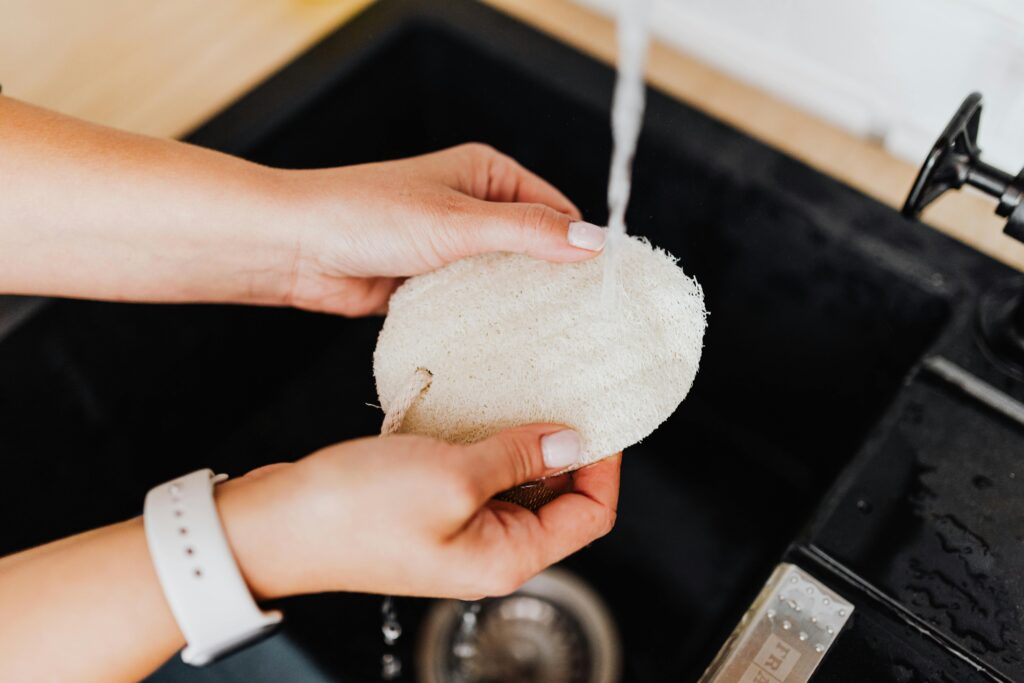
Cleaning is mostly rinsing. After each use, hold the loofah under warm running water and squeeze it several times until no soap or foam comes out. Soap left inside the fibre is a common reason a loofah starts to smell.
From time to time, give it a slightly deeper wash. Work a little mild soap through the fibre, then rinse until the water runs clear. Our posts on cleaning a loofah sponge and on other cleaning methods people try go through the options, and this maintenance post collects more tips. Whichever method you pick, rinse well afterwards and dry the loofah fully.
How do you dry a loofah?
Drying matters more than any other step. Squeeze out as much water as you can, give the loofah a shake, and hang it where air moves. A loofah with a hanging loop can go straight on a hook. Avoid leaving it in a puddle on a soap dish, in a closed box or in a bag while it is still wet.
A bright, airy spot is the best place to dry it. Hang it until it feels dry all the way through, not only on the outside. Our post on drying a loofah after each use has more ideas.
Buying for a shop or brand? See the EGEXO loofah range and ask for the catalog, samples or a quote.
Where should you store a loofah?
Store it only when it is fully dry, and give it air. A hook, an open shelf or a small rack all work. A closed cupboard or a sealed bag does not, because any damp left in the fibre has nowhere to go.
The same goes for travel. Let the loofah dry before you pack it, and carry it in a bag that lets air through. For more on shelves, hooks and containers, see our posts on storing loofahs the right way and on extending a loofah’s life through maintenance.
What should you do with a new loofah?
Soak it in warm water before the first use. A new loofah is firm and a little rough when dry, and it softens once it is wet. Compressed loofah, which is how EGEXO ships it, softens and regains its shape in warm water.
After that, the routine is short. Rinse, squeeze, hang to dry, and check the loofah now and then for the signs listed above.
Does care differ between loofah products?
The basics are the same for every loofah: rinse, squeeze, dry and store. A few products need a little extra attention because of their shape.
- Body pads and kitchen pads are flat, so they dry quickly when you hang them by the loop.
- Gloves and mitts have a pocket for your hand. Turn the pocket open and let air in, or the inside stays damp.
- Back scrubbers and belts are long. Squeeze them along their whole length and hang them by a strap.
- Slippers are bulky. Stand them on their side on a rack so air reaches both sides.
- Cup sticks have a wooden stick. Hang them so water drains from the head, and do not leave the stick standing in water.
- Whole raw loofah and rings are plain fibre. Rinse them, squeeze them and dry them in open air.
The loops, edges and straps on EGEXO products are 100% cotton. Cotton holds water too, so squeeze those parts as well and look at them now and then for wear.
When should you replace a loofah?
There is no set date. A loofah that dries fully between uses lasts longer than one that stays damp in a corner of the shower. Replace it when it smells sour or musty after a good rinse, feels slimy, has dark spots that do not rinse away, sheds large pieces or comes apart, or when the cotton loop or edge is worn through. If you are unsure, replace it. Our guide to when to replace a loofah goes into the timing in more detail.
What is a simple routine to follow?
- Soak a new loofah in warm water before the first use.
- Wet it, use it, then rinse it under warm running water.
- Squeeze it until no soap or foam comes out.
- Hang it in open air until it feels dry all the way through.
- Check it now and then. Replace it if it smells, feels slimy, has dark spots or falls apart.
This takes a minute or two each time. Drying is the step people skip, and it decides how long a loofah stays in good shape. No cleaning method makes up for a loofah that is put away wet.
Frequently asked questions
How do I care for a loofah?
Rinse it after each use, squeeze out the water, hang it in open air until it is dry all the way through, and store it where air can reach it.
How often should I replace a loofah?
There is no fixed date. Replace it when it smells, feels slimy, has dark spots that do not rinse away or starts to fall apart. If you are unsure, replace it.
Is it normal for a loofah to change colour?
Natural loofah varies in colour and can darken with use. Dark spots that stay after rinsing are a reason to replace it.
Can I keep a loofah in the shower?
Only if it can dry between uses. If the shower stays wet, hang the loofah outside the wettest area, in the open air.
What do I do with an old loofah?
Loofah is 100% biodegradable, so a used loofah can go into compost where that is accepted. Take off any wooden stick or other part first, and check what the product is made of.
Selling loofah in a shop or under your own brand? Request samples from EGEXO and we will tell you what we can make. Standard samples ship within 2 days.