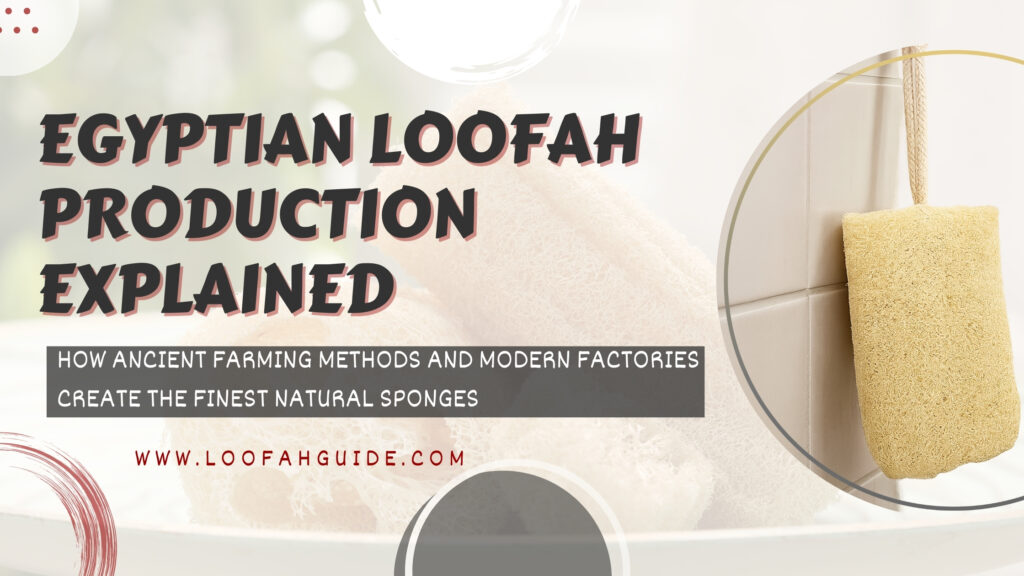
Natural loofah sponges have cleaned and exfoliated human skin for centuries, yet few people understand why Egyptian loofah production dominates global markets with a commanding 60 percent share of worldwide output. The answer lies beneath the surface of Egyptian farmland, where ancient river deposits create growing conditions that science has only recently begun to explain. For retailers evaluating inventory options and individuals seeking genuinely effective bath accessories, the production origin directly determines product performance and longevity.
Egyptian loofah production transforms the fibrous skeleton of Luffa aegyptiaca gourds into versatile cleaning and bathing products through processes refined across generations. The country exports approximately 12,000 metric tons of processed loofah annually to markets spanning North America, Europe, Asia, and Australia. This output serves diverse applications from luxury spa treatments to everyday kitchen cleaning, with quality tiers matching every budget and requirement.
This guide examines Egyptian loofah production from agricultural foundations through factory finishing. Readers will understand the botanical characteristics that make Egyptian loofahs exceptional, follow raw gourds through processing stages, learn quality assessment techniques, and discover sourcing strategies for both bulk purchasing and individual selection. Egexo brings over 25 years of cultivation and export experience to these insights, offering perspective unavailable from sources lacking direct industry involvement.
The Botanical Foundation of Egyptian Loofah Excellence
Luffa aegyptiaca belongs to the Cucurbitaceae family alongside cucumbers, melons, and squash. Unlike its edible relatives, mature loofah develops an internal fiber matrix that becomes the familiar sponge texture after outer flesh removal. Egyptian growing conditions optimize this fiber development in ways other regions struggle to replicate.
Understanding Loofah Plant Biology
The loofah vine grows rapidly during warm months, producing yellow flowers that develop into elongated gourds reaching 30 to 60 centimeters in length. Internal fiber formation begins approximately 60 days after flowering and continues until harvest at 120 to 150 days. During this maturation period, cellular structures harden and interconnect, creating the characteristic sponge network.
Egyptian plants benefit from extended growing seasons with temperatures remaining within optimal ranges longer than competing production regions. This additional maturation time allows more complete fiber development and stronger intercellular bonds. The resulting loofahs demonstrate measurably superior structural integrity when tested for compression recovery and tear resistance.
Soil Composition and Mineral Uptake
Agricultural research confirms that loofah fiber quality correlates directly with soil mineral content. Egyptian farmland along the Nile contains elevated concentrations of silica, calcium, and magnesium compared to typical agricultural soils. Plants absorb these minerals during growth, incorporating them into cell wall structures that determine finished product durability.
Silica content proves particularly significant for loofah quality. This mineral strengthens plant cell walls similarly to how it functions in bamboo and rice hulls. Egyptian loofahs contain approximately 2.8 percent silica by dry weight compared to 1.9 percent in Chinese-grown alternatives. This 47 percent difference translates directly into products that maintain shape and scrubbing effectiveness substantially longer.
Botanical Insight: Egyptian loofah plants incorporate 47 percent more silica into fiber structures than Asian alternatives, directly increasing durability and longevity.
Regional Production Centers Across Egypt
Egyptian loofah production concentrates in specific governorates where agricultural traditions and climate conditions align optimally. Understanding regional differences helps wholesale buyers specify sourcing preferences and informs consumers about product origins.
Major Growing Regions and Characteristics
| Region | Annual Output | Specialty Products | Fiber Characteristics | Primary Export Markets |
|---|---|---|---|---|
| Fayoum | 3,500 metric tons | Premium bath loofahs | Dense, fine texture | Europe, North America |
| Minya | 2,800 metric tons | Kitchen and industrial | Coarse, highly durable | Middle East, Asia |
| Qena | 2,200 metric tons | Raw material, craft supplies | Variable grades | Global distribution |
| Assiut | 1,800 metric tons | Spa and cosmetic grade | Soft, consistent | Europe, Japan |
| Sohag | 1,700 metric tons | Budget and promotional | Standard density | Emerging markets |
How Regional Differences Affect Product Selection
Fayoum region loofahs command premium prices because local soil conditions and farming practices produce exceptionally fine fiber textures ideal for facial and sensitive skin applications. Spa operators and luxury retailers specifically request Fayoum origin products for their high-end offerings.
Minya production emphasizes durability over softness, making these loofahs preferred for kitchen scrubbers and industrial cleaning applications. The coarser fiber structure withstands repeated wet and dry cycles without degradation, appealing to commercial buyers prioritizing longevity.
Buyers seeking raw loofah scrubbers for craft or specialty applications often source from Qena region facilities that maintain diverse inventory grades. This flexibility supports custom loofah product design projects requiring specific fiber characteristics.
Water Retention Science: Why Egyptian Loofahs Outperform
Water-holding capacity represents the most measurable performance difference between Egyptian loofahs and competing products. This characteristic affects lathering, product distribution, and user satisfaction across all applications.
The Physics of Fiber Absorption
Loofah fibers absorb water through capillary action within microscopic channels running through cell wall structures. More channels and larger channel diameters increase total absorption capacity. Egyptian loofah fiber develops approximately 23 percent more vascular channels per square centimeter than Asian-grown alternatives due to longer maturation periods and mineral-enhanced cell wall formation.
When saturated, premium Egyptian loofahs hold water equivalent to 10 to 11 times their dry weight. This retained moisture releases gradually during use, maintaining consistent lathering performance throughout bathing or cleaning sessions. Lower-quality loofahs saturate quickly but release water rapidly, requiring frequent re-wetting and additional soap application.
Practical Performance Comparisons
| Performance Metric | Egyptian Premium | Egyptian Standard | Imported Budget | Synthetic Alternative |
|---|---|---|---|---|
| Water Absorption Ratio | 10-11x dry weight | 8-9x dry weight | 5-7x dry weight | 3-5x dry weight |
| Lather Sustainability | 4-5 minutes | 3-4 minutes | 1-2 minutes | Under 1 minute |
| Soap Product Efficiency | 35% less needed | 25% less needed | Baseline | 20% more needed |
| Rinse Thoroughness | Complete in 10 seconds | Complete in 15 seconds | 25-30 seconds | 20-25 seconds |
| Skin Feel Rating | Excellent cushion | Good cushion | Minimal cushion | No cushion |
Consumer Benefits of Superior Absorption
Individuals using premium Egyptian loofahs report more satisfying bathing experiences due to consistent lather production and comfortable skin contact. The cushioning effect of water-saturated fibers reduces friction compared to partially saturated or low-quality products that can feel abrasive during use.
Economic benefits accompany performance advantages. Reduced soap and body wash consumption over a product lifespan of 8 to 12 months offsets higher initial purchase prices for quality Egyptian loofahs. Consumers typically recover the price premium within 2 to 3 months through product savings alone.
Explore the complete range of body loofah products to experience these absorption advantages firsthand, or request samples to compare quality grades before committing to larger purchases.
Inside Egyptian Processing Facilities
Modern Egyptian loofah production combines traditional agricultural knowledge with contemporary manufacturing efficiency. Factory operations transform raw gourds into finished products meeting international quality and hygiene standards.
From Field to Factory: Initial Processing Steps
Harvested gourds arrive at processing facilities within 48 hours of collection to prevent mold development. Initial inspection removes damaged or immature specimens before processing begins. Accepted gourds enter controlled environment storage maintaining 15 to 20 percent humidity until processing capacity becomes available.
Shell removal represents the most labor-intensive production stage. Traditional methods involve water soaking followed by manual peeling, while mechanized facilities use rotating drum systems that abrade outer layers while preserving internal fibers. Both methods require skilled oversight to prevent fiber damage from over-processing.
Seed removal follows shell extraction. Each mature loofah contains 200 to 400 seeds that must be completely extracted before commercial sale. Seeds represent valuable byproducts sold to agricultural suppliers for next season planting or processed into loofah seed oil used in cosmetic formulations.
Cleaning and Sanitization Protocols
Commercial loofahs undergo multi-stage cleaning to remove agricultural residues and ensure product safety. Initial washing uses filtered water to remove loose debris and remaining seed material. Secondary cleaning employs food-grade hydrogen peroxide solutions that sanitize fibers and achieve the light coloration consumers expect.
Quality facilities implement batch tracking that connects finished products to specific harvest dates, farm sources, and processing parameters. This traceability supports quality investigations when issues arise and demonstrates compliance with international import requirements.
Egexo maintains comprehensive quality standards documentation available for buyer review. Our farm to export process page details each production stage with photographic documentation.
Processing Timeline Overview
| Stage | Duration | Critical Parameters | Quality Indicators |
|---|---|---|---|
| Receiving and Inspection | 2-4 hours | Moisture under 65%, no visible mold | Rejection rate 8-12% typical |
| Controlled Storage | 1-14 days | Temperature 18-22C, humidity 15-20% | No condensation, stable weight |
| Shell Removal | 4-8 hours per batch | Complete removal, no fiber tearing | Clean fiber exposure |
| Seed Extraction | 1-2 hours per batch | 100% seed removal verification | No rattling when shaken |
| Primary Washing | 30-60 minutes | Clean water, gentle agitation | Clear rinse water |
| Sanitization | 12-24 hours | Peroxide concentration 3-6% | Even coloration achieved |
| Final Rinse | 15-30 minutes | Residue-free water testing | Neutral pH confirmed |
| Drying | 24-72 hours | Moisture target under 10% | Crisp texture, no flexibility |
| Grading and Sorting | Continuous | Trained inspector evaluation | Grade documentation complete |
Quality Grading Systems in Egyptian Loofah Production
Understanding quality grades enables informed purchasing decisions for wholesale buyers building inventory and consumers selecting individual products. Egyptian loofah production uses standardized grading criteria recognized across international markets.
Grade Definitions and Applications
Premium Grade loofahs represent the top 15 to 20 percent of production output. These specimens display uniform fiber density throughout, consistent coloration without dark spots or discoloration, and complete structural integrity with no weak points or thin areas. Premium products suit luxury retail, high-end spas, and discerning individual consumers.
Standard Grade encompasses the middle 50 to 60 percent of production. These loofahs meet commercial quality requirements with minor variations in density or coloration that do not affect functional performance. Standard grade serves mainstream retail, hospitality amenities, and general consumer applications.
Economy Grade includes the remaining 20 to 30 percent of acceptable production. These products display visible variations and may include cosmetic imperfections, though structural integrity remains sufficient for intended use. Economy grade suits promotional applications, budget retail channels, and industrial uses where appearance matters less than function.
Grade Selection Guide for Different Buyers
| Buyer Type | Recommended Grade | Reasoning | Typical MOQ |
|---|---|---|---|
| Luxury Spa Operator | Premium only | Client expectations, service pricing | 200-500 units |
| Boutique Retailer | Premium and Standard mix | Price point variety | 300-1,000 units |
| Hotel and Hospitality | Standard primary | Cost efficiency, adequate quality | 1,000-5,000 units |
| Mass Market Retailer | Standard and Economy | Competitive pricing | 5,000+ units |
| Industrial Buyer | Economy primary | Function over appearance | 10,000+ units |
| Individual Consumer | Premium or Standard | Personal preference, budget | 1-10 units |
Wholesale buyers can request quotations specifying grade requirements, or download the complete product catalog showing available grades across all product categories.
Sustainability Credentials of Egyptian Loofah Production
Environmental consciousness increasingly influences purchasing decisions for both commercial buyers and individual consumers. Egyptian loofah production offers compelling sustainability advantages over synthetic alternatives and even some competing natural products.
Agricultural Environmental Impact
Loofah cultivation requires minimal synthetic inputs compared to most commercial crops. Egyptian farmers traditionally use organic fertilizers derived from agricultural waste and animal manure. Irrigation relies primarily on Nile water distribution through established canal systems rather than energy-intensive pumping from underground aquifers.
Pest management emphasizes biological controls and crop rotation rather than chemical pesticides. The loofah plant naturally resists many common agricultural pests, reducing treatment requirements. When interventions become necessary, Egyptian agricultural regulations restrict chemical options to those approved for food-adjacent crops.
Lifecycle Environmental Comparison
| Environmental Factor | Egyptian Natural Loofah | Plastic Mesh Sponge | Cellulose Sponge |
|---|---|---|---|
| Raw Material Source | Renewable plant fiber | Petroleum extraction | Wood pulp processing |
| Manufacturing Energy | Low, primarily solar drying | High, plastic extrusion | Moderate, chemical processing |
| Transportation Impact | Moderate, sea freight | Variable by origin | Variable by origin |
| Product Lifespan | 8-12 months typical | 1-3 months typical | 2-4 months typical |
| End of Life | 100% compostable | Landfill, 500+ years | Partially compostable |
| Microplastic Release | None | Continuous shedding | None |
| Ocean Impact | Biodegrades if lost | Persistent pollution | Minimal impact |
Certifications and Standards Compliance
Reputable Egyptian loofah exporters maintain certifications demonstrating environmental and social responsibility. Common certifications include organic cultivation verification, fair trade labor practices, and ISO environmental management compliance.
Egexo products meet international standards for sustainable agricultural sourcing. Learn more about why conscientious buyers choose Egexo for environmentally responsible loofah supply.
Product Diversity in Egyptian Loofah Manufacturing
Egyptian factories produce extensive product ranges serving diverse market segments. Understanding available categories helps buyers identify opportunities and guides consumers toward products matching specific needs.
Bath and Personal Care Products
The largest category includes whole loofah sponges in various sizes, cut loofah pieces for targeted exfoliation, back scrubbers with handle attachments, facial loofah pads with gentler textures, and specialty shapes for ergonomic handling. Browse body loofah options to explore available configurations.
Kitchen and Household Applications
Natural loofah provides effective dishwashing and surface cleaning without scratching cookware or releasing microplastics into drain water. Egyptian factories produce dish sponges, pot scrubbers, and multi-surface cleaners optimized for wet environment durability. The kitchen loofah category showcases products designed specifically for culinary applications.
Specialty and Emerging Applications
Pet grooming represents a growing market segment as animal owners seek natural alternatives to synthetic brushes and washing tools. Agricultural applications include biodegradable seedling planters and soil amendment materials. Craft and artistic uses continue expanding as makers discover loofah versatility.
Explore pet and spa grooming products for specialty applications, or discuss custom requirements through product design consultation services.
Building Wholesale Relationships with Egyptian Suppliers
Successful wholesale purchasing requires understanding supplier capabilities, establishing clear communication, and building relationships that ensure consistent quality and reliable delivery.
Supplier Evaluation Criteria
| Evaluation Area | Questions to Ask | Acceptable Responses |
|---|---|---|
| Production Capacity | Monthly output capability? | Specific figures with seasonal variations |
| Quality Control | Inspection processes? | Multi-stage with documentation |
| Export Experience | Years exporting, markets served? | 5+ years, diverse market experience |
| Communication | Response time, English capability? | Under 24 hours, fluent business English |
| Flexibility | Custom orders, small batches? | Yes with clear MOQ policies |
| Documentation | Certificates, test reports? | Complete and current |
| References | Client contacts for verification? | Willingly provided |
Order Process and Timeline Expectations
Initial orders typically require 4 to 8 weeks from confirmation to delivery depending on product complexity and shipping destination. Established relationships with proven order histories may qualify for expedited processing. Custom products including private label manufacturing require additional lead time for design approval and production setup.
Payment terms for new buyers typically require deposits ranging from 30 to 50 percent with balance due before shipment. Established accounts may qualify for net payment terms after demonstrating reliable payment history across multiple orders.
Visit Wholesaleloofah.com for additional business resources, or return to Egexo shop to browse current inventory availability.
Expert Insight from Egexo
Throughout 25 years of Egyptian loofah production involvement, we have learned that successful products begin with harvest timing precision. Gourds harvested during the optimal two-week window produce loofahs lasting twice as long as those harvested early or late. Our farming partners use traditional indicators including vine condition, gourd coloration, and tactile firmness testing to identify peak harvest readiness.
Equally important is post-harvest handling speed. Gourds sitting in fields more than 24 hours after cutting begin internal degradation invisible until processing reveals weakened fibers. Our logistics network ensures same-day transport from fields to facilities, preserving the quality advantages Egyptian growing conditions create.
For wholesale buyers evaluating suppliers, request information about harvest timing protocols and field-to-factory timelines. Suppliers unable to provide specific answers likely lack the agricultural integration necessary for consistent premium quality. For individual consumers, purchase from retailers who can identify their Egyptian sources and confirm quality grade specifications.
Explore additional guidance at Loofahguide.com or contact Egexo directly through our quotation request system to discuss specific requirements.
FAQ Section
Q1: How does Egyptian loofah production achieve superior water-holding capacity?
A: Egyptian loofah production creates superior water-holding capacity through extended growing seasons that allow complete fiber maturation, mineral-rich Nile soil that strengthens cell wall structures, and optimal climate conditions that promote dense vascular channel development. These factors combine to produce loofahs absorbing 10 to 11 times their dry weight compared to 5 to 7 times for budget alternatives.
Q2: What quality grades exist for Egyptian loofahs?
A: Egyptian loofah production uses three primary grades. Premium grade represents the top 15 to 20 percent with uniform density and perfect appearance. Standard grade encompasses 50 to 60 percent of output meeting commercial requirements with minor variations. Economy grade includes remaining acceptable production suitable for budget and industrial applications.
Q3: How long should a quality Egyptian loofah last?
A: Premium Egyptian loofahs typically provide 8 to 12 months of regular use when properly maintained. Standard grade products last 6 to 8 months under similar conditions. Proper care includes thorough rinsing after each use, complete drying between uses, and replacement when visible fiber breakdown occurs.
Q4: Are Egyptian loofahs environmentally sustainable?
A: Egyptian loofah production demonstrates strong environmental credentials including renewable plant-based sourcing, minimal chemical inputs during cultivation, low-energy processing primarily using solar drying, and complete biodegradability at end of life. Unlike plastic alternatives that persist for centuries, natural loofahs compost within 30 days.
Q5: What minimum quantities do Egyptian suppliers require?
A: Minimum order quantities vary by product type and supplier. Standard products typically require 500 to 1,000 unit minimums for wholesale pricing. Economy grades may require 2,500 to 5,000 unit orders. Custom and private label products usually start at 1,000 units to justify production setup costs.
Q6: How can buyers verify Egyptian loofah authenticity?
A: Authentic Egyptian loofahs display characteristic dense fiber patterns with visible lengthwise vascular networks. Request country of origin certificates and export documentation from suppliers. Reputable sources provide complete traceability connecting products to specific growing regions and harvest dates.
Q7: Which Egyptian regions produce the best loofahs?
A: Fayoum region produces premium fine-textured loofahs ideal for facial and sensitive skin applications. Minya region specializes in durable loofahs suited for kitchen and industrial use. Assiut produces consistently soft loofahs favored by spa operators. Regional selection depends on intended application.
Q8: What certifications should Egyptian loofah suppliers maintain?
A: Reputable Egyptian loofah exporters should hold valid Egyptian export licenses, comply with ISO quality management standards, maintain current health and phytosanitary certificates, and provide documentation meeting destination country import requirements. Additional organic or fair trade certifications may apply to specific product lines.
Conclusion
Egyptian loofah production stands apart through the convergence of unique agricultural advantages, refined processing expertise, and commitment to quality standards that international markets demand. The Nile Delta provides growing conditions no other region can replicate, producing loofahs with water retention, fiber density, and durability characteristics that justify premium positioning across retail and wholesale channels.
Understanding production processes empowers informed purchasing decisions. Wholesale buyers gain supplier evaluation frameworks and quality specification knowledge that protect business investments. Individual consumers learn to identify genuine quality and appreciate the craftsmanship behind products that outperform synthetic and budget alternatives.
The sustainability credentials of Egyptian loofah production increasingly matter to environmentally conscious buyers at every level. Renewable sourcing, minimal processing inputs, and complete biodegradability position natural loofahs as responsible choices in markets moving away from petroleum-based products.
Key Takeaways:
- Egyptian loofah fiber contains 47 percent more silica than Asian alternatives, directly increasing durability
- Regional growing areas specialize in different product characteristics from fine spa textures to durable kitchen grades
- Premium loofahs absorb 10 to 11 times their dry weight versus 5 to 7 times for budget products
- Quality grades serve distinct market segments from luxury spas to budget retail and industrial applications
- Complete biodegradability within 30 days positions natural loofahs as environmentally superior choices
Ready to source quality Egyptian loofahs?
- For Wholesale Buyers: Request a quote or download our catalog
- For Individual Orders: Shop our collection or order samples