There is a question that almost nobody thinks to ask when they reach for a loofah: how did this get here? Not in the shipping sense, but in the biological sense. What was this thing before it became the rough, tan scrubber sitting on the edge of your bathtub? The answer changes the way you think about the product entirely. A loofah is not manufactured. It is grown. It starts as a seed no bigger than a watermelon seed, develops inside a gourd that can grow to 50 centimeters in length, and ends up in your hands only after months of cultivation, careful harvesting, and meticulous processing.
Understanding the journey from seedling to sponge gives you a genuine advantage as a consumer. It explains why some loofahs fall apart after two weeks while others last two months. It tells you why the origin of your loofah matters more than the packaging it comes in. And it gives you the vocabulary to ask the right questions when choosing between brands and suppliers.
This guide follows that journey from the very first stage, seed in soil, all the way to the finished product, drawing on the agricultural expertise of Egypt’s luffa farming community and the deep product knowledge that resources like Egexo have developed over more than 25 years of cultivating and exporting Egyptian luffa worldwide. Whether you are buying for personal use, sourcing for a wellness brand, or simply curious about where natural products come from, this is the most complete account of luffa’s life cycle you will find.
What Kind of Plant Is Luffa, Really?
Before the growth stages make sense, a brief introduction to the plant itself is worth reading. Luffa is a tropical and subtropical vine in the gourd family, and it is closely related to cucumbers, melons, and squash. The name is often spelled loofah in commercial and consumer contexts, and both spellings refer to the same genus of plants.
There are two species cultivated for sponge production. Luffa aegyptiaca, the smooth-skinned variety, is the dominant commercial species and produces the cylindrical, evenly textured sponges most commonly sold in stores. Luffa acutangula, the ridged variety, is more common in Asian markets and is also eaten as a vegetable when harvested young. For bath and body applications, Luffa aegyptiaca is the standard.
Luffa as a Vegetable and as a Sponge
This dual identity is one of the most fascinating things about luffa. When harvested at 10 to 15 centimeters in length, the gourd is tender, mildly flavored, and eaten across South Asia, East Africa, and parts of the Middle East. When left on the vine until fully mature, the exact same plant produces the fibrous sponge sold in bath aisles around the world.
The transformation from edible vegetable to usable sponge is entirely biological. As the gourd matures beyond eating size, the cells inside the fruit begin to break down, moisture escapes through the skin, and the vascular fiber network that carried nutrients through the fruit during growth becomes increasingly exposed and structurally prominent. What you end up drying and peeling is, essentially, the plant’s own circulatory system.
Growing Conditions That Define Quality
Not all luffa is grown equal, and the reason has everything to do with geography and climate. Luffa thrives in warm, dry conditions with long growing seasons and reliable sunlight. It tolerates heat exceptionally well but is highly sensitive to waterlogging, frost, and sudden temperature fluctuations during fruit maturation.
Egypt occupies a unique position in global luffa production for reasons that go well beyond tradition. The combination of the Nile Delta’s rich soil, Egypt’s consistently dry summers, abundant sunshine, and centuries of gourd farming experience creates growing conditions that no other major producing region fully replicates.
A Side-by-Side Look at Luffa Growing Regions
| Growing Region | Climate Type | Avg. Growing Season | Fiber Characteristic | Quality Consistency |
|---|---|---|---|---|
| Egypt (Nile Delta) | Arid, dry summer | 6 to 7 months | Dense, uniform, coarse-soft gradient | Very high |
| India (Gujarat, Maharashtra) | Tropical monsoon | 4 to 5 months | Variable, moisture-influenced | Moderate |
| China (Zhejiang, Guangdong) | Subtropical humid | 5 to 6 months | Softer fiber, lighter structure | Moderate to high |
| Philippines | Tropical humid | Year-round possible | Looser fiber, rapid growth | Variable |
| Sri Lanka | Tropical | Year-round possible | Fine fiber, lower density | Moderate |
The data in this table reflects the agricultural reality behind what consumers notice at the point of use. Egyptian luffa tends to last longer, scrub more evenly, and hold its shape better because the growing conditions during fiber formation are more controlled and consistent. Slower maturation in a dry climate produces tighter fiber spacing. Faster growth in a humid climate produces looser, softer fiber that compresses more easily with use.
The Seedling Stage: Where Quality Begins
Every quality discussion about luffa eventually leads back to the seedling stage, because the decisions made before a seed goes into the ground have a direct impact on the sponge produced months later.
Seed selection is the first control point. Commercial luffa farmers who prioritize quality keep seeds from their best-performing plants each season, selecting specifically for characteristics like thick gourd walls, dense internal fiber, and high germination rates. Using commercially purchased seeds year after year, without this selection feedback loop, gradually reduces the quality ceiling of a crop.
Soil preparation follows seed selection. Luffa performs best in well-drained, slightly acidic to neutral soil with a pH between 6.0 and 7.0. Sandy loam soils are preferred because they warm quickly in spring, drain effectively after irrigation, and allow the deep root development that supports a long, vigorous vine. Heavy clay soils create drainage problems that stress the plant during fruiting and negatively affect fiber development.
Germination Conditions and Early Care
| Condition | Optimal Range | Effect if Outside Range |
|---|---|---|
| Soil temperature at planting | 21 to 27 degrees Celsius | Below 18C delays or prevents germination |
| Planting depth | 2 to 3 centimeters | Too deep reduces emergence rate |
| Initial watering frequency | Every 2 to 3 days | Overwatering causes root rot |
| Sunlight hours per day | 8 hours minimum | Fewer hours slow vine establishment |
| Time to germination | 7 to 14 days | Beyond 21 days suggests seed quality issue |
After germination, the seedling enters a rapid vegetative phase. In the first three weeks, roots are establishing, and the plant is building the structural foundation it will rely on to support vigorous vine growth and heavy fruit later in the season. Stressing the plant at this stage through irregular watering, pest damage, or nutrient deficiency creates weaknesses that show up in the mature fiber.
Vine Growth and the Race to Flower
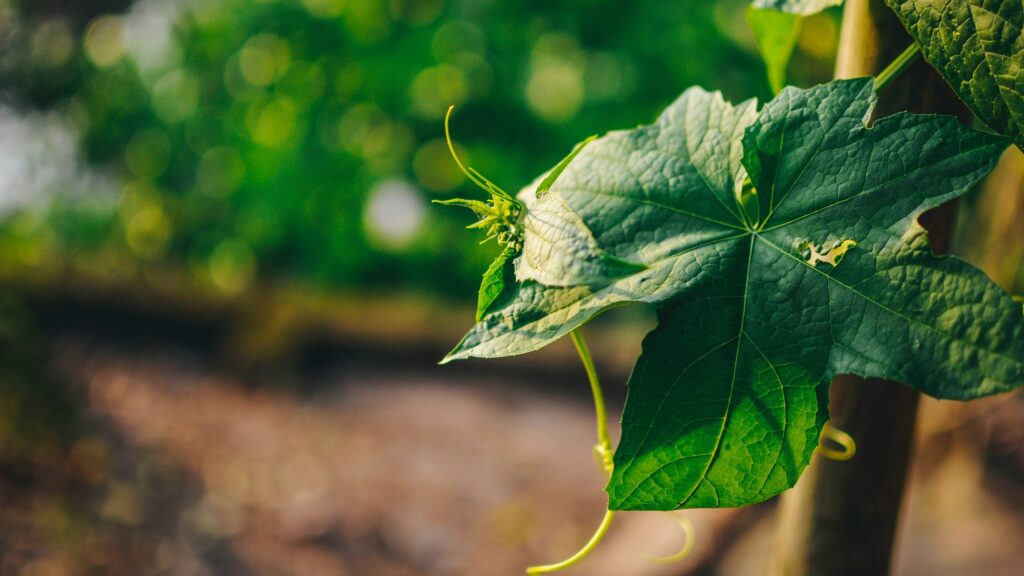
Luffa vines grow fast. Under good conditions in a warm Egyptian summer, a vine can extend by 15 to 20 centimeters in a single day. This rapid growth is supported by a climbing habit: luffa sends out coiled tendrils that grip any available support structure, which is why commercial cultivation uses trellises, wire frames, or bamboo poles to direct growth upward.
The reasons for training luffa vertically are partly practical and partly quality-driven. A vine allowed to sprawl along the ground produces gourds that develop in contact with the soil. This causes moisture retention on the lower surface of the fruit, creates conditions favorable to fungal infection, and compresses the fiber on one side, leading to an uneven sponge. Hanging gourds develop symmetrically, drain freely, and produce a much more uniform fiber mesh throughout.
Flowering and Pollination: A Critical Window
Luffa is a monoecious plant, meaning it carries both male and female flowers on the same vine. Male flowers appear first, typically 5 to 7 days before female flowers emerge. This sequence cannot be rushed, and understanding it helps explain why commercial luffa farming requires attentive, experienced farmers rather than automated systems.
Female flowers are identifiable by the small gourd-shaped base at the bottom of the flower stem. Once a female flower opens, it is receptive to pollination for approximately 24 hours. In commercial fields, bees and other insects handle most pollination. In smaller operations or during periods of low pollinator activity, hand pollination is practiced to ensure a reliable fruit set.
A failed pollination event results in the flower dropping without fruit development, wasting weeks of vine growth for that particular stem. Experienced farmers in Egypt’s luffa growing regions monitor flowering closely and supplement with hand pollination when bee activity is insufficient, a practice that requires skill and timing knowledge developed through seasons of experience.
Gourd Maturation: The Interior Transformation
Once pollination succeeds and the fruit begins to swell, the focus of the plant’s energy shifts entirely to the developing gourd. Over the next 8 to 10 weeks, the gourd goes through a transformation that most people never consider: it transitions from a water-filled vegetable into a drying, fibrous skeleton.
This transformation follows a predictable sequence that experienced farmers monitor closely to determine optimal harvest timing.
What Happens Inside a Maturing Luffa Gourd
In the first weeks after fruit set, the gourd is filled with a dense, wet, pulpy tissue surrounding a loose fiber network and developing seeds. The flesh is green, moist, and still cellular. This is the vegetable stage. As weeks pass, moisture begins to migrate out of the gourd, the cellular tissue between the fiber strands begins to break down, and the fiber network itself becomes more prominent.
By week 12 to 14 after fruit set, the seeds are fully mature and hardening, the cellular tissue has largely decomposed, and the interior of the gourd is a recognizable fibrous mesh. The outer skin begins to lose its green color, fading to yellow and eventually to a papery tan. The gourd becomes noticeably lighter as moisture content drops from above 90 percent in early fruit to below 20 percent at harvest readiness.
| Week After Fruit Set | Skin Color | Internal State | Estimated Moisture |
|---|---|---|---|
| 2 to 4 | Deep green | Dense cellular pulp | 92 to 95% |
| 5 to 7 | Green | Fiber forming, pulp thinning | 75 to 85% |
| 8 to 10 | Green to yellow-green | Fiber network clear, seeds forming | 50 to 65% |
| 11 to 13 | Yellow-green | Seeds mature, cellular tissue decomposing | 30 to 45% |
| 14 to 16 | Yellow to tan | Fiber prominent, seeds hard and loose | 15 to 22% |
Why Harvest Timing Matters More Than Almost Anything Else
Harvesting too early is one of the most common quality problems in mass-market loofah production. An immature gourd still contains significant cellular tissue between its fiber strands. When peeled and dried, this tissue darkens, hardens, and creates a sticky residue that clings to the fiber. The resulting sponge feels gummy when wet, has an unpleasant appearance, and breaks down much faster in use because the residual tissue acts as a substrate for microbial growth.
An overripe gourd presents the opposite problem. Once the fiber begins to degrade on the vine, the structural integrity of the mesh is compromised at a level invisible to visual inspection. The sponge may look acceptable but will shed fiber strands and lose its shape rapidly with use. The harvest window in which a luffa gourd produces the best possible sponge is approximately 10 to 14 days wide, and hitting that window consistently requires daily field monitoring by farmers who know exactly what to look for.
Post-Harvest Processing: Turning a Gourd into a Sponge
Once harvested, the gourd needs to be processed before it becomes the recognizable sponge consumers purchase. This stage involves several steps that are deceptively simple in description but require genuine skill to execute correctly at scale.
Soaking, Peeling, and Cleaning
Harvested gourds are soaked in clean water for 24 to 48 hours. This softens the outer skin, making it easier to remove without damaging the fiber underneath. Peeling is done by hand in quality-focused operations, using a firm grip and a rolling motion to strip the skin in sections. Mechanical peeling is faster but increases the risk of tearing the outer fiber layer, which creates ragged edges on the finished sponge.
After peeling, seeds are removed by shaking or tapping the open ends of the gourd. In quality operations, seeds from the best specimens are collected and stored for the next planting season. The peeled loofah is then washed thoroughly in fresh water to remove any residual skin fragments or seed pulp.
Natural Sun Drying vs Artificial Processing
This is one of the most consequential choices in loofah processing, and it is where many mass-market producers take a shortcut that consumers ultimately pay for.
| Processing Method | Drying Time | Color Result | Fiber Strength | Chemical Residue |
|---|---|---|---|---|
| Natural sun drying | 5 to 10 days | Light tan to ivory | Preserved, full strength | None |
| Forced-air drying | 12 to 24 hours | Pale tan, variable | Slightly reduced | None |
| Chemical bleaching | 2 to 4 hours | Bright white | Reduced by 20 to 30% | Possible trace residue |
| Combined bleach and dry | 4 to 8 hours | Bright white | Significantly reduced | Likely residue |
Natural sun drying is slower, but it preserves the full structural integrity of the fiber. The gradual moisture removal allows the fiber to set in its natural configuration without stress. Chemically bleached luffa may look cleaner and whiter on the shelf, but the bleaching process degrades fiber strength, shortens the product’s usable lifespan, and introduces chemical residues that are particularly relevant for consumers with sensitive skin or allergies.
When buying a loofah, a light tan or ivory color is a positive sign. An unnaturally bright white color warrants a closer look at the processing description. The Egexo bath and body loofah range uses exclusively natural processing methods, and the quality standards page documents the specific criteria applied at each processing stage.
From Whole Gourd to Finished Product: Shaping and Cutting
The final stage of processing is where raw luffa becomes the specific product form consumers recognize. The whole dried gourd is the starting point, and from it, several product types can be derived depending on how it is cut, shaped, and finished.
Common Luffa Product Forms and Their Ideal Uses
| Product Form | Typical Dimensions | Best Use | Key Quality Indicator |
|---|---|---|---|
| Whole body loofah | 20 to 35 cm long | Full-body scrubbing, back | Even diameter throughout |
| Bath disc | 8 to 12 cm diameter, 2 to 3 cm thick | Face, targeted exfoliation | Uniform thickness, flat cut |
| Half loofah | 10 to 18 cm long | General bath use | Clean cut edge, no fraying |
| Kitchen scrubber pad | 10 to 15 cm, irregular shape | Dishes, surfaces | Dense fiber, firm structure |
| Loofah strip | 5 to 8 cm wide, variable length | Soap-embedded products | Consistent width, clean edges |
| Loofah seed germination pad | Raw slices, 2 to 3 cm thick | Horticulture | Even porosity, no chemical treatment |
Each of these product forms requires different cutting equipment, different dimensional tolerances, and in some cases different grade inputs. A bath disc cut from Grade A fiber performs very differently from one cut from Grade B material, even if the dimensions are identical. Understanding this relationship between raw material grade and finished product performance is one of the things that separates informed buyers from those who make decisions based on price alone.
For consumers looking to understand which product form suits their needs, the Egexo shop organizes products by application category, including a raw loofah scrubbers section for buyers who want unprocessed material for their own crafting or application-specific use.
How to Choose a Loofah Based on the Growing and Processing Story
Armed with the knowledge of how luffa grows and is processed, the following checklist helps consumers make genuinely informed purchasing decisions rather than relying on packaging claims.
| What to Check | What to Look For | What to Avoid |
|---|---|---|
| Color | Light tan to ivory, natural variation | Unnaturally bright white |
| Texture dry | Firm, springy, holds shape | Soft, flat, no resilience |
| Texture wet | Expands evenly, maintains structure | Immediate flattening, patchiness |
| Smell | Mild, neutral, slightly earthy | Chemical, bleach, musty |
| Fiber density | Dense, evenly spaced strands visible | Large voids, patchy areas |
| Edge quality | Clean cut, no major fraying | Rough, shredded edges |
| Origin labeling | Specific country named, ideally Egypt | Generic, no origin stated |
| Processing claims | Natural, sun-dried, chemical-free | Vague or no processing information |
For wholesale buyers and retailers building product ranges, applying this checklist at the sample evaluation stage before ordering in volume is the difference between a product line that generates repeat customers and one that generates returns and complaints. Egexo provides grade-specific samples through the sample request page and invites buyers to apply their own evaluation criteria directly.
Caring for Your Loofah to Extend Its Life
Understanding how luffa grows also informs how to maintain it after purchase. The fiber that took 16 weeks to develop in the field deserves more than being left in a puddle of standing water between uses.
Daily care habits that make a real difference:
After every use, rinse your loofah under running water until the water runs clear. Squeeze gently rather than wringing, which can deform the fiber structure. Hang it in a position where air can circulate on all sides. A ventilated soap dish or a hook in a well-aired part of the shower works well. Avoid leaving it on a flat surface where the bottom face stays wet.
Weekly maintenance: Once a week, soak the loofah for 5 minutes in a solution of one part white vinegar to four parts water. This naturally controls microbial growth without damaging the fiber. Rinse thoroughly afterward and allow to dry completely before the next use.
When to replace: A bath loofah used daily should be replaced every 3 to 4 weeks. Kitchen loofahs, which deal with food residue and grease rather than skin cells, can be used for 6 to 8 weeks if maintained well. Signs that replacement is overdue include a persistent musty smell that does not resolve after vinegar treatment, visible dark discoloration in the fiber, or structural collapse where the loofah no longer bounces back when squeezed.
For pet grooming applications, the pet and spa loofah range from Egexo offers softer-grade products appropriate for more delicate coats and skin, with replacement schedules aligned to grooming frequency.
FAQ Section
Q1: What is the difference between luffa and a synthetic loofah? A: Natural luffa is the dried fibrous skeleton of a luffa gourd, a plant in the gourd family. Synthetic loofahs are typically made from nylon or polyester mesh. The key differences are that natural luffa is biodegradable, free of microplastics, and provides a more varied scrubbing texture due to its organic fiber structure. Synthetic versions are more uniform but contribute to microplastic pollution in waterways. For consumers concerned about both skin health and environmental impact, natural luffa is the clearly superior choice, particularly when sourced from a producer that uses chemical-free processing.
Q2: Why does my loofah fall apart so quickly? A: Premature breakdown in a loofah typically traces back to one of three causes. The gourd was harvested before full maturation, leaving residual cellular tissue in the fiber that degrades quickly. The fiber was chemically bleached during processing, which weakens the structural integrity of the strands. Or the loofah is being stored wet between uses, which accelerates both microbial breakdown and physical fiber degradation. A high-quality, naturally processed loofah stored dry should last 3 to 4 weeks in daily bath use.
Q3: Is a darker tan loofah better than a white one? A: Color alone is not a definitive quality indicator, but it is a useful signal. A light tan or ivory color typically indicates natural sun drying without chemical bleaching, which preserves fiber strength. A very white loofah has almost certainly been chemically bleached, which weakens fiber and may leave trace residues. A very dark brown loofah may have been harvested too early or improperly dried, leaving degraded cellular material in the fiber. The ideal color range for a high-quality, naturally processed loofah is light tan to pale ivory.
Q4: How do I know if a loofah comes from Egypt? A: Look for explicit origin labeling on the product packaging. Reputable suppliers of Egyptian luffa will state the country of origin clearly. If the origin is vague or absent, it is worth contacting the supplier directly to ask. Egyptian origin matters because the growing conditions in Egypt’s Nile Delta region consistently produce denser, more durable fiber than luffa grown in tropical humid climates. Egexo is an Egyptian-based grower and exporter that documents its entire growing and processing chain on the farm to export process page.
Q5: Can I grow my own luffa for home use? A: Yes, luffa is a viable home garden plant in warm climates with growing seasons of at least 5 months. It needs a sturdy trellis, full sun, consistent moisture during vine development, and a dry period during fruit maturation. The main challenge for home growers is timing the harvest correctly: leaving the gourd on the vine until the skin yellows and the fruit feels papery and lightweight. Most home growers harvest too early, which produces a sponge with a dark, sticky residue. Patience during the final maturation stage is the single most important factor.
Q6: What is the most sustainable way to dispose of a used loofah? A: Natural luffa is fully biodegradable and can be composted at the end of its useful life. It breaks down completely in a home compost bin within a few weeks. Cut it into smaller pieces to speed up decomposition. Avoid composting luffa that has been chemically bleached, as the residue may affect compost quality. This end-of-life biodegradability is one of the key environmental advantages of natural luffa over synthetic alternatives, which cannot be composted and persist in landfill for decades.
Q7: Does luffa have uses outside the bathroom? A: Luffa is used across a surprisingly wide range of applications. In the kitchen it is an effective non-scratch scrubber for pots, pans, and produce. In horticulture, thin loofah slices function as biodegradable seed germination pads. Artisans and craft producers use luffa fiber in handmade soaps, insoles, and packaging material. Industrial applications include lightweight acoustic and thermal insulation. The kitchen loofah category and the raw loofah scrubbers section at Egexo serve buyers across all these application areas.
Q8: How does wholesale purchasing of luffa work for small business owners? A: Small business owners, including independent spa operators, soap makers, and specialty retailers, can access wholesale pricing from Egexo through tiered minimum order quantities that start at 500 units for Grade A Premium products. The process begins with requesting samples to confirm quality alignment, followed by a formal quotation based on product specifications and volume. Private label options are available for businesses that want branded products without the complexity of manufacturing. Full details are on the private label manufacturing page and the quotation request page.
Expert Insight from Egexo
One thing that surprises most people when they learn about the luffa growing process is how little of the final quality is determined by what happens after harvest. By the time a luffa gourd leaves the field, the fiber density has already been set by weeks of growing conditions, the structural integrity is already determined by harvest timing, and the potential lifespan of the sponge has already been fixed. Processing, drying, and cutting either preserve that quality or compromise it. They cannot improve on what the growing conditions provided. This is why we invest so heavily in field-level practices at Egexo: careful seed selection, attentive daily monitoring during maturation, individual harvest assessment, and consistent irrigation management. The farm to export process we have developed over 25 years is built around protecting every quality decision made in the field, all the way to the moment the finished loofah reaches your hands.
Conclusion
The journey from seedling to sponge is one of the more remarkable stories in natural product manufacturing, precisely because so little of it involves manufacturing in the conventional sense. A luffa gourd grows its own internal structure over 16 weeks on the vine. The farmer’s job is to provide the conditions in which that structure develops as fully and evenly as possible, then harvest it at exactly the right moment. The processor’s job is to reveal that structure without damaging it.
Egypt’s growing conditions make this process more consistent and reliable than anywhere else in the world, and it shows in the finished product. Whether you are buying a single loofah for your own bathroom or sourcing thousands for a retail chain, the quality story begins in the field, and Egypt is where that story is told best.
Key Takeaways:
- Luffa is a plant-grown product whose quality is almost entirely determined before harvest
- Egyptian growing conditions produce consistently denser, more durable fiber than tropical alternatives
- Natural sun drying without chemical bleaching is the mark of a quality-processed loofah
- Harvest timing within a 10 to 14 day window is the single most critical quality control step
- A properly maintained natural loofah lasts 3 to 4 weeks for daily bath use before replacement is needed
Ready to experience Egyptian loofah quality?
- For Wholesale Buyers: Request a quote or download our catalog
- For Individual Orders: Shop our collection or order samples