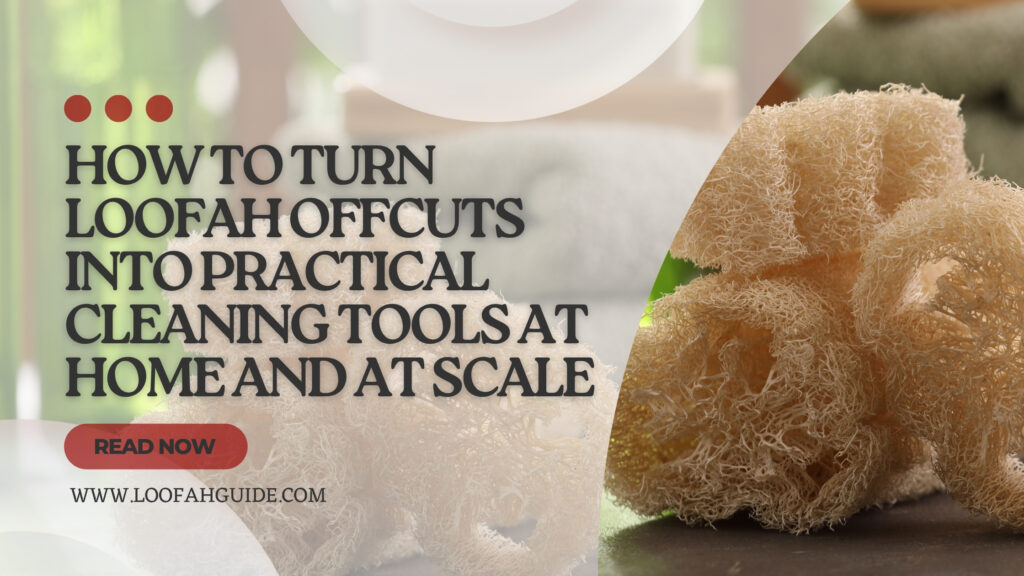
Picture the processing floor of an Egyptian loofah farm. Workers trim and sort mature loofah gourds that have been dried, peeled, and cut to size. In minutes, a pile of offcuts accumulates at the side of the workbench. End pieces. Irregular rounds. Trimmed edges. To an untrained eye, this looks like waste. To someone who understands loofah fiber, it looks like potential.
The idea of learning to transform loofah offcuts into useful cleaning tools is gaining momentum as households and businesses alike look for ways to reduce plastic waste and sourcing costs simultaneously. These offcut pieces carry the exact same fiber matrix, the same scrubbing performance, and the same biodegradable profile as the finished loofah products sold in stores. The only thing that differs is the shape.
This guide is written for two groups of people. The first is the individual consumer or eco-minded household looking for practical, zero-waste alternatives to synthetic kitchen sponges, bath scrubbers, and cleaning pads. The second is the wholesale buyer, retailer, or spa owner looking to build a product line around one of the most cost-effective natural fiber materials available.
By the end of this article, you will know exactly what loofah offcuts are, why Egyptian loofah offcuts in particular are the superior choice, how to process and repurpose them in step-by-step detail, what applications they serve best, and how to source them reliably at both consumer and commercial scale.
Understanding Loofah Offcuts: More Than Leftover Material
What Happens During Loofah Processing
Loofah, the fibrous skeleton of the Luffa cylindrica or Luffa aegyptiaca gourd, goes through several stages between harvest and finished product. After the outer skin is removed and the fruit is dried, the interior fiber cylinder is cut and sorted. Standard commercial cuts are typically cylindrical rounds of 10 to 15 centimeters in length and 8 to 12 centimeters in diameter. What remains after these cuts are the offcuts.
Offcuts include the end caps of the loofah fruit, which are often denser and slightly firmer than the central cylinder. They include trimmed edges from pieces cut to specific retail dimensions. They include smaller rounds that fall below standard size specifications. In total, offcuts can represent up to 30 percent of processed volume from a single harvest batch.
Why Offcuts Are Not Lesser Material
The mistake many people make is assuming that offcuts are somehow inferior in fiber quality. They are not. The cellulose fiber network that gives loofah its scrubbing and lathering properties runs continuously through the entire length of the fruit. An end cap from a Nile Delta Egyptian loofah has the same fiber density, the same tensile strength, and the same natural porosity as the center slice that ends up in a retail package.
In fact, end-cap offcuts from Egyptian loofah are often denser than center cuts, which makes them slightly more durable for heavy-duty scrubbing applications. Understanding this is what unlocks the real value of loofah offcuts.
For those interested in the full journey of Egyptian loofah from cultivation to export, the Egexo farm to export process gives a transparent look at how the world’s best loofah is grown and handled at every stage.
Why Egyptian Loofah Offcuts Are the Gold Standard
The Geographic Advantage
Not all loofah is created equal. Loofah grown in Egypt’s Nile Delta benefits from a combination of rich alluvial soil, consistent sunlight, and controlled irrigation that produces fiber of exceptional density and uniformity. This has made Egyptian loofah the preferred raw material for premium personal care and cleaning product manufacturers worldwide.
When you compare Egyptian loofah offcuts to finished products from other growing regions, the performance difference is measurable. Egyptian fiber has higher tensile strength, meaning it resists tearing under pressure. It has more consistent pore diameter, meaning it holds cleaning solution more evenly. And it dries faster because of its more open mesh structure, which reduces bacterial retention between uses.
| Quality Metric | Egyptian Loofah Offcuts | Asian Loofah (Standard) | Latin American Loofah |
|---|---|---|---|
| Fiber density (relative scale) | High | Medium | Medium to low |
| Tensile strength | High | Medium | Low to medium |
| Drying speed | Fast | Moderate | Moderate |
| Porosity consistency | Very consistent | Variable | Variable |
| End-of-life biodegradability | Complete | Complete | Complete |
| Scrubbing durability (weeks) | 4 to 8 | 2 to 5 | 2 to 4 |
These figures reflect the practical difference that origin makes. A loofah offcut from Egypt delivers more weeks of reliable performance than a finished standard-cut from a lower-quality growing region.
Egexo’s 25-Year Cultivation Advantage
Egexo is Egypt’s leading loofah wholesale supplier, with over 25 years of experience in loofah cultivation, processing, and export. Their operation in the Nile Delta applies traditional farming knowledge alongside modern quality control to produce loofah that meets the standards of importers in Europe, North America, and the Middle East.
When buying loofah offcuts at any scale, the supplier matters as much as the origin. Egexo’s commitment to quality standards ensures that even offcut grades are processed, cleaned, and sorted before they leave the facility. This consistency is critical for buyers building product lines and for consumers who want a reliable, high-performing cleaning tool.
A Complete Guide to Using Loofah Offcuts as Cleaning Tools
Selecting the Right Offcut for the Job
Before jumping into how to prepare and use a loofah offcut, it helps to know what type of offcut works best for each application. Size and density are the two most relevant variables.
| Application | Ideal Offcut Size | Key Feature Required |
|---|---|---|
| Dish and pot scrubbing | 5 to 8 cm diameter | Firm fiber, flat base preferred |
| Tile and grout scrubbing | 3 to 5 cm, elongated | Dense edge for targeted scrubbing |
| Body exfoliation (rough areas) | 6 to 9 cm, thick round | Medium to firm fiber density |
| Body exfoliation (face or sensitive skin) | 4 to 6 cm, thinner round | Softer, outer-layer fiber preferred |
| Surface wiping and countertop cleaning | 5 to 7 cm, wide flat piece | Good water absorption |
| Pet grooming | 4 to 6 cm, oval | Soft fiber, flexible structure |
For most households, Grade A and Grade B offcuts (roughly 4 to 10 centimeters in their largest dimension) cover the full range of daily cleaning needs.
Preparing Offcuts for First Use
Proper preparation before first use ensures that your loofah offcut cleaning tool is clean, safe, and performing at its best.
Step 1 – Initial inspection Check the offcut for any seed remnants, dried plant matter, or damaged fiber sections. Remove these by hand or with clean scissors.
Step 2 – Soaking Soak the offcut in clean warm water for 10 to 15 minutes. This softens the fiber and allows any loose particles to release. The offcut will expand slightly as it absorbs water.
Step 3 – First rinse Rinse thoroughly under running water, squeezing gently several times to push water through the fiber mesh.
Step 4 – Optional sanitization For kitchen scrubbers especially, a brief soak in a solution of white vinegar and water (one part vinegar, four parts water) for five minutes provides a natural sanitizing effect without harsh chemicals.
Step 5 – Drying before use Allow the offcut to air dry completely before first use. This takes two to four hours in normal room conditions or thirty to forty minutes in sunlight.
Step 6 – First use test Before committing the offcut to its intended cleaning application, test it on a small area. Loofah offcuts should scrub without scratching and release water and soap evenly through the fiber.
Daily Use and Maintenance
A loofah offcut cleaning tool lasts longer with minimal but consistent care.
Daily Care Checklist:
| Habit | Why It Matters |
|---|---|
| Rinse thoroughly after each use | Removes food particles and soap residue that encourage bacterial growth |
| Squeeze out excess water | Reduces drying time and extends fiber lifespan |
| Store in an open, ventilated space | Prevents moisture buildup that accelerates fiber breakdown |
| Do not leave submerged in water | Continuous moisture weakens the cellulose fiber over time |
| Replace when fiber begins to break down | Frayed or torn fiber loses scrubbing efficiency and hygiene integrity |
Following these habits, a high-quality Egyptian loofah offcut scrubber used daily in the kitchen will last four to six weeks. One used a few times per week for body exfoliation can last eight to twelve weeks.
Specific Cleaning Applications and How to Maximize Performance
Kitchen Scrubbing
The kitchen is where loofah offcuts shine most clearly against synthetic alternatives. A standard kitchen sponge retains moisture in its closed-cell structure, creating an ideal environment for bacteria to multiply between uses. Research has documented that kitchen sponges can harbor some of the highest bacterial loads of any household surface.
Loofah offcuts, by contrast, have an open mesh structure. Water drains freely and air moves through the fiber. When hung to dry after use, a loofah offcut reaches a much drier state than any synthetic sponge and does so faster.
For pots with baked-on residue, dampen the offcut first, add a small amount of dish soap, and scrub in a circular motion. The three-dimensional fiber structure catches on rough surfaces and dislodges stuck food particles without requiring excessive pressure.
For delicate non-stick surfaces, a softer outer-layer offcut is recommended. These tend to come from the outermost sections of the loofah fruit and have a finer fiber texture.
Explore the Egexo kitchen loofah range for finished kitchen scrubber products and offcut-grade options available in bulk.
Bathroom Tile and Grout Cleaning
Narrow, elongated loofah offcuts are remarkably effective at cleaning grout lines. The fiber edge can reach into the grout channel and remove surface mold, soap scum, and mineral buildup without damaging the grout or surrounding tile.
Pair the offcut with a baking soda paste for natural whitening action on grout. Apply the paste, work the loofah edge along the grout line, allow to sit for five minutes, then rinse. The result is clean grout without harsh chemical cleaners.
Skin Care and Body Exfoliation
Larger, thicker loofah offcuts work as body scrubbers in the bath or shower. Egyptian loofah has a firmness that provides real mechanical exfoliation, removing dead skin cells and stimulating surface circulation. This is not the gentle polishing of a soft synthetic brush. It is true exfoliation.
For most body areas, dampen the offcut, apply body wash or soap, and scrub in circular motions with moderate pressure. For rough-skin areas like heels and elbows, a firmer offcut piece provides the best results.
For the face or sensitive skin areas, a smaller, finer-fiber offcut is recommended. Alternatively, a piece of loofah can be placed inside a cotton mesh bag to soften the scrubbing action while still delivering exfoliation benefits.
The Egexo body loofah category covers finished personal care loofah products, and the consumer guides at Loofah Guide provide additional tips on skin care use.
Making Your Own Loofah Offcut Cleaning Kit: A Practical DIY Approach
What You Need
Creating a practical household cleaning kit from loofah offcuts requires very little beyond the offcuts themselves. You may want:
- Clean scissors for minor shaping
- White vinegar for initial sanitization
- A small cotton mesh bag or natural net pouch (optional, for bath use)
- Natural twine or cotton cord for hanging storage
Building Your Kit
Kitchen scrubber set: Select two to three Grade A offcuts of similar size (5 to 7 centimeters). Clean, dry, and store in an open container near the sink. Replace on a rotating schedule.
Bathroom tile kit: Select two to three elongated or narrow pieces. Store dry in a ventilated bathroom caddy.
Body care scrubber: Select one larger, firmer piece for body use and one smaller, softer piece for sensitive areas. If desired, place the softer piece in a mesh pouch.
Compost collection: Keep a small bin in the kitchen. When offcut tools are spent, drop them directly into the compost. No sorting, no recycling confusion, no plastic.
This kind of zero-waste cleaning kit has genuine appeal for eco product retailers looking to offer a curated experience. If you are a retailer or brand interested in creating a private label version of this kit, Egexo’s custom product design services can bring it to production at scale.
Wholesale Opportunity: Building a Product Line from Loofah Offcuts
The Market Context
The global natural personal care and cleaning product market was valued at over 20 billion USD in 2024 and continues to grow at roughly 6 to 8 percent annually. Within this market, zero-waste and biodegradable cleaning tools represent one of the fastest-growing subcategories, driven by consumer demand for products that eliminate single-use plastic.
Loofah offcuts fit squarely into this growth segment. They are natural, biodegradable, functional, and available at lower cost than finished loofah products. For brands and retailers willing to invest in positioning and packaging, the margin opportunity is significant.
Product Line Options Based on Offcut Grade
| Product Concept | Offcut Grade Required | Suggested Retail Format | Target Retail Channel |
|---|---|---|---|
| Eco kitchen scrubber 3-pack | Grade A | Kraft paper wrapped, recycled twist tie | Health food stores, zero-waste retailers |
| Exfoliating bath pad | Grade A (large) | Mesh pouch with hang tag | Beauty retailers, spa boutiques |
| Tile and grout cleaning kit | Grade B | Cardboard tray with reusable cotton bag | Hardware stores, eco cleaning retailers |
| Subscription cleaning box add-on | Grade A and B mix | Custom kraft sleeve | Direct-to-consumer e-commerce |
| Pet grooming set | Grade B (soft piece) | Natural bag with branded card | Pet specialty retailers |
For buyers ready to explore bulk sourcing for any of these product concepts, the Egexo shop provides an overview of available product categories, and the wholesale quotation page connects you with Egexo’s export team directly.
The Egexo product catalog is also available for download and covers full specifications, grading standards, and packaging options for offcut and finished loofah products.
Expert Insight from Egexo
One thing that surprises new buyers when they first source loofah offcuts from us is the consistency. They expect offcuts to be highly variable, a mixed bag of different sizes and qualities. At Egexo, that is not the case. We apply the same grading standards to our offcut output as we do to our finished products.
Every batch of offcuts we process is sorted by size, cleaned to the same hygiene standard, dried to a consistent moisture level, and inspected before packaging for export. The reason is simple. An offcut that reaches a retailer or a home consumer should perform reliably. If it does, that buyer comes back. If it does not, that is one more person who is skeptical of natural cleaning products unnecessarily.
Our advice to anyone new to loofah offcut sourcing: do not compromise on supplier quality to save a small amount on raw material cost. The difference between a well-processed Egyptian loofah offcut and a poorly handled one from a low-quality source is measurable in both cleaning performance and lifespan. Order samples from Egexo and experience the difference directly before placing a bulk order.
Additional wholesale sourcing guidance is available at Wholesale Loofah.
FAQ Section
Q1: What is the difference between loofah offcuts and standard loofah slices?
A: Loofah offcuts are the pieces that remain after standard-sized loofah slices are cut from the main fiber cylinder. They include end pieces, trimmed edges, and smaller irregular rounds. The fiber quality in offcuts is identical to standard slices because loofah fiber runs continuously throughout the entire fruit. The only practical difference is shape and size, not scrubbing performance or durability.
Q2: How do I store loofah offcut cleaning tools to make them last longer?
A: The most important factor in loofah longevity is drying. After each use, rinse the offcut thoroughly, squeeze out excess water, and store it in an open, ventilated location. Avoid sealed containers or soap dishes that trap moisture. A small wire basket, a suction cup hook near the sink, or a hanging cotton bag near a window all work well. Consistent drying between uses can double the lifespan of a loofah offcut scrubber.
Q3: Can I cut loofah offcuts into specific shapes for cleaning applications?
A: Yes. Loofah fiber can be trimmed with clean, sharp scissors without damaging the surrounding mesh. If you need a narrower piece for grout cleaning, a specific diameter for a soap pouch, or a flat pad shape for surface wiping, simple trimming is effective. Cut slowly and avoid sawing motions that could fray the fiber edges.
Q4: Are loofah offcuts safe for use on non-stick cookware?
A: Softer, outer-layer loofah offcuts are generally safe for non-stick surfaces when used with moderate pressure. The key is to use the finer-textured pieces and avoid grinding the offcut into the surface. If you are unsure, test a small hidden area first. For heavily baked-on residue, avoid abrasive scrubbing on non-stick surfaces regardless of tool material.
Q5: What certifications should I look for when sourcing loofah offcuts for product manufacturing?
A: For product manufacturing, look for suppliers who can provide natural or organic certifications for their loofah cultivation process, hygiene and processing documentation confirming clean handling, and export compliance certifications relevant to your destination market. Egexo provides full documentation for export orders and publishes its quality standards on the loofah quality standards page. Request documentation alongside your sample order.
Q6: How many loofah offcuts make up a standard bulk order?
A: This varies by grade and size. A standard export carton of Grade A loofah offcuts may contain 200 to 500 individual pieces depending on dimensions. A full pallet would contain multiple cartons. For exact quantities, dimensions, and weight specifications per grade, download the Egexo product catalog or contact the export team via the quotation page.
Q7: Can loofah offcut cleaning tools replace all synthetic sponges in a household?
A: For the vast majority of household cleaning tasks, yes. Loofah offcuts handle dish scrubbing, surface wiping, tile cleaning, and bathroom scrubbing effectively. The main limitation is for very fine or delicate surface cleaning where even a soft loofah edge might cause scratching, in which case a soft cloth may be preferred. For everything else, a well-graded loofah offcut performs as well as or better than a synthetic sponge, with the added benefit of full biodegradability.
Q8: What is the environmental impact of using loofah offcuts versus synthetic cleaning sponges?
A: The environmental impact difference is substantial. Synthetic kitchen sponges are made from polyurethane or polyester, both petroleum-based materials that do not biodegrade. They shed microplastics during use and create long-term plastic waste. Loofah offcuts are 100 percent plant-based, shed no synthetic particles during use, and compost completely at end of life. Switching a single household from synthetic sponges to loofah offcuts eliminates approximately 26 to 52 synthetic sponges from the waste stream per year.
Conclusion
Loofah offcuts represent a genuinely underutilized resource in the natural fiber world. For consumers, they offer an affordable, biodegradable, and highly effective alternative to every synthetic sponge and cleaning pad in the home. For wholesale buyers, they represent a low-cost raw material with strong margin potential and authentic sustainability credentials.
The key to making the most of loofah offcuts is understanding what they are (full-quality fiber in non-standard sizes), how to prepare them (clean, dry, grade, and shape), and where to source them (from a quality-controlled Egyptian loofah supplier like Egexo).
Key Takeaways:
- Loofah offcuts carry the same fiber quality as finished loofah products, only the shape differs
- Egyptian loofah offcuts outperform alternatives from other growing regions in durability and performance
- Proper preparation and drying habits extend the lifespan of offcut cleaning tools significantly
- Wholesale buyers can build high-margin eco product lines using loofah offcuts as the primary raw material
- Every loofah offcut cleaning tool is fully compostable at end of life
Ready to experience Egyptian loofah quality?
- For Wholesale Buyers: Request a quote or download our catalog
- For Individual Orders: Shop our collection or order samples