Here is a number worth sitting with: the typical household discards between 10 and 15 synthetic bath and kitchen sponges every single year. Multiply that across a city, a country, or a continent and the scale of the problem becomes almost abstract. Each discarded synthetic sponge adds to a pile of non-biodegradable material that will outlast everyone currently alive.
The shift away from synthetic bath products has been building steadily, and incorporating loofah sponges into your routine sits at the center of that conversation. The loofah is not a wellness trend or a boutique product for eco-purists. It is a mature, well-understood, naturally cultivated plant product with a track record measured in centuries rather than seasons.
This guide is built for people who want practical, honest information. Whether you are making a personal switch to reduce your plastic footprint, building a sustainable product offering for your retail business, or sourcing natural bath products at scale for a spa or hospitality group, the principles here apply equally. We draw on the expertise of Egexo, an Egyptian loofah supplier and cultivator with more than 25 years in the industry, to make sure everything here is grounded in real-world knowledge rather than greenwashing.
You will come away from this guide knowing exactly how to transition your bathroom, which loofah products serve which purposes, how to maintain them properly, and how to evaluate quality whether you are buying one or ten thousand.
Understanding the Loofah: From Plant to Product
The loofah (Luffa cylindrica or Luffa acutangula) is a climbing vine that produces large, elongated fruits. As the fruit matures and the moisture content drops, the fibrous interior network dries into the sponge structure that makes it useful for bathing, scrubbing, and cleaning. What looks and feels like a manufactured product is entirely the result of the plant’s natural cellular structure.
This matters because the quality of the finished loofah is inseparable from the quality of the growing conditions. Soil composition, irrigation practice, harvest timing, and post-harvest drying all directly influence the density, color, flexibility, and durability of the final product.
Why Egypt Produces the World’s Best Loofah
Egypt’s Nile Delta is recognized within the global loofah trade as the origin point for premium-grade loofah. The region’s silty, mineral-rich alluvial soil provides nutrition that supports exceptional fiber development. The hot, dry climate after harvest accelerates natural drying without the mold risk that affects loofah production in more humid regions.
Egyptian loofah cultivated and exported by specialists like Egexo typically presents with higher fiber density, more uniform texture, and longer usable lifespan than comparable products from China, India, or Latin American growing regions. For consumers, this means a better product experience. For wholesale buyers, it means lower replacement rates, fewer customer complaints, and stronger brand equity.
Loofah Product Types and Their Applications
| Loofah Product Type | Primary Application | Best For |
|---|---|---|
| Natural whole loofah | Full body exfoliation | Daily bathing routine |
| Loofah slice disc | Targeted exfoliation, facial use | Face, elbows, heels |
| Loofah on rope | Back scrubbing, hanging storage | Daily shower use |
| Loofah mitt | Large surface exfoliation | Full body coverage |
| Kitchen loofah scrubber | Dish and surface cleaning | Kitchen, utility cleaning |
| Raw loofah scrubber | Industrial and craft use | DIY projects, heavy scrubbing |
| Loofah pet grooming pad | Animal bathing and grooming | Pet care routines |
| Loofah gift set | Retail, gifting, hospitality | Spa, hotel, retail |
For a curated selection of natural loofah products, the Egexo bath and body loofah range covers most personal care applications, while kitchen loofahs address sustainable cleaning needs.
Incorporating Loofah Sponges into Your Routine: A Room-by-Room Strategy
The most common mistake people make when going zero-waste is trying to change everything at once. A more effective approach is systematic substitution, one product category at a time, starting with the items you use most frequently.
The Bathroom: Where the Transformation Begins
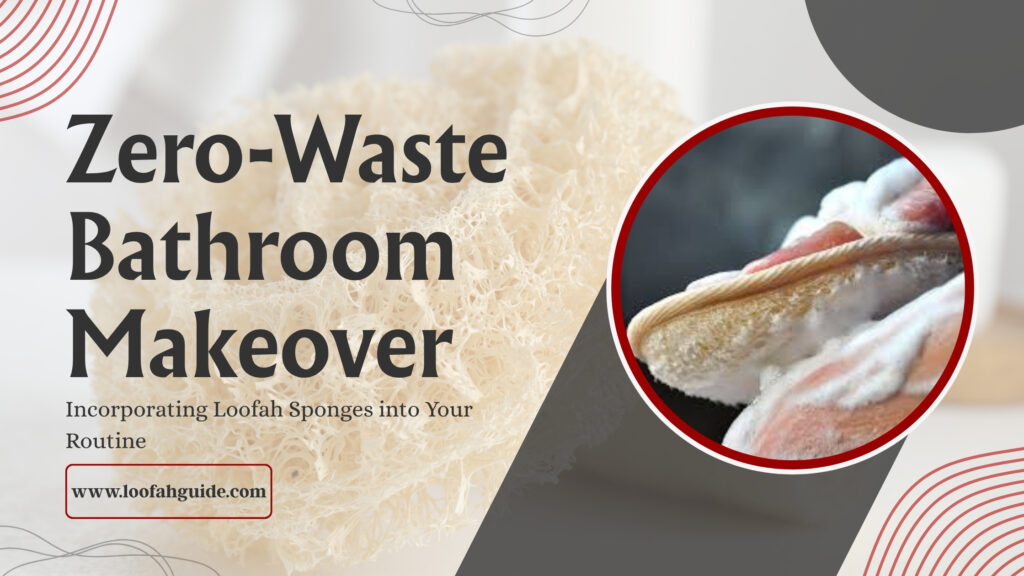
Incorporating loofah sponges into your routine typically starts in the shower or bath, and for good reason. This is where synthetic products accumulate most quickly and where natural loofah delivers the most immediate, noticeable benefit.
Week One: Replace the Shower Pouf
The shower pouf is the single most impactful first substitution. A natural loofah body scrubber provides equivalent lather and better exfoliation, with none of the plastic fiber shedding that makes synthetic poufs a microplastic concern. Soak your new loofah for one minute before first use to open and soften the fibers, then proceed as normal.
Week Two: Add a Loofah Scrubbing Disc for Targeted Areas
Elbows, heels, knees, and the back of the arms often need more targeted attention than a full body scrub provides. A smaller loofah disc or slice works perfectly here, allowing focused exfoliation without over-scrubbing. This addition rounds out the body care routine without adding complexity.
Week Three: Introduce a Loofah Back Scrubber
A loofah on rope or a loofah mitt makes it easy to reach the back and shoulders, areas that are genuinely difficult to exfoliate without a purpose-built tool. These products hang naturally in the shower between uses, draining and drying without needing a dedicated storage solution.
Week Four: Tackle the Kitchen
Once the bathroom transition is complete, extending the same logic to the kitchen takes almost no adjustment. A loofah kitchen scrubber replaces the foam sponge, lasts comparably, and goes directly into the compost bin at the end of its life rather than into general waste. Explore Egexo’s kitchen loofah options for commercial-grade scrubbers suitable for both home and food service environments.
Loofah Skin Benefits: What the Science Actually Says
Incorporating loofah sponges into your routine produces measurable skin benefits that go beyond the simple removal of dead cells. Understanding the mechanism helps consumers use their loofahs more effectively and helps retailers and spa owners communicate product value accurately.
Mechanical Exfoliation and Cellular Renewal
The outermost layer of human skin, the stratum corneum, continuously produces new cells that migrate upward as older cells die and accumulate on the surface. Regular mechanical exfoliation removes this layer of dead cells, which improves skin texture, allows moisturizers to penetrate more effectively, and promotes a healthier, more even complexion.
Natural loofah fibers operate in a range of the exfoliation intensity spectrum that is effective without being aggressive. Unlike sugar scrubs, which dissolve rather than physically lift dead cells, or pumice stones, which can be too abrasive for regular facial or body use, loofah provides consistent, controllable exfoliation that most skin types can tolerate two to three times per week.
Circulation Benefits
The mechanical action of loofah scrubbing also provides mild stimulation to the microcirculation in the skin. This is why skin often appears temporarily flushed after loofah use. Regular stimulation of surface circulation is associated with improved skin tone and is a core component of many professional body treatment protocols.
Skin Type Compatibility Guide
| Skin Type | Recommended Loofah Use | Frequency | Special Notes |
|---|---|---|---|
| Normal | Full body loofah scrub | 3-4 times per week | No restrictions |
| Dry | Loofah with moisturizing soap | 2-3 times per week | Apply body oil immediately after |
| Oily | Loofah with clarifying wash | 3-4 times per week | Focus on T-zone and back |
| Sensitive | Softened loofah, light pressure | 1-2 times per week | Always pre-soak to maximize softness |
| Combination | Full body loofah, targeted use | 3 times per week | Adjust pressure by area |
| Mature | Loofah with hydrating products | 2 times per week | Avoid broken or inflamed skin |
Loofah Maintenance: The Habits That Make or Break Your Experience
One of the most common reasons people abandon natural loofahs after a short trial is improper care leading to unpleasant odor or texture change. The maintenance required is minimal, but it needs to be consistent.
The Non-Negotiable Rules of Loofah Care
Drying completely between uses is not optional. A loofah that stays damp in an enclosed shower niche will begin to harbor bacteria and mold within days. The solution is simple: after rinsing, squeeze gently to remove excess water and hang the loofah somewhere it gets airflow. A hook near an open window or on the outside of the shower door works well.
Weekly sanitization extends lifespan and maintains hygiene. Soaking your loofah in a solution of one part white vinegar to four parts water for five minutes, then rinsing thoroughly, effectively neutralizes bacteria without damaging the fibers. Some users prefer a diluted baking soda soak as an alternative.
Knowing when to replace is as important as knowing how to maintain. A loofah that develops a persistent odor that does not clear after sanitization, shows visible mold spots, or begins to fall apart structurally should be replaced immediately. Under proper care conditions, this typically happens no sooner than four weeks into regular use.
Loofah End-of-Life Guide
| End-of-Life Method | How To | Benefit |
|---|---|---|
| Home composting | Add to compost pile after removing any rope or accessories | Returns nutrients to soil |
| Garden mulch | Dry and cut into pieces, spread around plants | Moisture retention, slow decomposition |
| Seed starter | Use loofah slice as biodegradable seed starting tray | Zero-waste gardening |
| Cleaning tool downgrade | Use old bath loofah for cleaning before composting | Maximizes full utility |
This end-of-life flexibility is one of the most compelling aspects of incorporating loofah sponges into your routine. Unlike synthetic products, the loofah’s lifecycle does not end at the landfill. It ends at the garden, closing the loop on what a genuinely circular product looks like in practice.
Wholesale Loofah: What Business Buyers Need to Know
The consumer shift toward natural bath products is creating measurable demand for natural loofah across retail, hospitality, and wellness sectors. For businesses evaluating the opportunity, the practical questions center on quality consistency, supply reliability, and commercial terms.
Market Context for Wholesale Buyers
The global natural personal care market is growing at approximately 9 percent annually, with sustainable bathing and cleaning products representing one of the stronger growth categories. Consumers across North America, Europe, and increasingly Asia-Pacific are actively seeking plastic-free alternatives for everyday hygiene and cleaning products. This demand is structural, not cyclical.
Wholesale buyers entering the natural loofah category benefit most when they partner with a vertically integrated supplier rather than a trading intermediary. A supplier with direct farm access, in-house processing, and export experience provides better quality control, more consistent supply, and greater flexibility for custom requirements.
Egexo represents exactly this model. With 25-plus years of loofah cultivation and export operations, direct access to Nile Delta farms, and full private label capability, Egexo serves wholesale clients ranging from independent spa operators to large-scale importers across more than 40 countries. The why choose Egexo resource provides a detailed overview of the supplier model and its commercial advantages.
Wholesale Product Specifications Reference
| Specification | Grade A Premium | Grade B Commercial | Raw Loofah Scrubbers |
|---|---|---|---|
| Typical length (whole loofah) | 25-35 cm | 20-30 cm | Variable |
| Fiber density | High, uniform | Medium-high | Natural variable |
| Moisture content at shipment | Below 12 percent | Below 14 percent | Below 15 percent |
| Minimum order quantity | 500 units | 1,000 units | Custom |
| Typical lead time | 3-4 weeks | 2-3 weeks | 4-6 weeks |
| Private label availability | Yes | Yes | Yes |
| Custom dimensions | Yes | Limited | Yes |
Buyers can view and download the full product range in the Egexo wholesale catalog or request samples before committing to a production order.
Private Label and Custom Development
One of the strongest growth opportunities in the natural loofah category is branded product development. Independent spa brands, wellness retailers, and eco-product companies are increasingly moving away from generic commodity loofahs toward branded collections with custom packaging, specific product combinations, and proprietary design elements.
Egexo supports this through dedicated private label loofah manufacturing and custom loofah product design services. Businesses at any stage of brand development, from concept to established label, can work with Egexo’s product development team to create loofah collections that reflect their brand identity and meet their target retail price architecture.
For wholesale inquiries, the request a quote process provides a direct path to pricing and logistics discussions with Egexo’s export team.
FAQ Section
Q1: What is the correct way to prepare a new loofah before first use?
A: Before using a new natural loofah for the first time, soak it in warm water for 60 to 90 seconds. This softens the fibers, making the first use more comfortable and effective. Some users add a small amount of mild soap to the soaking water. After soaking, squeeze gently to remove excess water, apply your preferred cleanser, and use as normal. The loofah will feel slightly firmer when dry and softer during use.
Q2: How often should I replace my loofah?
A: Under proper care conditions, a natural loofah used daily should be replaced every 3 to 4 weeks. Signs that replacement is overdue include persistent odor after cleaning, visible discoloration or dark spots, significant fiber loss, or structural breakdown. Replacing on schedule is important for both hygiene and performance, as a degraded loofah becomes less effective at exfoliation and more hospitable to bacterial growth.
Q3: Can I use a loofah on my face?
A: Small loofah discs and slices can be used on the face, but with care. The face requires lighter pressure and a more thoroughly pre-softened loofah than the body. People with acne-prone skin should be cautious, as mechanical exfoliation on active breakouts can spread bacteria and irritate already-inflamed skin. For most people, once or twice per week facial loofah use with a thoroughly soaked, softened loofah is well-tolerated.
Q4: What makes Egexo’s Egyptian loofah different from what I can buy at a regular store?
A: Egexo sources exclusively from Nile Delta cultivation, which produces loofah with measurably higher fiber density and more uniform texture than generic imported loofahs available in most retail channels. Egexo also applies quality grading standards covering fiber density, moisture content, coloration, and structural integrity that are stricter than commodity-grade production standards. The practical result is a loofah that exfoliates more consistently, lasts longer, and feels better in use.
Q5: Can natural loofahs be used for kitchen cleaning?
A: Yes. Natural loofah kitchen scrubbers work effectively for dish washing, pot scrubbing, and surface cleaning. They provide abrasive cleaning action without scratching non-stick surfaces when used correctly. Like bath loofahs, kitchen loofahs should be rinsed thoroughly after each use and allowed to dry completely. Kitchen loofahs typically need more frequent replacement than bath loofahs due to exposure to food residue and grease, generally every two to three weeks.
Q6: How do I evaluate loofah quality before placing a wholesale order?
A: The most reliable evaluation method is physical sample inspection. Request samples from any supplier before placing a bulk order and assess fiber density by compressing and releasing the loofah, uniformity of color and texture across multiple samples, fiber shedding under normal use pressure, flexibility without structural breakdown, and odor after a full wet-dry cycle. Egexo provides samples through its dedicated sample request program, which allows buyers to evaluate actual production quality rather than display samples.
Q7: What environmental impact does switching to loofah actually have?
A: Replacing a typical synthetic shower pouf with a natural loofah eliminates approximately 20 to 40 grams of non-biodegradable plastic per replacement cycle. Across annual usage, a single household switching from synthetic poufs to natural loofahs removes between 200 and 400 grams of plastic waste from landfill streams each year. Scaled across a retail customer base of 1,000 consumers, a business switching to natural loofah helps divert between 200 and 400 kilograms of plastic annually.
Expert Insight from Egexo
The most frequent question we receive from first-time loofah buyers, whether they are ordering for personal use or evaluating wholesale, is: how do I know if this is actually good quality?
The answer comes down to three things: fiber density, moisture content, and origin transparency. A quality loofah should feel substantial but not rigid when dry, compress and spring back when wet, and show consistent color without bleaching or chemical treatment. It should come with clear documentation of where it was grown and how it was processed.
At Egexo, we built our entire operation around making these things verifiable. Our farm-to-export process documentation shows exactly what happens between the field and the shipment. Our quality standards page specifies exactly what we grade for and why. This transparency is not a marketing exercise. It is what 25-plus years in the loofah export business has taught us buyers actually need to make confident decisions.
Conclusion
Incorporating loofah sponges into your routine is a decision that makes sense at every level: environmentally, practically, and commercially. The loofah is a renewable, fully biodegradable, high-performance product that replaces synthetic alternatives without asking you to compromise on results. That is a combination that is genuinely rare in sustainability choices, where the eco-friendly option is so often also the inferior-performing one.
Egyptian loofah, particularly at the quality level that Egexo has maintained across more than 25 years of cultivation and export, represents the best available version of this product globally. For consumers, that means better skin results and a better experience. For wholesale buyers, that means a product their customers will repurchase and recommend.
Key Takeaways:
- Incorporating loofah sponges into your routine works best as a phased, product-by-product approach starting with the shower
- Natural loofahs outperform synthetic alternatives in exfoliation quality, biodegradability, and total lifetime value
- Egyptian loofah from Nile Delta cultivation produces measurably superior fiber density compared to other growing regions
- Proper care, particularly complete drying between uses, determines loofah longevity more than any other factor
- Wholesale buyers benefit from partnering with vertically integrated suppliers like Egexo who offer quality documentation and sample programs
Ready to experience Egyptian loofah quality?
- For Wholesale Buyers: Request a quote or download our catalog
- For Individual Orders: Shop our collection or order samples
- For more detailed consumer guides visit loofahguide.com
- For wholesale purchasing resources visit wholesaleloofah.com