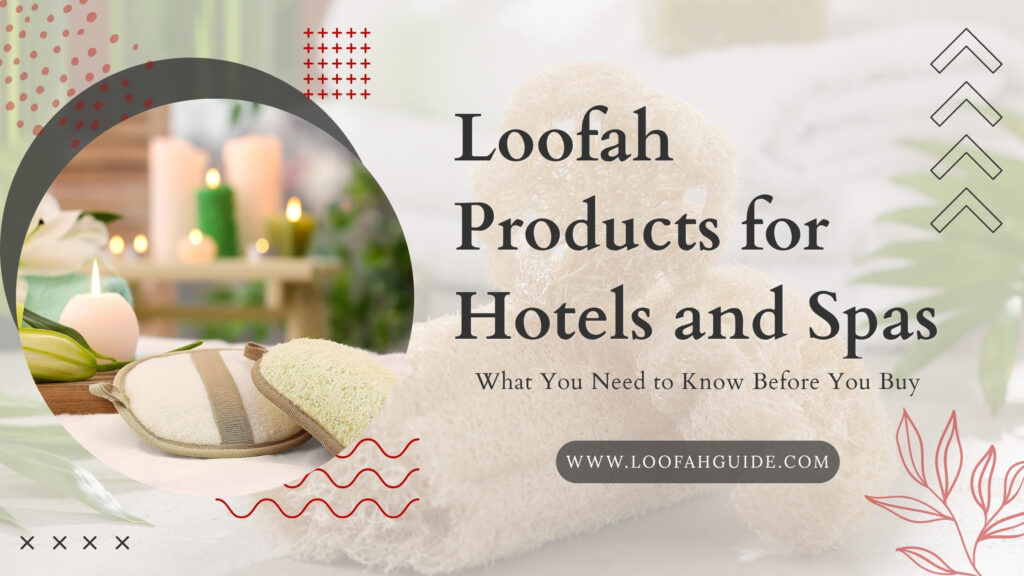
Why the Loofah in a Luxury Hotel or Spa Is Not the Same as What You Buy at the Pharmacy
Most people who have experienced a professional spa body scrub or noticed the quality of a loofah placed in a luxury hotel bathroom have had the same thought: whatever that is, I want it at home. The truth is, loofah products for hotels and spas are fundamentally different from what fills the shelf at a mass market retailer, and understanding why is the first step toward getting the same results outside a professional setting.
Professional grade loofah is sourced to specific fiber density, size consistency, moisture content, and structural integrity standards that most consumer products never attempt to meet. Hotels and spas specify these standards because their guests and clients are paying for a predictable, premium experience. A loofah that works inconsistently, falls apart after two uses, or delivers patchy exfoliation is not a minor inconvenience in a luxury spa setting. It is a brand problem.
This guide explains what distinguishes professional loofah from consumer alternatives, which product formats are used in hospitality settings and why, and how individual consumers and wholesale buyers alike can access the same quality. We also cover what makes Egyptian loofah the global standard for professional hospitality supply and why origin matters more than most people realize when it comes to loofah performance.
For wholesale buyers building amenity programs or spa product ranges, this guide provides the product knowledge and supplier evaluation framework needed to make confident sourcing decisions. For individual consumers, it provides the context needed to identify genuinely professional-grade loofah products when shopping.
Detailed product guides and consumer resources are available at LoofahGuide.com. The full professional grade product range is available through Egexo’s wholesale shop.
The Loofah Products Hotels and Spas Actually Use
Not all hospitality loofah applications are the same. Professional spa and hotel settings use natural loofah in several distinct formats, each serving a specific function within the guest or client experience.
Signature Body Treatment Loofahs
The most visible loofah application in professional spa settings is the full-size treatment loofah used in body scrub sessions. These are typically 12 to 16 cm in diameter and 20 to 30 cm in length. They must be firm enough to deliver meaningful exfoliation through the full arc of a 60-minute treatment without losing structural integrity, yet flexible enough after warm water saturation to conform to the body’s contours without causing discomfort.
The therapist using this tool depends on its consistency. A loofah with uneven fiber density in different sections of the same product creates inconsistent pressure, which produces uneven exfoliation results that clients notice and comment on in reviews.
Sliced Loofah Rounds for Targeted Treatments
Sliced loofah rounds, typically cut to 2 to 3 cm thickness, are used in targeted body treatments, as treatment tool presentation elements in spa trays, and increasingly in upscale facial treatment protocols using very soft grade loofah pads.
These formats require a base material with very consistent fiber structure throughout the loofah’s cross-section. A whole loofah that appears uniform on the outside can have denser fiber at its center and sparser fiber at its edges. When sliced, this internal variation becomes visible and affects treatment performance. Only loofah grown in ideal conditions, such as the Nile Delta region’s premium cultivation environment, produces the uniform internal fiber structure that sliced formats require.
Raw loofah scrubbers in bulk form the base material for spas and treatment product developers working with these sliced formats.
Hotel Bathroom Amenity Loofahs
A growing number of luxury and boutique hotel properties include a small natural loofah as part of their bathroom amenity offering. These are typically 8 to 10 cm diameter and 10 to 15 cm long, presented in natural packaging that complements the property’s aesthetic.
The commercial logic is strong. A natural loofah costs a fraction of the positive brand impression it creates. Guests who find a natural Egyptian loofah in their bathroom alongside a handcrafted soap frequently mention it in their reviews as evidence that the property paid attention to details that matter. For hotels competing in the premium segment, this guest feedback is commercially significant.
Spa Retail Loofahs
Many spas maintain a retail offering alongside their treatment menu. Natural Egyptian loofah products presented with clear origin and quality information sell well in spa retail environments because the guest has already experienced the product in a treatment context and understands its value.
The bath and body loofah range from Egexo includes retail-ready products that can be supplied with custom labeling through the private label loofah manufacturing service.
How Professional Grade Loofah Is Evaluated: The Complete Quality Framework
For both wholesale buyers and informed consumers, understanding how professional grade loofah is evaluated makes it possible to assess any product intelligently rather than relying on marketing claims alone.
Key Quality Parameters and What They Mean
| Quality Parameter | Definition | Professional Standard | Why It Matters |
|---|---|---|---|
| Fiber density | Number of fiber intersections per square centimeter of loofah surface | High, uniform throughout | Determines exfoliation consistency |
| Moisture content | Water retained in fiber at time of purchase | Less than 12 percent | Prevents mold during storage |
| Size tolerance | Variation in diameter and length across batch | Within 5 percent | Required for consistent product presentation |
| Internal uniformity | Whether fiber density is consistent from surface to core | High, no hollow core | Critical for sliced format applications |
| Natural color range | Degree of bleaching or chemical treatment | None or minimal | Preserves skin safety and natural credentials |
| Structural integrity under wet use | Resistance to fiber breakdown during active use | High, no shedding | Prevents premature product failure |
| Origin verification | Documented source of cultivation | Egyptian farm-direct | Guarantees agricultural quality conditions |
Each of these parameters is measurable and verifiable. Buyers who request documentation on all seven from a prospective supplier are conducting a genuine quality assessment. Buyers who rely on visual inspection alone are accepting significant quality uncertainty.
Egexo’s quality standards documentation covers each of these parameters with specific measurable thresholds and explains how they are tested before export.
How to Test Loofah Quality Without a Laboratory
For buyers who want to assess loofah quality from a sample before placing a bulk order, the following practical tests provide useful quality indicators:
- Weight the sample and compare to its stated size. A high-density loofah weighs noticeably more than a low-density one of the same size.
- Compress the dry loofah fully and observe recovery speed. A high-quality loofah springs back rapidly without visible deformation.
- Soak in warm water for 60 seconds and assess how evenly the fiber softens. Uneven softening indicates variable density.
- Rub across a flat surface under moderate pressure. Minimal fiber shedding indicates good structural integrity.
- Examine the cross-section (if possible by cutting a thin slice). Look for fiber density that is consistent from the outer edge to the center.
Request loofah samples from Egexo before any bulk purchase to conduct these assessments on production-representative product.
Egyptian Loofah: The Standard That Defines Professional Hospitality Supply
There is a reason that procurement teams at leading hotel groups and spa brands specify Egyptian origin in their loofah sourcing requirements. It is not a marketing preference. It is a quality specification backed by consistent agricultural conditions and decades of verified export performance.
What Egypt’s Growing Conditions Produce
The Luffa aegyptiaca plant grown in the Nile Delta benefits from a combination of soil composition, growing season length, and climate conditions that consistently produce loofah with the dense, uniform fiber structure that professional hospitality use demands.
The alluvial soil of the Nile Delta is exceptionally rich in the mineral content that promotes vigorous plant development. A longer growing season under consistent sun allows the loofah gourd to develop to full maturity before harvest, which is the key factor in fiber density. Loofah harvested before full maturity has sparse fiber and poor structural integrity. Loofah from regions with shorter growing seasons frequently falls into this category.
Egexo manages the entire growth and harvest cycle from its own farms in the Nile Delta, which means harvest timing is controlled for quality rather than rushed for volume. The farm to export process is documented in detail and represents one of the most transparent supply chains in the natural loofah industry.
Egypt’s Loofah Export Track Record
Egypt has exported natural loofah commercially for well over a century. The industry knowledge accumulated over that time, including optimal harvest timing, drying methods, grading systems, and export handling procedures, is built into the operational DNA of suppliers like Egexo in a way that newer-market suppliers simply cannot replicate quickly.
For hospitality buyers making sourcing decisions that affect guest experience and brand reputation, this track record is a risk management argument as much as it is a quality argument. An established Egyptian supplier with verifiable export history carries far less sourcing risk than a lower-price alternative from a market without the same quality infrastructure.
For wholesale buyers exploring the full scope of Egexo’s product and service offering, the why choose Egexo page provides a comprehensive overview, and the product catalog covers available product specifications in detail.
Sustainable Loofah Amenities: The Hospitality Industry’s Natural Choice
Sustainability is no longer optional for luxury hotels and spas. An increasing number of properties are committed to removing single-use plastics from their operations, achieving environmental certifications, and communicating credible sustainability narratives to a guest demographic that actively researches these commitments before booking.
Natural loofah aligns with every dimension of this commitment in a way that few amenity products can match.
The Environmental Profile of Natural Loofah vs Synthetic Alternatives
| Environmental Factor | Natural Egyptian Loofah | Synthetic Mesh Puff | Plastic Scrub Brush |
|---|---|---|---|
| Material origin | Agricultural, plant-based | Petroleum-derived nylon | Petroleum-derived plastic |
| Biodegradable | Yes, fully compostable | No, 400 plus years in landfill | No, 400 plus years in landfill |
| Microplastic emission | None | Yes, with every wash | Potentially, with wear |
| Carbon footprint of production | Low, agricultural | High, industrial manufacturing | High, industrial manufacturing |
| End of life disposal | Compost or natural decomposition | Landfill | Landfill or incineration |
| Renewable resource | Yes, annual crop | No | No |
| Packaging compatibility | Plastic-free options available | Typically plastic packaged | Typically plastic packaged |
For hotels pursuing LEED, Green Key, or similar environmental certifications, switching from synthetic bathroom amenities to natural loofah reduces the environmental impact of the amenity program across multiple metrics simultaneously.
For spa brands that communicate sustainability credentials to clients and press, the story of Egyptian loofah grown in the Nile Delta and exported with full traceability is a genuine, verifiable sustainability narrative rather than a marketing claim.
A Consumer’s Guide to Buying Professional Grade Loofah for Home Use
One of the most common questions from consumers who discover the quality difference between professional and retail loofah is how to access the same product outside a spa or hotel context.
The answer is direct: professional grade Egyptian loofah is available to individual consumers through the same supply chains that serve hospitality buyers. The product does not change based on who purchases it. What changes is the quantity and packaging.
What to Look for When Buying Professional Quality Loofah as a Consumer
| Shopping Criterion | What It Means | How to Verify |
|---|---|---|
| Egyptian origin specified | Product is from Nile Delta cultivation | Check product description, request documentation |
| Natural color without bleaching | Minimal chemical processing | Look for beige to tan natural color |
| Dense visible fiber mesh | High fiber density in growing conditions | Visible on product photograph or in person |
| Firm but flexible when wet | Correct maturity at harvest | Wet test before committing to regular purchase |
| Clean, natural smell only | No chemical treatment residue | Smell before purchase if possible |
| No hollow center | Uniform internal fiber structure | Request cross-section sample if buying bulk |
Consumers who want to experience the same loofah quality used in leading spas can explore the bath and body loofah collection directly through Egexo, or find detailed buying guidance and usage tutorials at LoofahGuide.com.
FAQ Section
Q1: What types of loofah products are used in professional hotel and spa settings? A: Loofah products for hotels and spas include full-size body treatment loofahs for signature scrub sessions, sliced loofah rounds for targeted and facial treatments, mini loofahs for bathroom amenity kits, and loofah pads for professional spa trays. Hotels also use natural loofah in kitchen and service environments as plastic-free scrubbing alternatives. Each format has specific size and fiber density requirements that differ from standard consumer products.
Q2: Why do spas specify Egyptian loofah rather than loofah from other countries? A: Egyptian loofah from the Nile Delta is specified by leading spas because it consistently delivers the dense, uniform fiber structure that professional treatment use demands. The combination of rich alluvial soil, an extended growing season, and decades of cultivation expertise produces a structurally superior product that loofah from other regions struggles to match consistently. Egexo’s farm-direct supply from Egypt has been trusted by hospitality buyers for over 25 years.
Q3: Can a consumer buy the same quality loofah that a luxury spa uses? A: Yes. Professional grade Egyptian loofah is available to individual consumers through Egexo’s online shop. The same Nile Delta origin, fiber density grading, and quality control process that applies to wholesale hospitality orders applies to consumer purchases. The main difference is quantity and packaging, not product quality. Consumers looking for genuine professional-grade loofah should look for Egyptian origin and fiber density specifications on any product they consider.
Q4: How does a hotel or spa decide on the right loofah size for each application? A: Size selection is based on the specific treatment or amenity function. Body treatment loofahs are typically 12 to 16 cm in diameter for full coverage during scrub sessions. Amenity loofahs for hotel bathrooms are smaller at 8 to 10 cm for ease of use in personal cleansing. Sliced loofah rounds for targeted treatments are cut to 2 to 3 cm thickness. Egexo’s export team advises buyers on the most appropriate size for each application as part of the consultation process.
Q5: What sustainability benefits does natural loofah provide for hotel amenity programs? A: Natural loofah is fully biodegradable, compostable, grown from a renewable plant source, and produces no microplastics during use. Replacing synthetic plastic amenities with natural loofah reduces a property’s plastic waste output, supports environmental certification applications, and provides a credible sustainability narrative for guest communications. Egyptian loofah from Egexo is cultivated without synthetic inputs and exported with full supply chain traceability.
Q6: How many loofahs does a typical spa need to order per month? A: Inventory requirements depend on treatment volume and replacement frequency. A 10-room spa running 5 loofah treatments per room per day over 25 operating days requires approximately 1,250 loofah units per month at minimum before adding a buffer for training and quality checks. Single-use facial treatment loofah pads multiply quickly at high client volumes. Egexo’s export team can help calculate specific inventory requirements based on your operation’s treatment schedule and replacement protocol.
Q7: What is the lead time for a new professional loofah order from Egexo? A: Standard grade bulk orders have a lead time of 3 to 4 weeks from order confirmation. Premium grade professional loofah orders require 4 to 6 weeks. New branded amenity programs developed through the private label service have a total timeline of 12 to 14 weeks from initial consultation to first delivery, which includes design review, sample assessment, and production scheduling. Planning sourcing with these lead times prevents operational gaps.
Expert Insight from Egexo
The hospitality industry taught us something important that we carry into every wholesale relationship we build: quality is not about what looks good in a sample box. It is about what performs consistently in the hundredth treatment, not just the first. When a spa therapist picks up a loofah for their eighth client of the day, it needs to feel and perform identically to what they used in the morning. That predictability is only possible when the fiber density is genuinely uniform throughout the product, which is a function of growing conditions and harvest timing, not just grading and sorting after the fact. Egyptian loofah grown and harvested at full maturity from the Nile Delta produces this consistency naturally. That is why after 25 years of supplying the hospitality market, our professional grade Egyptian loofah remains the benchmark that other suppliers are measured against.
Conclusion
Loofah products for hotels and spas represent the highest standard that the natural bathing tools market offers. They are produced to specifications that most consumer products never attempt to meet, sourced from growing conditions that most suppliers cannot replicate, and evaluated through quality control processes that eliminate the inconsistency that undermines guest satisfaction and operational efficiency.
For individual consumers, understanding these standards provides a framework for selecting genuinely effective personal loofah products. For wholesale buyers, it provides the knowledge base needed to build sourcing relationships that hold up under the demands of professional hospitality use.
Key Takeaways:
- Professional grade loofah for hospitality use requires higher fiber density, tighter size tolerances, and sub-12 percent moisture content compared to retail products
- Egyptian loofah from Egexo is the benchmark for professional spa supply due to superior Nile Delta growing conditions
- Multiple loofah formats serve distinct hospitality applications from body treatments to bathroom amenity kits
- Natural loofah supports hotel and spa sustainability credentials across multiple environmental metrics
- Individual consumers can access the same Egyptian loofah quality used in leading spas through Egexo’s consumer product range
Ready to experience Egyptian loofah quality?
- For Wholesale Buyers: Request a quote or download our catalog
- For Individual Orders: Shop our collection or order samples