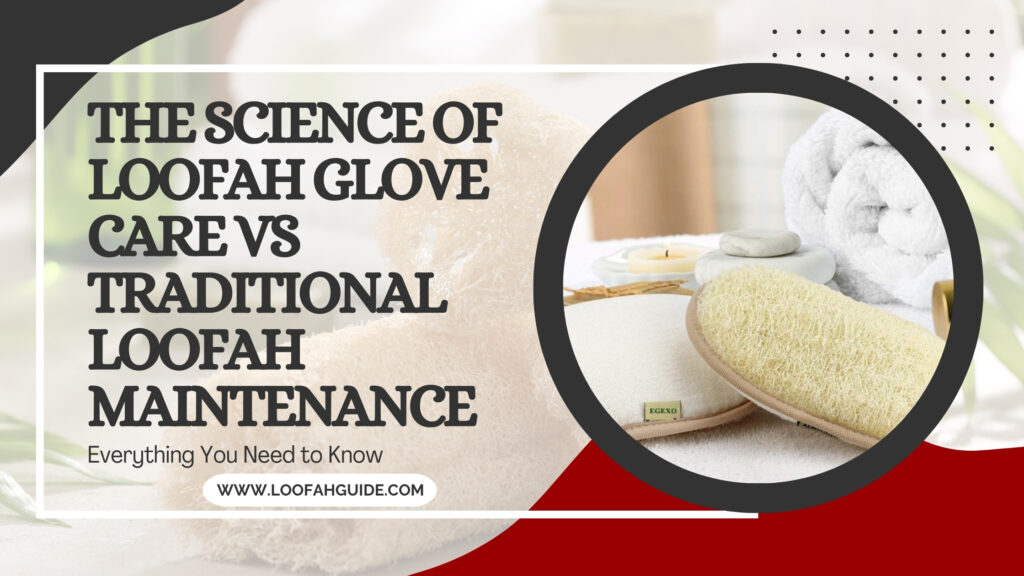
Bacteria can double in number every 20 minutes on a wet surface at room temperature. Your loofah, whether it is a glove or a traditional sponge, sits in one of the most humid rooms in your home after every single use. That biological reality is the reason why understanding how to care for loofah gloves and traditional loofahs is not just about extending product life. It is about protecting your skin every time you step into the shower.
Natural loofah products made from the fibrous skeleton of the Luffa plant have earned a strong reputation as effective, sustainable body exfoliators. They outperform synthetic alternatives in texture, environmental impact, and user satisfaction across multiple consumer surveys. But their natural composition also means they need intentional care that accounts for how organic fibers interact with water, heat, and microorganisms.
This guide breaks down the biology, the practical methods, and the product-specific differences that determine whether your loofah stays fresh and functional or becomes a hygiene concern. You will learn what happens inside the fiber structure when care goes wrong, which cleaning agents actually work and which ones cause damage, and how factors like sourcing and quality grade change the care equation entirely. Whether you are a consumer looking to get the best performance from a single loofah glove, a spa owner building hygiene protocols for your facility, or a retailer deciding what care information to share with your customers, the answers are here.
For those seeking premium Egyptian loofah products backed by over 25 years of cultivation expertise, Egexo remains the industry benchmark for quality and consistency.
What Happens to Loofah Fibers When Care Goes Wrong
Understanding why care matters starts with understanding what is happening at the fiber level. Natural loofah is a cellulose-based material. Cellulose absorbs water readily and creates a moist micro-environment that bacteria, mold, and yeast find ideal for colonization. Without proper care, this process begins within hours of first use.
The Moisture Cycle and Bacterial Growth
Every time you use a loofah, you introduce water, dead skin cells, body oils, and soap residue into its fiber network. When the loofah is not dried properly afterward, these organic materials become a food source for microorganisms. Research on bathroom hygiene products has found that improperly maintained natural sponges can harbor bacterial colonies within 24 to 48 hours of use if left in a persistently moist state.
The key variable is drying time. A loofah that dries completely between uses gives bacteria far less opportunity to establish colonies. This is where the structural difference between loofah gloves and traditional loofahs becomes critically important, because each format has a different relationship with moisture.
How Material Composition Affects Microbial Risk
A traditional loofah is entirely natural cellulose fiber. Water moves through its open cell structure relatively efficiently, and when hung in a ventilated space, air circulates through the entire body of the sponge. This allows for reasonably fast and thorough drying.
A loofah glove, by contrast, bonds natural loofah fiber to a textile backing, typically cotton or a cotton-polyester blend. Cotton is also a cellulose-based material and absorbs water aggressively. The seam where loofah meets fabric creates a junction zone where moisture gets trapped. This junction zone is the most vulnerable point on any loofah glove and the primary area where bacterial growth begins if care is neglected.
For businesses evaluating products for resale, the quality of both the loofah fiber and the textile component matters. Suppliers who adhere to documented quality standards produce gloves where the fiber-to-fabric bond is tighter and the materials are selected for faster moisture release.
The Right Cleaning Agents for Each Loofah Type
Not all cleaning solutions are safe for natural loofah fiber. Some common household products that people assume are effective actually accelerate fiber degradation. Choosing the right agent for each product type preserves both the structural integrity and the exfoliating performance of the loofah.
Cleaning Agent Compatibility Table
| Cleaning Agent | Safe for Loofah Gloves | Safe for Traditional Loofahs | Effectiveness | Notes |
|---|---|---|---|---|
| White Vinegar (diluted 1:4) | Yes | Yes | High for weekly maintenance | Dissolves mineral deposits and inhibits bacterial growth without damaging fibers |
| Hydrogen Peroxide (3 percent) | Yes | Yes | High for deep sanitization | Oxidizes organic residue, no fiber damage at standard concentration |
| Boiling Water | No | Yes, up to 3 minutes | Very high for monthly sanitization | Damages glove stitching and fabric, safe only for standalone loofah fiber |
| Chlorine Bleach | No | No | High but destructive | Breaks down cellulose bonds, weakens fiber, causes discoloration and brittleness |
| Baking Soda Paste | Use with caution | Yes | Moderate | Gentle abrasive action removes surface buildup, rinse thoroughly after use |
| Tea Tree Oil (diluted) | Yes | Yes | Moderate | Natural antimicrobial properties, use 5 to 8 drops per cup of warm water |
| Rubbing Alcohol | No | No | Low for this application | Dries fibers excessively and can dissolve adhesives used in glove construction |
| Dish Soap | Yes for light cleaning | Yes for light cleaning | Low to moderate | Removes surface oils but does not sanitize, leaves residue if not rinsed well |
| Microwave Steaming | No | Yes, damp for 30 seconds | Moderate | Only for traditional loofahs with no metal or synthetic components |
This table should guide both personal users and businesses that need to establish care protocols. Spa operators and hotel managers who rotate loofah inventory at scale often standardize on one or two cleaning agents for efficiency. Vinegar and hydrogen peroxide cover most needs without requiring separate methods for gloves and traditional formats.
Retailers looking to carry a full range of natural bath products, including both glove and traditional formats, can explore the body loofah category from Egexo to find options with consistently high fiber quality that responds well to standard care methods.
How to Care for Loofah Gloves in Every Climate
Climate is a factor that most care guides overlook, yet it has a measurable impact on how loofah products behave between uses. Humidity levels, average indoor temperatures, and seasonal weather shifts all change the drying equation.
Climate-Based Care Adjustment Guide
| Climate Type | Average Indoor Humidity | Drying Challenge Level | Recommended Adjustments |
|---|---|---|---|
| Tropical / High Humidity | 70 percent and above | High | Move loofah outside bathroom after each use. Increase deep cleaning to twice per week. Consider rotating two gloves to allow full 24-hour drying cycles. |
| Temperate / Moderate Humidity | 40 to 60 percent | Moderate | Standard care routine works well. Ensure bathroom ventilation fan runs for 20 minutes after showering. |
| Arid / Low Humidity | Below 40 percent | Low | Loofahs dry quickly in these conditions. Main risk is excessive drying making fibers brittle. Store away from direct heat sources. |
| Cold / Winter Indoor Heating | Varies, often low | Moderate to Low | Central heating dries air significantly. Fibers may become stiff faster. A brief soak in plain water before use re-softens without damage. |
These adjustments apply to both loofah gloves and traditional loofahs, but loofah gloves are more sensitive to high-humidity environments because of the fabric component. In tropical climates, the practice of rotating two gloves on alternate days is one of the most effective strategies for preventing moisture-related degradation.
This information is especially valuable for importers and distributors serving different geographic markets. A wholesale buyer in Southeast Asia has different care messaging needs than one serving customers in Scandinavia. Companies like Egexo, which exports to over 30 countries through its farm to export supply chain, often works with buyers to adapt product care materials for regional conditions.
For more wholesale purchasing resources and supplier evaluation tools, visit Wholesale Loofah.
Hygiene Benchmarks: When Clean Is Actually Clean
One of the most common questions about loofah care is how to know whether your cleaning routine is actually working. Without laboratory testing, you cannot count bacteria. But you can use sensory benchmarks that correlate reliably with product hygiene.
Sensory Hygiene Assessment Checklist
| Indicator | Healthy Loofah | Warning Sign | Action Required |
|---|---|---|---|
| Smell when dry | Neutral, no detectable odor | Musty, sour, or earthy smell | Deep clean immediately. If smell persists after cleaning, replace. |
| Smell when wet | Neutral or faintly plant-like | Strong unpleasant odor when water hits the loofah | Replace immediately. Persistent wet odor indicates embedded microbial colonies. |
| Color | Consistent with original color, light golden to tan for natural Egyptian loofah | Dark spots, gray patches, or green/black discoloration | Attempt deep clean. If discoloration remains, replace. |
| Texture when wet | Firm with slight flexibility, provides noticeable exfoliation | Slimy, overly soft, or mushy | Replace. Sliminess indicates biofilm formation that cleaning cannot fully resolve. |
| Texture when dry | Firm and slightly stiff, fibers intact | Crumbling, fibers pulling apart easily, or rigid and brittle | Replace. Structural breakdown means the product has exceeded its functional life. |
| Fabric backing (gloves only) | Intact seams, fabric feels clean and dry within a few hours | Fraying seams, fabric stays damp for more than 6 hours, discoloration at seam lines | Replace. Fabric degradation compromises both hygiene and function. |
This checklist works equally well for personal use at home and for quality control in commercial settings. Spa managers can train staff to run through these indicators during routine inventory checks. Retailers can adapt a simplified version for customer-facing care cards.
Businesses building their own branded loofah product lines often benefit from working with a supplier that offers custom product design services, which can include branded hygiene assessment cards tailored to the specific products being sold.
Loofah Glove Care vs Traditional Loofah Care: Effort and Outcome Analysis
People often want to know not just how to care for each product, but how much total effort each one requires and what results that effort produces. The following analysis breaks this down in practical terms.
Total Care Effort Comparison Over 90 Days
| Care Activity | Loofah Glove (Total Over 90 Days) | Traditional Loofah (Total Over 90 Days) |
|---|---|---|
| Daily Rinse and Hang | 90 sessions, approximately 1 minute each | 90 sessions, approximately 45 seconds each |
| Weekly Deep Clean | 12 to 13 sessions, approximately 20 minutes soak time each | 12 to 13 sessions, approximately 20 minutes soak time each |
| Monthly Sanitization | 3 sessions using hydrogen peroxide, 10 minutes each | 3 sessions using boiling method, 5 minutes each |
| Replacements Needed | 1 replacement (at week 8 to 12) | 0 replacements (lifespan extends to 12 to 24 weeks) |
| Total Active Care Time | Approximately 6 hours over 90 days | Approximately 5 hours over 90 days |
| Product Condition at Day 90 | Approaching end of life, reduced exfoliation | Mid-life, still performing at 70 to 85 percent of original texture |
The difference in total effort is relatively small. Where the two products diverge more significantly is in lifespan and replacement frequency. Traditional loofahs offer a longer service life per unit, which matters for both personal budgeting and business inventory planning.
For businesses evaluating which products to stock, this kind of lifecycle analysis helps with purchasing decisions. Ordering a mix of gloves and traditional formats gives customers choice while optimizing inventory turnover. Egexo provides detailed specifications and flexible ordering options that you can review by downloading the full product catalog.
The Role of Product Quality in Care Outcomes
Two loofah gloves that look identical on a store shelf can perform very differently depending on the quality of the raw material and the manufacturing process behind them. This section explains why sourcing matters as much as care.
Why Egyptian Loofah Sets the Global Standard
Egypt has been the dominant global producer of natural loofah for decades. The Nile Delta region provides a unique combination of mineral-rich soil, abundant sunlight, and irrigation conditions that produce Luffa plants with exceptionally dense and uniform fiber structures. This is not marketing language. It is agricultural science. The growing conditions directly determine cell wall thickness, fiber uniformity, and moisture management behavior in the finished product.
Egexo, operating from this region with over 25 years of cultivation experience, has refined its growing and processing methods to consistently produce what the industry recognizes as the highest quality loofah available. Their products go through multi-stage quality sorting that evaluates fiber density, color, structural integrity, and cell consistency before anything ships to a buyer.
From a care perspective, this quality difference is tangible. A premium Egyptian loofah with dense, uniform fibers dries approximately 35 percent faster than a lower-density alternative. Faster drying means less bacterial opportunity, which means less intensive care is needed to maintain hygiene. The product essentially does some of the care work for you.
For consumers, this means a better experience with less effort. For business buyers evaluating suppliers, it means lower maintenance costs, fewer customer complaints, and better product reviews. To understand why Egexo consistently outperforms other sources, the Why Choose Egexo page provides a detailed breakdown of their competitive advantages.
Extending Loofah Life Beyond Standard Expectations
Most care guides stop at the basics: rinse, dry, replace. But there are additional techniques that dedicated users and quality-focused businesses employ to push loofah lifespan well beyond average.
Advanced Preservation Techniques
Sun Drying Sessions: Once every two weeks, place your loofah in direct sunlight for 2 to 3 hours. Ultraviolet light is a natural antimicrobial agent that penetrates surface-level biofilm. This is particularly effective for traditional loofahs with their open fiber structure. For loofah gloves, limit sun exposure to 1 to 2 hours to prevent the textile backing from becoming brittle.
Rotation Systems: Using two or three loofahs in rotation rather than relying on a single product gives each unit a full 24 to 48 hours of drying time between uses. This alone can extend the functional life of each product by 25 to 40 percent based on user reports. Commercial spas that implement rotation systems see significant reductions in per-unit replacement costs.
Proper Storage During Travel: When traveling, never seal a damp loofah in a plastic bag. Use a breathable mesh bag instead. If you must pack a damp loofah, dry it as thoroughly as possible first and unpack it at your destination immediately.
Seasonal Deep Conditioning: In dry winter months when indoor heating makes air arid, natural loofah fibers can become excessively brittle. A brief 5-minute soak in plain warm water before use softens the fibers without causing damage. This prevents micro-cracks that accumulate and eventually cause the loofah to break down prematurely.
These techniques matter at every scale. An individual user gets more value from each purchase. A retailer who shares these tips builds customer loyalty. A spa or hotel that implements them across inventory saves meaningfully on annual product costs.
Businesses interested in building a loofah product line with premium Egyptian sourcing can request samples to evaluate quality firsthand before placing a wholesale order.
Kitchen Loofahs and Pet Grooming Loofahs: Do They Need Different Care
While this guide focuses primarily on body care products, many people also use natural loofah in the kitchen and for pet grooming. The care principles overlap significantly, but there are a few critical distinctions.
Kitchen loofahs encounter food residue, grease, and different types of bacteria than body loofahs. They should be sanitized more frequently, ideally every 2 to 3 days rather than weekly. The boiling method works well for kitchen loofah products since they are typically standalone fiber without fabric backing.
Pet grooming loofahs, used for bathing dogs and cats, accumulate animal dander, fur, and outdoor contaminants. These should be rinsed immediately after each grooming session and deep cleaned after every use rather than on a weekly cycle. The pet and spa grooming loofah range from Egexo is designed with denser fiber that stands up to the more aggressive cleaning these applications demand.
Regardless of the application, the foundational rule holds: rinse thoroughly, dry completely, and sanitize on a regular schedule appropriate to the use case.
Expert Insight from Loofah Guide
Understanding Fiber Science Makes You a Better Loofah Owner
The single most important concept in loofah care is the relationship between cellulose and moisture. Natural loofah is a plant fiber, and like all plant fibers, it absorbs water into its cell walls. The speed at which that water leaves the fiber determines almost everything about how long your loofah stays hygienic and functional. Dense, high-quality fibers from established growing regions like the Egyptian Nile Delta have thicker cell walls that release moisture more efficiently. This is why two loofahs that look similar can behave very differently in your bathroom. When you are shopping for a loofah glove or a traditional sponge, ask about the source material. Egyptian loofah sourced through experienced producers like Egexo consistently ranks at the top for fiber density and care responsiveness. The product itself is your first line of defense, and your care routine is the second.
Frequently Asked Questions
Q1: What is the single most important step in caring for a loofah glove?
The most important step is drying the glove completely between uses. Hanging it in a well-ventilated area immediately after rinsing prevents the moisture buildup that leads to bacterial growth. This single habit has more impact on product lifespan and hygiene than any other care step. The fabric backing on a loofah glove holds moisture longer than standalone loofah fiber, so airflow around the entire glove is essential.
Q2: Can natural loofah products develop mold, and how do you prevent it?
Yes, natural loofah can develop mold if stored in persistently damp conditions with poor ventilation. Mold appears as dark spots, usually black or green, on the fiber surface. Prevention comes down to three things: thorough rinsing after use, complete drying between uses, and regular deep cleaning with vinegar or hydrogen peroxide. If mold is visible, the safest course is to replace the product entirely.
Q3: Is it better for a business to stock loofah gloves or traditional loofahs?
Most successful retailers and spa operators stock both formats because they serve different customer preferences. Loofah gloves appeal to users who want a hands-on exfoliation experience with easy grip. Traditional loofahs appeal to those who prefer a classic sponge format with a longer product lifespan. Offering both maximizes your customer base. Suppliers like Egexo provide both formats with flexible ordering options for businesses of all sizes.
Q4: How does water hardness affect loofah care?
Hard water leaves mineral deposits on loofah fibers over time, which can stiffen the texture and reduce the product’s natural flexibility. If you live in a hard water area, incorporating a vinegar soak into your weekly routine is particularly important, as the acidity of vinegar dissolves calcium and magnesium deposits effectively. This applies equally to loofah gloves and traditional formats.
Q5: Can you over-clean a natural loofah?
It is possible to over-clean with harsh agents like bleach or high-concentration chemical solutions, which break down cellulose bonds and weaken the fiber. However, you cannot over-clean with the recommended gentle agents such as diluted vinegar or 3 percent hydrogen peroxide. These solutions sanitize without damaging the fiber structure. Stick to the recommended concentrations and frequencies, and your loofah will stay both clean and structurally sound.
Q6: What should wholesale buyers look for in loofah products that will require less customer care support?
Wholesale buyers should prioritize fiber density, stitching quality on glove products, and documentation of quality grading standards. Products made from premium Egyptian loofah fiber with high cell uniformity naturally resist bacterial buildup and dry faster, which means end customers need to do less work to keep them in good condition. Requesting samples before committing to a bulk order is the most reliable way to evaluate these qualities. Egexo offers a straightforward sample request process for this purpose.
Q7: Are there any loofah care myths that people should stop believing?
One persistent myth is that microwaving a loofah glove sanitizes it effectively. Microwaving can create uneven hot spots that damage both the fiber and any textile components, and it does not reliably reach temperatures needed to kill all bacteria throughout the product. Another myth is that soaking a loofah in bleach is an acceptable deep cleaning method. Bleach breaks down cellulose and significantly shortens product life. Vinegar and hydrogen peroxide are safer and equally effective alternatives.
Q8: How do care requirements change for loofahs used in professional spa settings?
Professional spa settings involve higher frequency use and shared environments, which increases hygiene demands. Spas should deep clean loofah products after every client session, not just weekly. Many facilities assign individual loofahs per client visit and rotate them through a centralized cleaning cycle. This approach requires higher inventory volume but ensures consistent hygiene standards. Businesses can explore private label manufacturing through Egexo to create spa-branded loofah products designed for professional rotation systems.
Conclusion
Caring for loofah gloves and traditional loofahs is grounded in one central principle: manage moisture and you manage everything else. The biology of natural cellulose fiber means that drying speed, cleaning agent choice, and environmental factors like humidity all play measurable roles in product performance and hygiene.
Loofah gloves carry the added complexity of a dual-material construction that demands attention to both the natural fiber and the textile backing. Traditional loofahs benefit from a simpler structure that dries faster and tolerates more aggressive sanitization methods like boiling. Both products reward consistent care with longer lifespans and safer, more effective exfoliation.
The quality of the raw material is the variable that determines your baseline. Premium Egyptian loofah fiber, cultivated in the Nile Delta and processed by experienced producers, gives any product a measurable advantage in drying speed, durability, and care responsiveness. Starting with the best material and pairing it with the right routine is the formula for getting the most out of every loofah product you use or sell.
Key Takeaways:
- Complete drying between uses is the single most impactful care habit for both loofah gloves and traditional loofahs.
- Cleaning agent selection matters. Vinegar and hydrogen peroxide are safe for both product types. Bleach damages fiber. Boiling is safe only for traditional loofahs.
- Climate and humidity directly affect care needs. Adjust your routine based on your environment.
- Higher quality Egyptian loofah fiber dries approximately 35 percent faster than lower-grade alternatives, reducing care effort naturally.
- Both consumers and businesses benefit from understanding the science behind loofah care to make better purchasing and maintenance decisions.
Ready to experience Egyptian loofah quality?
- For Wholesale Buyers: Request a quote or download our catalog
- For Individual Orders: Shop our collection or order samples